Service Area Business Local SEO That Works
If you run a plumbing company, garage door service, mobile detailing business, or any company that goes to the customer, you already know the problem. You can do great work across a wide area and still barely show up in Google Maps where it counts. That is the core challenge of service area business local SEO - proving local relevance when you do not have a storefront customers visit.
This is where a lot of businesses waste time. They publish a few city pages, add some keywords, and hope rankings improve. Sometimes that helps. Often it does not. Google wants stronger signals than that, and for service area businesses, the details matter more than most owners realize.
Why service area business local SEO is harder
A brick-and-mortar business has one obvious advantage: a public address tied to a physical location customers can visit. A service area business does not. That means Google has less location certainty to work with, and your visibility can be more volatile, especially in the map pack.
You are also competing against two kinds of businesses at once. First, other service area companies covering the same ZIP codes. Second, storefront businesses that may have a location advantage even if they provide a similar service. If your profile, website, citations, and local signals are weak or inconsistent, Google has no reason to rank you ahead of them.
That is why local SEO for service businesses is not just about adding cities to your website. It is about building trust across every signal Google checks - your Google Business Profile, your service categories, review quality, NAP consistency, local landing pages, page speed, on-page relevance, and the strength of your competitors.
Start with your Google Business Profile
For most service area businesses, the Google Business Profile is the center of the fight. If this is incomplete, inaccurate, or poorly optimized, everything else has less impact.
First, make sure your primary category is right. This sounds basic, but it is one of the biggest ranking levers you control. A company that picks a broad or slightly wrong category can lose visibility to a weaker competitor with better category alignment. Secondary categories matter too, but the primary one carries more weight.
Next, define your service area carefully. Bigger is not always better. If you claim an enormous region but your real customer base, reviews, and website content are concentrated in a handful of towns, your relevance gets diluted. Pick areas you actually serve and can support with local proof.
You should also complete every field that matters - business description, services, hours, phone, website, and photos. A half-finished profile sends the wrong signal. Google rewards clarity. Customers do too.
If you hide your address, which many service area businesses should, you need the rest of your profile to work even harder. That means stronger reviews, cleaner category targeting, and a website that clearly supports the locations and services you want to rank for.
Your website has to back up your service area claims
Google does not rank your profile in isolation. Your website either confirms your local relevance or weakens it.
The biggest mistake is relying on one generic homepage with a long list of cities in the footer. That is not a location strategy. It is filler, and Google can tell the difference.
Instead, build pages around real service and location intent. If you offer water heater repair in multiple towns, the ideal setup is not always one thin page per city. Sometimes a strong service page plus a few high-value location pages works better. Sometimes a county-level page makes more sense than ten weak suburban pages. It depends on search demand, competition, and whether you can make each page genuinely useful.
Useful means specific. Mention the service, the area, common customer problems in that area, response times, neighborhoods served, and trust signals like reviews or project examples. If every city page says the same thing with the town name swapped out, that is not an asset. It is duplication.
Your title tags, headings, internal linking, and schema should reinforce this structure. Keep it plain. Keep it accurate. And make sure mobile performance is solid, because most local service searches happen on phones, often when the customer needs help fast.
Reviews do more than build trust
For service area business local SEO, reviews are not just social proof. They are location and service relevance signals.
A review that says, "They fixed our AC in Mesa the same day," gives Google and future customers more context than, "Great company." You cannot script reviews, and you should not fake them, but you can ask better. Ask customers to mention the service they received and the area they are in if it feels natural.
Volume matters, but recency and quality matter too. A business with 40 current, detailed reviews can outrank one with 200 old, generic ones. Replying to reviews also helps. It shows activity and gives you another chance to reinforce services and locations in a natural way.
If you are trying to rank in towns where you have no review footprint, that gap can hold you back even if your website mentions those places. Google wants evidence that you actually do business there.
Citation consistency still matters
A lot of business owners think directory listings are old news. They are not the most powerful ranking factor, but bad citations still cause problems.
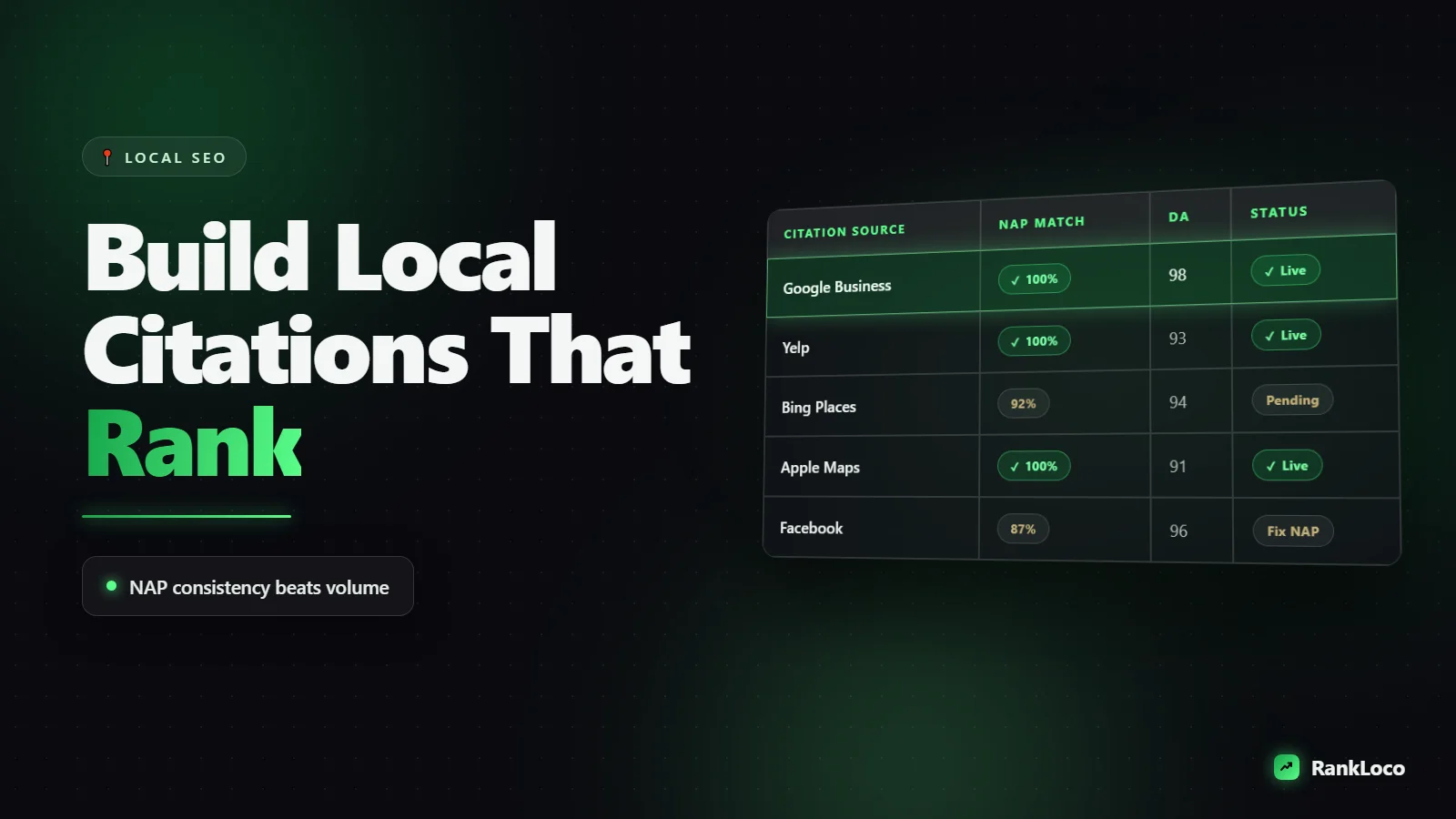
If your business name, phone number, website, or service details are inconsistent across major directories, Google gets mixed signals. That confusion is especially risky for service area businesses because you already have fewer location anchors than a storefront.
Clean up the basics first. Make sure your core business information is identical everywhere it appears. Then look for duplicate listings, outdated phone numbers, old addresses, and category mismatches. These issues are boring, but they can quietly suppress rankings.
This is also where speed matters. Small businesses do not need another vague dashboard with colored scores and no action plan. They need to know what is broken, where it is broken, and what to fix first. That is why tools like RankLoco are useful when you want a fast read on local ranking issues instead of a pile of SEO jargon.
Proximity is real, but it is not the whole story
One hard truth: you will not rank equally well everywhere in your service area. Google still leans heavily on proximity, especially in the map pack. A roofer based in one suburb may struggle to rank in another city 25 miles away, even if they serve it every day.
That does not mean local SEO is pointless. It means expectations need to match geography. You can improve relevance, authority, and prominence, but you cannot fully erase distance.
This is why smart service area businesses prioritize. Focus first on the towns closest to your operating base, the cities with the best revenue potential, and the areas where you already have reviews or job history. Build strength there before expanding outward.
Trying to rank everywhere at once usually spreads your signals too thin. A tighter service area strategy often produces faster gains and better leads.
What usually blocks rankings
When a service business is invisible on Google Maps, the cause is rarely one dramatic issue. It is usually a stack of smaller problems.
The common ones are a weak Google Business Profile, the wrong primary category, inconsistent citations, thin location pages, poor mobile speed, weak review signals, and competitors with stronger authority. Sometimes the issue is simpler: the business is targeting terms customers do not actually search.
That last point gets missed all the time. Owners optimize for what they call the service, not what local customers type into Google. Those are not always the same. If your pages and profile are built around internal jargon, you can be perfectly optimized for the wrong keywords.
The fastest way to improve results
If you want better local visibility, stop guessing. Scan the profile. Scan the site. Check rankings by city. Compare your categories, reviews, citations, and on-page signals against the businesses already sitting in the map pack.
Then fix the highest-impact issues first. Usually that means your Google Business Profile setup, your core website pages, your citations, and your review strategy. Fancy tactics can wait. The businesses that win local search are often the ones that execute the basics more completely than everyone else.
Service area business local SEO works when your business sends one clear message everywhere Google looks: this is what you do, this is where you do it, and customers in those places trust you. If that message is inconsistent, rankings stall. If it is strong, specific, and backed by real proof, the phone starts ringing more often.