Why Am I Not Ranking in Maps?
You search your business category, check Google Maps, and there they are again - the same competitors showing up above you. Maybe they have fewer reviews. Maybe their website looks worse. Maybe you know your service is better. So why am I not ranking in maps? Usually, the answer is not one big problem. It is a stack of smaller issues that tell Google your business is less relevant, less trusted, or less established than the businesses in the map pack.
That is the frustrating part of local SEO. You can do a few things right and still stay invisible if the basics are weak in the wrong places. Google Maps rankings are built on signals, not guesswork. If your visibility is slipping, there is a reason, and it can usually be found fast if you know where to look.
Why am I not ranking in maps for my main keywords?
Google has never ranked local businesses based on one factor alone. It weighs relevance, distance, and prominence, then uses supporting signals to decide which businesses deserve top placement. If you are not ranking, one of those pillars is weak, or your competitors simply have stronger supporting signals across the board.
Relevance is about how clearly your business matches the search. If you are a plumber but your Google Business Profile is missing the right primary category, weak on services, and vague in the business description, Google has less confidence that you are the best match. Distance matters too, especially for searches with local intent. If someone searches from across town, a closer competitor may win even if your business is stronger overall.
Prominence is where many businesses lose ground. This includes reviews, local citations, backlinks, brand mentions, website authority, and overall trust. A business with a complete profile, consistent listings, strong local pages, and a steady flow of reviews often outranks a better business that has simply done less SEO work.
Your Google Business Profile may be sending weak signals
The first place to look is your Google Business Profile. A half-finished profile will hold you back, even if everything else looks decent. Your primary category carries a lot of weight. Pick the wrong one, and your business can become less relevant for the searches that matter most.
Secondary categories help too, but only if they reflect real services. Stuffing in every possible category is not a smart move. It can dilute relevance and confuse the profile. The same goes for business descriptions and services. If your profile does not clearly state what you do and where you do it, you are leaving ranking opportunities on the table.
Photos, hours, service areas, products, attributes, and Q&A are not magic buttons, but together they improve completeness and trust. Google prefers profiles that look active and reliable. If your listing appears neglected, that is a problem.
Another common issue is suspension history, duplicate listings, or profile inconsistencies. If Google sees conflicting versions of your business or odd edits over time, that can create ranking instability that is hard to diagnose without a full audit.
Inconsistent business information can drag you down
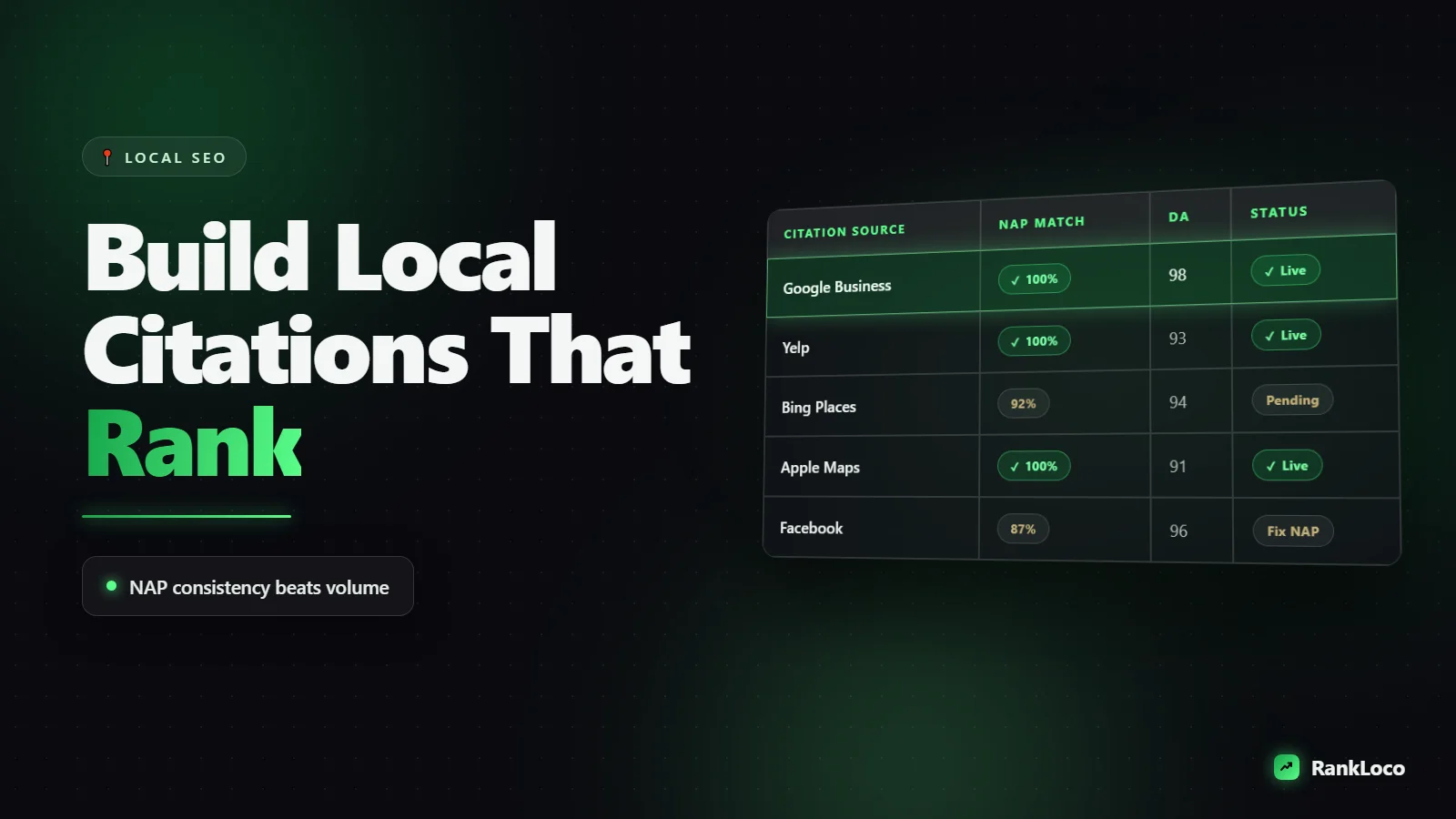
If your business name, address, or phone number changes from one directory to another, Google gets mixed signals. This is one of the most common local SEO problems and one of the easiest to miss. Maybe you moved locations, changed your suite number format, or used a tracking number in some listings but not others. Small differences add up.
Consistency matters because citations help confirm that your business is real, established, and located where you say it is. When those references conflict, trust drops. You might still rank for branded searches, but broader non-branded local searches can suffer.
This issue gets worse for service-area businesses. If your address is hidden on your profile but still appears inconsistently across the web, or if old listings remain live from previous locations, Google may struggle to understand your real footprint.
Your website may be weaker than you think
A lot of owners assume Maps rankings live entirely inside Google Business Profile. They do not. Your website supports local rankings in a big way. If your site is slow, thin, poorly structured, or missing local relevance, that weakens your ability to compete.
Start with your core pages. Does your homepage clearly say what you do and where you do it? Do your service pages target real local search terms, or are they generic? Does each location have its own useful page if you serve multiple cities? If your site barely mentions your service area, Google has less context.
On-page SEO still matters. Title tags, headings, internal links, and body content should reinforce your location and services naturally. Schema markup can also help by making your business details easier for search engines to interpret. It will not fix a weak site by itself, but it helps support the bigger picture.
Then there is page speed and mobile usability. Most local searches happen on phones. If your site is clunky, slow, or hard to use, that affects both user behavior and trust. A competitor with a cleaner site can win even without a stronger brand.
Reviews influence rankings, but not in the simple way people think
Yes, reviews matter. But the answer is not just getting more of them. Quality, recency, frequency, and keyword relevance all play a role. A business with 200 reviews from three years ago may lose ground to a business with 80 recent reviews and steady activity.
Google also looks at engagement signals around reviews. Are people responding? Are reviews detailed? Do they mention specific services and locations? Real review content helps Google better understand what your business is known for.
If you are asking, why am I not ranking in maps when I have great reviews, the problem may be that reviews are the only area where you are winning. Reviews can strengthen trust, but they will not overcome major weaknesses in categories, citations, website relevance, or local authority.
Competitors may be doing more local SEO than you realize
A lot of businesses compare themselves to competitors based on what they can see at a glance. That is rarely enough. You might notice they have fewer reviews and assume you should outrank them, but their local SEO foundation could be much stronger.
They may have cleaner citations, better backlinks, stronger service pages, better category targeting, more branded searches, or higher engagement on their profile. They may also be closer to the searcher in the exact area where rankings are being tested.
This is why manual spot checks can be misleading. Maps rankings vary by location, device, search history, and proximity. If you only search from your office, you are not seeing the full picture. What matters is how your business appears across your target service area, not one search on one screen.
Spam and proximity can distort the map pack
Sometimes the reason you are not ranking is annoying but real: Google Maps is not perfectly clean. Keyword-stuffed business names, fake listings, virtual offices, and duplicate profiles still show up in many markets. That does not mean you should copy them. It means you need to recognize the market conditions.
There is also the proximity issue. If your business is located outside the center of the city you want to rank in, your visibility may naturally drop for searches made closer to other competitors. This hits service businesses especially hard. You can expand relevance with strong local landing pages, citations, and authority signals, but you cannot fully override geography.
That is where expectations need to stay realistic. Some ranking problems are fixable fast. Others are structural and need a longer play.
What to fix first if you are not ranking in maps
Do not start by changing random settings and hoping for a bump. Start with diagnosis. You need to know whether the issue is profile completeness, NAP consistency, weak local pages, missing schema, poor reviews, technical site problems, or a competitor gap.
First, clean up your Google Business Profile. Make sure your primary category is correct, services are filled out, hours are accurate, photos are current, and every relevant field is complete. Then check your business information across directories and correct any mismatch in name, address, and phone number.
Next, look at your website through a local SEO lens. Tighten your location signals, improve service pages, fix speed issues, and add structured data where it makes sense. After that, work on review generation and make sure the reviews reflect your real services and service areas.
Finally, compare your business against the map pack leaders. Not emotionally. Objectively. Look at categories, reviews, citations, backlinks, on-page signals, and local content. That is where tools built for local search save time. RankLoco, for example, is useful because it scans the local ranking signals that usually explain why a business is invisible on Google Maps and turns them into a plain-English fix list instead of a vague score.
The good news is this: if you are asking why am I not ranking in maps, you are already asking the right question. The wrong question is why Google is being unfair. Maps rankings are rarely random. They are usually the result of specific gaps, and once you find those gaps, you can stop guessing and start fixing the right things.
The businesses that win local search are not always the biggest. They are usually the ones that clean up the fundamentals first and keep going until Google has no reason to ignore them.