How to Do Keyword Research in 2026 (Without Expensive Tools)
Most keyword research advice tells you to buy a $200/month tool, punch in a seed word, and export 5,000 keywords. Then you stare at a spreadsheet and do nothing. That is not research. That is data hoarding.
Here is how to do keyword research in 2026 without expensive tools, in a way that ends with a list of keywords you can actually rank for and a plan to write about them. This is the exact process I use when I take over a new site with no budget.
What keyword research actually is
Keyword research is figuring out three things: what your audience types into Google, how hard it is to rank for those terms, and whether ranking for them makes you money. Skip any one of those and you waste months. Plenty of people rank for keywords nobody searches, or chase terms that will never convert.
The goal is not a giant list. The goal is 20 to 50 good keywords tied to pages you will actually create.
Step 1: Build your seed list from your own head
Before you touch a tool, write down every phrase a customer would use to describe your product, problem, or service. Do not overthink it. If you sell dog grooming, your seeds are things like "dog grooming," "mobile dog groomer," "how to trim dog nails," "dog matting."
Then steal seeds from these free sources:
- Google autocomplete: Start typing your seed and note every suggestion that drops down.
- People Also Ask: Search your seed, expand a few PAA boxes, and copy the questions.
- Related searches: Scroll to the bottom of the results page for eight more ideas.
- Reddit and forums: Search "your topic reddit" and read how real people phrase problems. The exact wording is gold.
- Your own site search and email: What do people already ask you?
Spend 30 minutes and you will have 100+ raw phrases. That is your starting pool.
Step 2: Expand your list with free tools
Now multiply those seeds. You do not need a paid suite to do this.
- Google Keyword Planner: Free with any Google Ads account. It shows search volume in ranges and gives dozens of related terms. Volume ranges are wide, but they are enough to sort big from small.
- Google Search Console: If your site has any traffic, the Performance report is the best free keyword tool that exists. It shows the exact queries you already get impressions for. Filter for keywords where you rank on page two (positions 11 to 20). Those are your fastest wins.
- Answer-style tools: Free versions of question-based tools group keywords into questions, prepositions, and comparisons. Great for blog topics.
- Autocomplete scrapers: Free tools pull hundreds of autocomplete variations by adding a to z after your seed.
Dump everything into one spreadsheet. Remove obvious duplicates and anything totally irrelevant. You want quantity here; you will cut hard in the next step.
Step 3: Understand search intent before anything else
Search intent is the most important filter and it is completely free to check. For every keyword you are serious about, actually Google it and look at what ranks. The results tell you what Google thinks the searcher wants.
There are four main intent types:
| Intent | What they want | Example |
|---|---|---|
| Informational | An answer or how-to | how to trim dog nails |
| Commercial | To compare options | best dog nail clippers |
| Transactional | To buy or book now | mobile dog groomer near me |
| Navigational | A specific brand or page | petsmart grooming prices |
Match the page type to the intent. If the top results are all listicles and you publish a product page, you will not rank no matter how good it is. When in doubt, copy the format that already ranks, then make it better.
Step 4: Judge difficulty the free way
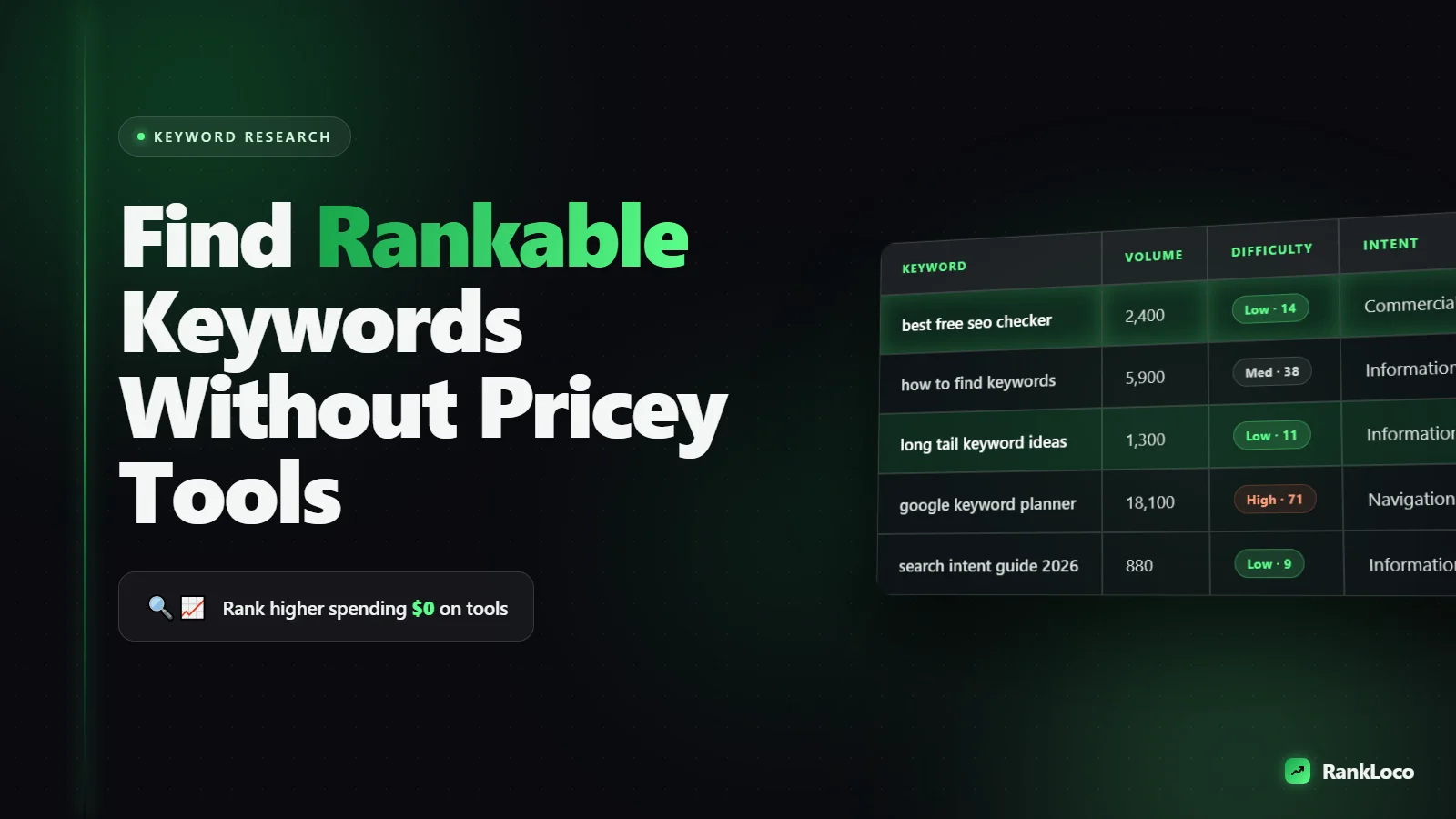
Paid tools give you a difficulty score. You can estimate the same thing by hand in about 60 seconds per keyword. Search the term and look at page one for these signals:
- Who ranks? If the first page is all major brands and huge sites, that keyword is a wall for a new site. If you see forums, small blogs, or thin pages, there is an opening.
- Content quality: Are the ranking pages actually good, or are they short and outdated? Weak content means room to win.
- Intent match: Do the results clearly answer the query, or does Google seem confused? Confusion means opportunity.
- SERP features: If ads, a shopping carousel, and a big featured snippet eat the top of the page, your organic click share shrinks even at position one.
Install a free SERP overlay extension that shows domain metrics right in the results. It will not be as precise as paid data, but for spotting winnable keywords it is plenty.
The new-site rule
If your site is young or has few backlinks, prioritize long-tail keywords: three or more words, lower volume, clearer intent, and weaker competition. "Keyword research" is a war. "How to do keyword research for a local plumber" is a fight you can win this month.
Step 5: Group keywords into clusters
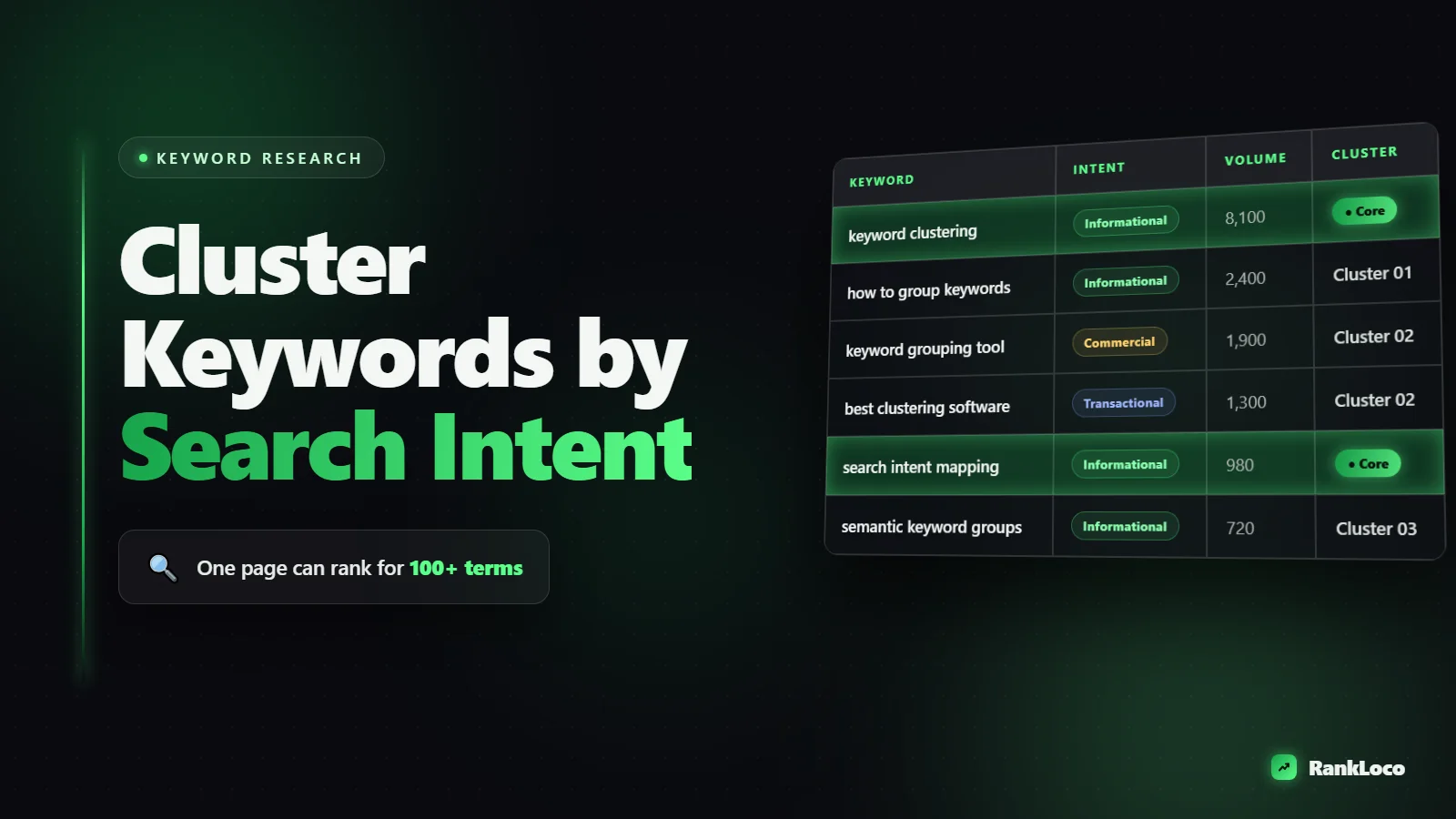
Do not build one page per keyword. Google understands topics, so many keywords should live on the same page. Group your list into clusters where every keyword shares the same intent and answer.
For example, all of these belong on one page:
- how to do keyword research
- keyword research process
- keyword research steps
- how to find keywords
But "best keyword research tools" is a different page, because the intent is comparison shopping, not learning a process. Sort your spreadsheet by intent, then eyeball which terms answer the same question. Each cluster becomes one URL with a primary keyword and a handful of secondary ones you work into headings and copy.
Step 6: Prioritize with a simple scoring system
You cannot write everything at once. Score each cluster so you know what to build first. Add three columns to your spreadsheet and rate each from 1 to 5:
- Volume: Rough monthly searches. Higher is better, but do not worship it.
- Difficulty: How winnable it is for your site. Reverse-scored, so easier gets a 5.
- Value: How close it is to your money page or offer. A buying keyword beats a curiosity keyword.
Add the three numbers. Sort descending. The top of that list is your content plan for the next quarter. This beats any fancy tool because it forces you to think about business value, not just traffic.
Step 7: Track your results and adjust
Keyword research is not one-and-done. After you publish, you need to know if you are actually moving up. Check positions weekly, watch which keywords land on page two, and double down on the pages that are climbing. Search Console shows movement for free, but if you want daily position tracking across a full keyword list without doing it manually, this is where a tool like RankLoco earns its keep. You can also run its site audit to catch technical issues that quietly hold back pages you worked hard to rank.
Revisit your list every few months. New questions appear, your rankings shift, and Search Console will surface keywords you never thought of. Feed those back into your clusters.
A quick free keyword research checklist
- Brain-dump 20+ seed phrases your customers would use.
- Expand with autocomplete, People Also Ask, and related searches.
- Pull real queries from Google Search Console (focus on positions 11 to 20).
- Run seeds through free Keyword Planner for volume and more ideas.
- Google every serious keyword and read the top results.
- Label intent: informational, commercial, transactional, navigational.
- Judge difficulty by who ranks and how good their content is.
- Group keywords into topic clusters, one cluster per page.
- Score each cluster on volume, difficulty, and value.
- Build the highest-scoring clusters first, then track and repeat.
Mistakes that waste your time
Even with a solid process, these errors kill results:
- Chasing high volume only: A keyword with 10,000 searches you can never rank for is worth zero. A 200-search term you win is worth real traffic.
- Ignoring intent: The single most common reason good content does not rank. Always check the SERP.
- One keyword per page: This creates thin, cannibalizing pages. Cluster instead.
- Never revisiting: Rankings move. If you research once and forget it, you leave easy wins on page two forever.
- Skipping your own data: Search Console is free and tells you exactly what Google already associates with your site. Start there before buying anything.
The bottom line
Knowing how to do keyword research in 2026 is less about tools and more about process. Free sources give you all the ideas you need. The SERP itself tells you intent and difficulty. A simple scoring system tells you what to build first. Add rank tracking so you know what is working, and you have a system that beats most people paying hundreds a month and doing nothing with the data.
Start with 30 minutes and a spreadsheet today. You will end up with a real content plan, not another export you never open.