How to Build Local Citations for a Small Business
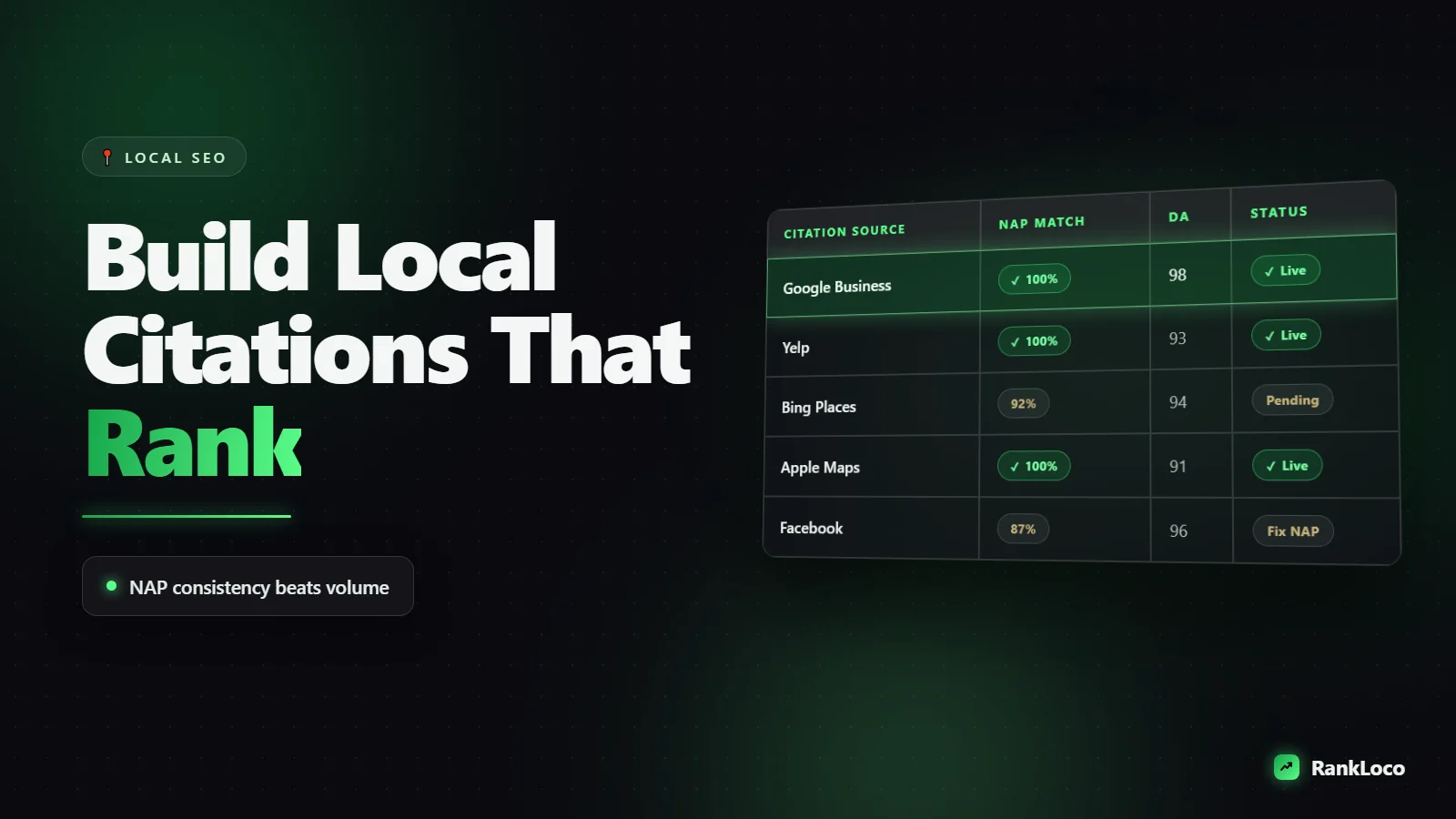
To build local citations for a small business, list your exact business name, address, and phone number (NAP) on the major data aggregators and directories, starting with Google Business Profile, Apple Maps, Bing Places, Yelp, and Facebook, then add industry and local directories relevant to your niche. The goal is simple: keep your NAP identical everywhere so Google trusts your location data and ranks you higher in local search. Consistency matters more than volume.
A citation is any online mention of your business name, address, and phone number, with or without a link back to your site. Google uses these mentions as corroborating evidence that your business is real, legitimate, and located where you say it is. Get them right and you strengthen your foundation for the Map Pack. Get them sloppy and you confuse the algorithm with conflicting data.
Why Local Citations Still Matter for Ranking
Citations are not the flashiest ranking factor, but they are table stakes for local SEO. When Google sees your business name, address, and phone number repeated consistently across dozens of trusted sources, it gains confidence in your location and relevance. That confidence feeds directly into Map Pack and local organic rankings.
There are two broad types:
- Structured citations: Listings on directories and platforms with dedicated fields for business data (Google Business Profile, Yelp, Yellow Pages).
- Unstructured citations: Mentions of your NAP on blogs, news sites, event pages, or local roundups, usually in the flow of regular content.
Structured citations are easier to build in volume. Unstructured citations often carry more authority because they come from editorial content. You want both. If you are serious about showing up when people search nearby, citations work alongside your broader effort to rank for near me searches without paid ads.
Nail Your NAP Before You List Anywhere
This is the step most people skip, and it costs them. Before you create a single new listing, lock down the exact version of your business information you will use everywhere. One format. No variations.
Decide on the canonical version of each field:
- Business name: Use your real legal or trading name exactly as it appears on your storefront and Google Business Profile. Do not stuff keywords into it.
- Address: Pick one format. If it is "Suite 200" do not write "Ste 200" on some listings and "#200" on others. Decide on "Street" vs "St" and stick with it.
- Phone number: Use a single local number with consistent formatting. A local area code beats a toll-free number for local trust.
- Website URL: Use the same version, including whether you use www or not, and always https.
Write this down in a simple document. Every person who ever creates a listing for your business should copy and paste from it. Inconsistent NAP is the single biggest reason citations fail to help, because Google cannot tell if two listings refer to the same business.
Start With the Core Platforms That Carry the Most Weight
Not all citations are equal. Build these first, in this order, before touching smaller directories.
- Google Business Profile: The most important listing you will ever create. Claim it, verify it, fill out every field, choose precise categories, and add photos. This feeds the Map Pack directly.
- Apple Maps (Apple Business Connect): Captures iPhone and Siri searches. Free and fast to set up.
- Bing Places: Powers Bing and some AI search results. You can often import directly from Google.
- Facebook Business Page: A high-authority mention and a trust signal, even if you never post.
- Yelp: Still a top directory in many industries and feeds other data sources.
Once these five are consistent and verified, you have covered the sources that influence rankings most. Everything after this is incremental.
The Data Aggregators That Feed Dozens of Directories
In the US, a handful of data aggregators distribute business information to hundreds of smaller directories automatically. Fix your data at the source and it propagates downstream. The main ones to know:
- Data Axle
- Foursquare
- Localeze (Neustar)
Submitting accurate data to these aggregators cleans up a huge swath of the directory ecosystem in one move. In the UK and other regions, the aggregator landscape differs, so research the equivalents for your country.
Find Industry and Local Niche Citations
General directories are good. Niche directories are better, because they signal relevance for your specific industry and area. A plumber benefits from plumbing association listings. A restaurant benefits from food and reservation platforms. A law firm benefits from legal directories like Avvo.
Here is how to find them quickly:
- Search "[your industry] + directory" and "[your city] + business directory" in Google.
- Check your local chamber of commerce, Better Business Bureau, and neighborhood association sites.
- Look at where your top-ranking competitors are listed. Search their business name in quotes and see which directories show up.
- Find sponsorship pages, local event listings, and "local businesses we recommend" pages.
These niche and local citations double as backlinks in many cases. For a deeper list of link opportunities that also act as citations, see our guide to the best backlink sources for local service businesses.
A Step-by-Step Citation Building Workflow
Work through this process methodically rather than randomly signing up for every directory you find.
- Audit what already exists. Search your business name, phone number, and address in Google. Note every listing you find, correct or incorrect.
- Build your master NAP document. Lock in the exact format described above.
- Claim and fix existing listings first. It is faster to correct a wrong listing than to create a duplicate. Duplicates hurt you.
- Build the five core platforms. Verify each one.
- Submit to data aggregators.
- Add 15 to 30 quality directories and niche citations. Prioritize relevance and authority over raw count.
- Track and monitor. Re-check your listings quarterly for drift.
Citation Priority Checklist
| Priority | Source | Why It Matters |
|---|---|---|
| 1 | Google Business Profile | Direct Map Pack ranking factor |
| 2 | Apple Maps, Bing Places | Captures non-Google and voice searches |
| 3 | Facebook, Yelp | High-authority trust signals |
| 4 | Data aggregators | Propagate data to hundreds of sites |
| 5 | Industry directories | Signal niche relevance |
| 6 | Local directories | Signal geographic relevance |
Clean Up Duplicate and Inconsistent Listings
Duplicate listings are poison. If Google finds two Google Business Profiles for the same location, or two Yelp pages with different phone numbers, it splits your trust and reviews across them. This drags down rankings.
To clean up:
- Search for duplicates on each major platform using your name, address, and old phone numbers.
- On Google Business Profile, report duplicates through the profile and request a merge.
- Fix outdated addresses from previous office moves. Old addresses floating around directories confuse the algorithm badly.
- Standardize formatting across every listing you control.
Think of this like fixing broken plumbing in your technical SEO. The same principle applies when you fix duplicate content issues with canonical tags: duplication divides signals that should be unified.
How Citations Fit With the Rest of Local SEO
Citations are a foundation, not a complete strategy. They make your other local efforts work harder. Pair your citation building with:
- Reviews: Volume and recency of reviews heavily influence the Map Pack. Work on getting more Google reviews to rank higher locally at the same time.
- On-page local signals: City and service pages, embedded maps, and local schema markup.
- Rank tracking: You cannot improve what you do not measure. Use RankLoco to track your local keyword positions by location so you can see whether your citation work is moving the needle in the Map Pack and local organic results.
If you run several locations, citations get more complex because each location needs its own consistent NAP set. We cover that in detail in our guide to ranking in the Google Map Pack for a multi-location business.
How Many Citations Do You Actually Need?
There is no magic number. Quality and consistency beat quantity every time. For most local businesses, 30 to 50 accurate, authoritative citations create a solid foundation. Chasing 500 low-quality directory listings adds almost no value and risks spreading inconsistent data.
Focus your energy on:
- The core five platforms being flawless and fully filled out.
- Data aggregators carrying correct information.
- A dozen or so high-relevance niche and local directories.
- Ongoing cleanup so nothing drifts out of sync.
Build the foundation, keep it clean, and let your reviews and content do the heavy lifting on top. For more local and technical SEO guides, browse our full library of SEO guides on the blog, and when you are ready to measure results, run your site and keywords through RankLoco.
Frequently Asked Questions
Do local citations need a backlink to count?
No. A citation counts as long as it mentions your business name, address, and phone number, even without a link. Links add SEO value, but Google uses the NAP mention itself as a trust and corroboration signal. Many of your most authoritative citations will include links anyway.
How long does it take for citations to affect rankings?
Expect several weeks to a few months. Directories need time to index, and data aggregators propagate updates on their own schedules. Citations also work gradually by building cumulative trust rather than causing a sudden jump, so treat them as a long-term foundation, not a quick win.
Should I pay for a citation building service?
Paid services can save time by submitting to aggregators and directories at scale, which is useful for cleanup. But verify they use your exact NAP and do not create duplicates. The core five platforms are worth claiming and managing yourself so you control verification, categories, and photos.
What happens if my address or phone number changes?
Update your master NAP document first, then change your Google Business Profile, the other core platforms, and data aggregators immediately. Old information left on directories creates conflicting signals that can hurt rankings. Set a reminder to audit all listings a month after any change to catch stragglers.
Are citations useful for a service-area business with no storefront?
Yes, but hide your address on platforms that allow it and set your service areas instead. Use a consistent name and local phone number across listings. Service-area businesses still benefit strongly from directory presence, especially niche and local directories that signal where you operate.
How do I find where my competitors have citations?
Search a competitor's exact business name and phone number in quotes in Google. The results reveal directories and sites listing them. Note any industry or local directories you are missing. This competitor-style research mirrors how you would run a content gap analysis, just applied to local listings instead of keywords.