How to Do Keyword Clustering to Group Keywords by Search Intent
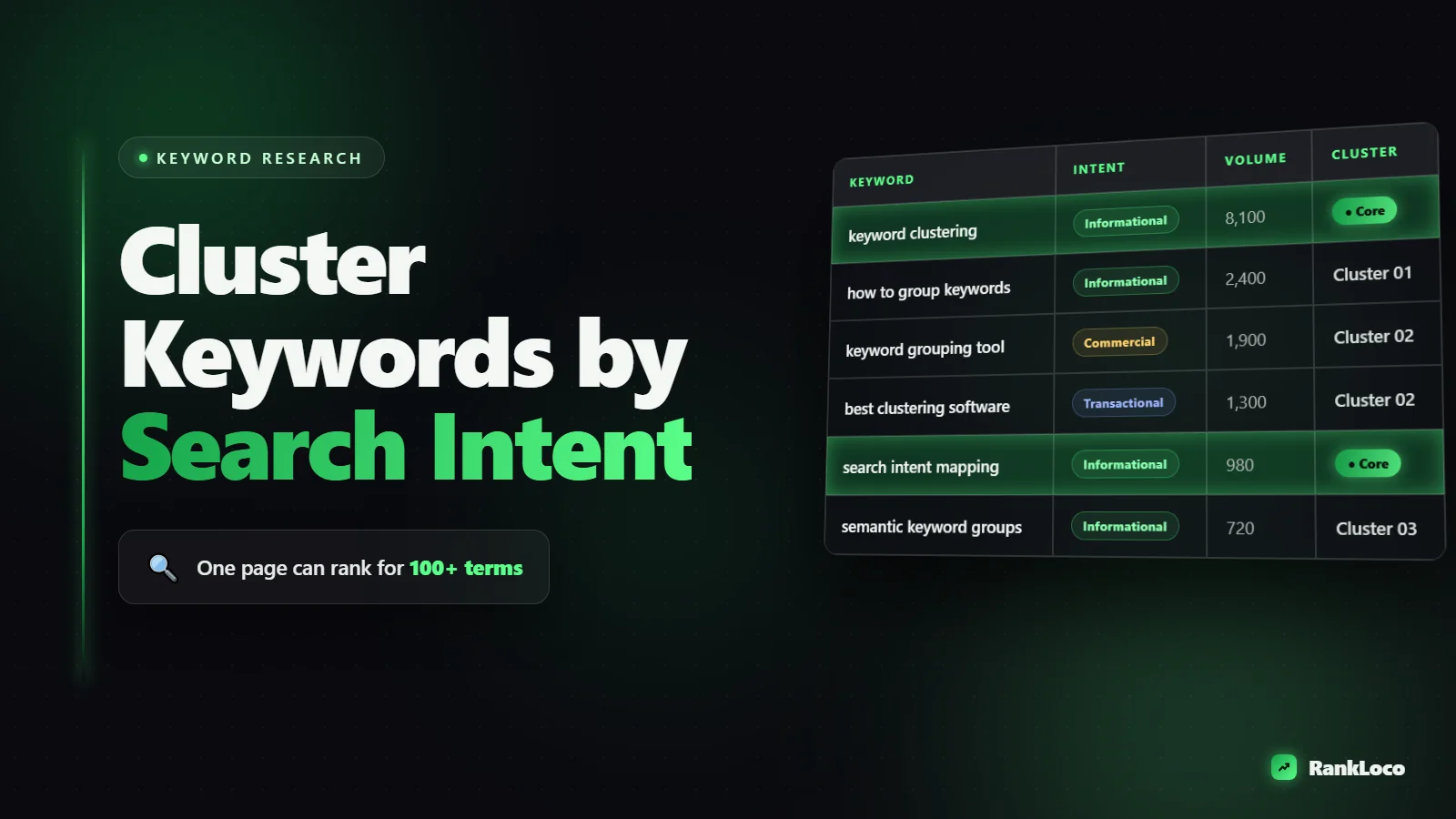
To group keywords by search intent, pull your full keyword list, label each term by its intent (informational, commercial, transactional, or navigational), then cluster terms that share the same intent and the same SERP results into one group per target page. The fastest reliable signal is the search results themselves: if two keywords return mostly the same ranking URLs, they belong on the same page. Do this and you build pages that rank for dozens of related terms instead of spreading thin across near-duplicate posts.
Below is the exact process I use to turn a messy keyword export into a clean content plan where every page has a job.
What Keyword Clustering Actually Means
Keyword clustering is the process of grouping keywords that can rank on the same page. The goal is simple: one page should target one search intent, not one keyword. Google ranks pages, and a single strong page routinely ranks for 50 to 200 variations of a core query. If you build a separate post for every keyword variation, you end up with thin pages that cannibalize each other and split your authority.
Search intent is the why behind a query. Someone searching "best running shoes" wants to compare options. Someone searching "buy nike pegasus 41" wants a product page. Someone searching "how to clean running shoes" wants a how-to guide. Those three queries can never live happily on the same URL because the searcher wants three different things. Clustering by intent keeps related queries together and conflicting ones apart.
The Four Types of Search Intent to Sort For
Before you cluster, you need to classify. Every keyword falls into one of four intent buckets:
- Informational: The searcher wants to learn. Signals include "how to," "what is," "guide," "tips," "examples," "ideas." These map to blog posts and guides.
- Commercial investigation: The searcher is comparing before buying. Signals include "best," "top," "review," "vs," "alternatives," "comparison." These map to listicles, comparison pages, and buying guides.
- Transactional: The searcher is ready to act. Signals include "buy," "price," "coupon," "for sale," "near me," "hire," "book." These map to product, service, and category pages.
- Navigational: The searcher wants a specific brand or page. Signals include brand names and "login," "pricing," "contact." These map to your branded and utility pages.
Classifying intent manually works for a few hundred keywords. Do it in a spreadsheet with a formula that flags intent modifiers, then eyeball the ones that do not match a clear pattern.
How to Group Keywords by Search Intent, Step by Step
Step 1: Build one master keyword list
Gather every keyword from every source into a single spreadsheet. Pull from your keyword research tool, Google autocomplete, People Also Ask, and your own Search Console data. If you have not mined Search Console yet, it is the richest free source you own, and this walkthrough on how to use Google Search Console to find new keyword ideas shows exactly where to look. Add columns for search volume, keyword difficulty, and current ranking URL.
Step 2: Clean and dedupe
Remove exact duplicates, obvious junk, and keywords with zero relevance to your business. Normalize plurals and word order so "shoes running" and "running shoes" do not clutter your list as separate rows. You want a clean base before you start grouping.
Step 3: Tag each keyword with its intent
Add an "Intent" column and label every row using the four buckets above. Use the modifier signals to speed this up. A term like "best crm for small business" is commercial. "What is a crm" is informational. "Crm pricing" is transactional-ish or navigational depending on your product. When a term is ambiguous, defer to the SERP in the next step.
Step 4: Cluster by SERP overlap, not just by words
This is the step that separates real clustering from guessing. Two keywords belong together if Google shows the same pages for both. Take a seed keyword, note the top 10 ranking URLs, then check a candidate keyword's top 10. If three or more URLs overlap, they share intent and can target the same page. If almost none overlap, split them, even if the words look similar.
Example: "keyword research" and "how to do keyword research" usually share most of their top results, so one guide can cover both. But "keyword research" and "keyword research tool" often return different pages (guides versus tool pages), so they need separate URLs. The words are close; the intent is not.
Step 5: Name each cluster and assign a page
Give every cluster a label based on its core topic and intent, then pick the highest-volume, best-fit keyword as the primary target. Everything else in the cluster becomes a secondary keyword you work into subheadings, body copy, and FAQs. Decide the page type (blog post, comparison, product, category) based on the dominant intent.
Step 6: Map clusters to a content structure
Group related clusters under broader topics so you can see your site architecture forming. Informational clusters usually become supporting blog posts that link up to a central hub. This is where clustering connects directly to building topic clusters and pillar pages: each intent cluster is a node, and the pillar page ties them together with internal links.
A Simple Clustering Example
Here is what a finished cluster map looks like for a small section of a hypothetical site about espresso machines:
| Cluster | Primary keyword | Intent | Page type |
|---|---|---|---|
| Learn espresso basics | how does an espresso machine work | Informational | Blog guide |
| Compare machines | best espresso machines for home | Commercial | Listicle |
| Specific model shopping | buy breville barista express | Transactional | Product page |
| Maintenance help | how to descale espresso machine | Informational | How-to post |
Notice how "best espresso machines" and "buy breville barista express" live on separate pages. A listicle that tries to also be a product page converts poorly and ranks for neither well. Keep intent clean and each page earns its own rankings.
The Clustering Checklist
- All keywords pulled into one master sheet with volume and difficulty
- Duplicates and irrelevant terms removed
- Every keyword tagged with one of the four intents
- Clusters validated by SERP overlap (3+ shared URLs)
- Each cluster has one primary keyword and a list of secondaries
- Each cluster assigned a page type that matches its intent
- Clusters mapped to existing or new URLs so you avoid cannibalization
- Related clusters grouped under pillar topics with internal links planned
Common Clustering Mistakes That Kill Rankings
Mixing intents on one page
The most common error is cramming informational and transactional keywords onto a single page because the words look related. Google will rank that page for neither cleanly. Split them.
Clustering on word similarity alone
"Cheap flights" and "flight schedule" share a word but not an intent. Always let the SERP break the tie. If the ranking pages differ, the keywords differ.
Making a separate page for every long-tail variation
Long-tail terms almost always belong inside a broader cluster. If you are mining variations, pair your clustering with the tactics in this guide to find long-tail keywords using Google autocomplete and People Also Ask, then fold those terms into existing clusters as subheadings instead of launching thin standalone posts.
Ignoring what you already rank for
Before creating a new page for a cluster, check whether an existing URL already ranks for part of it. Strengthening one page usually beats splitting signals across two. A content gap analysis can show where you have coverage and where you have holes.
Clustering at Scale Without Losing the Plot
For a few hundred keywords, a spreadsheet and manual SERP checks are fine. Past a thousand keywords, manual SERP comparison gets slow, and that is where a tool earns its keep. You can use RankLoco to pull keyword ideas, check real search volumes, and track how each cluster's primary keyword moves after you publish. Once pages are live, group your tracked keywords by cluster so you can see which clusters are climbing and which need another pass of optimization.
Whatever method you use, keep the output the same: a tidy map where every keyword has a home, every page has one intent, and no two pages fight for the same query. That discipline is what turns a pile of keywords into a ranking content plan. For more ways to turn research into traffic, browse the rest of our SEO guides.
Frequently Asked Questions
How many keywords should be in one cluster?
There is no fixed number. A cluster can hold anywhere from 5 to over 100 keywords as long as they all share the same intent and the same SERP. Quality of overlap matters more than quantity. If adding a keyword forces the page to serve a second intent, it belongs in a different cluster.
Can I cluster keywords without a paid tool?
Yes. Build your list in a spreadsheet, tag intent using modifier keywords, and manually compare the top 10 ranking URLs for each keyword. It is slower but accurate for smaller lists. Paid tools mainly save time on SERP comparison and volume data when you are working with thousands of keywords.
What is the difference between keyword clustering and topic clusters?
Keyword clustering groups individual search terms that can rank on one page. Topic clusters are a site architecture where several related pages link to a central pillar page. You use keyword clustering to define each page, then arrange those pages into topic clusters to build authority around a broader subject.
How do I use SERP overlap to confirm intent?
Search both keywords and compare the top 10 organic results. Count how many URLs appear for both. Three or more shared URLs is a strong signal they share intent and can target the same page. Little to no overlap means Google sees them as different needs, so split them.
Should transactional and informational keywords ever share a page?
Rarely. They serve different searchers at different stages. Keep buying and category pages focused on transactional terms, and keep guides focused on informational terms. You can link between them, but mixing both on one URL usually weakens rankings for the higher-value transactional queries.
How often should I re-cluster my keywords?
Re-cluster when you do major keyword research, after a Google update shifts the SERPs, or every six to twelve months as a maintenance pass. Search intent can change over time, so a cluster that was commercial last year might skew informational now. Re-checking the SERP keeps your pages aligned.