How to Improve Map Pack Visibility Fast
If your business is buried below the top three map results, you are losing calls to companies that are not always better - just better optimized. That is why so many owners ask how to improve map pack visibility when the phones slow down, bookings dip, or a competitor suddenly starts showing up everywhere on Google Maps.
The good news is this is usually fixable. The bad news is most businesses waste time on the wrong fixes. They tweak one photo, post a quick update, and hope rankings move. Local visibility does not work like that. Google is comparing trust, relevance, and proximity across dozens of signals, and weak spots stack up fast.
How to improve map pack visibility starts with diagnosis
Before you change anything, figure out what is actually holding you back. A low-performing Google Business Profile might be the problem. It could also be inconsistent business information across directories, weak location pages, poor local keyword relevance, bad site speed, thin reviews, or stronger nearby competitors.
This is where many businesses get stuck. They know they are invisible, but they do not know why. Guessing gets expensive. You need a clear list of issues in priority order so you can fix the items most likely to move rankings first.
A complete local audit should look at your Google Business Profile, local keyword rankings, NAP consistency, on-page SEO, schema, backlinks, page speed, and competitor signals. If you skip that step, you risk polishing the wrong part of the machine.
Your Google Business Profile has to be complete and accurate
For most local businesses, your Google Business Profile is the center of map pack performance. If it is incomplete, outdated, or poorly categorized, you are making Google work harder to trust what you do and where you do it.
Start with the basics. Your business name, primary category, address, phone number, website, hours, and service areas need to be accurate and consistent. Categories matter more than many owners realize. If your primary category is too broad or just plain wrong, you can rank for the wrong searches or not rank at all.
Then look at the profile details that often get ignored. Services, products, business description, appointment links, attributes, photos, and Q&A all help Google understand your business. None of these fields alone will save a weak profile, but together they strengthen relevance.
There is a trade-off here. Stuffing your profile with keywords can do more harm than good. Add services and descriptions in plain English. Be specific without sounding forced. A profile built for real customers usually performs better than one built for search engines alone.
Reviews do more than build trust
Reviews affect click behavior, conversions, and local prominence. They also give Google more context about what customers say you do well. If your competitors have 120 recent reviews and you have 18 from two years ago, that gap matters.
You do not need fake velocity or gimmicks. You need a steady system. Ask happy customers at the right moment, make it easy, and respond to every review. Responses are not magic ranking fuel, but they show activity and help improve trust with searchers.
Quality matters too. A review that mentions the service, location, and experience gives stronger local context than a generic five-star rating with no text. You cannot script reviews, but you can encourage honest detail.
If you get negative reviews, do not ignore them. A calm, useful response can limit damage and sometimes improve how your brand looks compared to competitors who go silent or defensive.
Citation consistency still matters
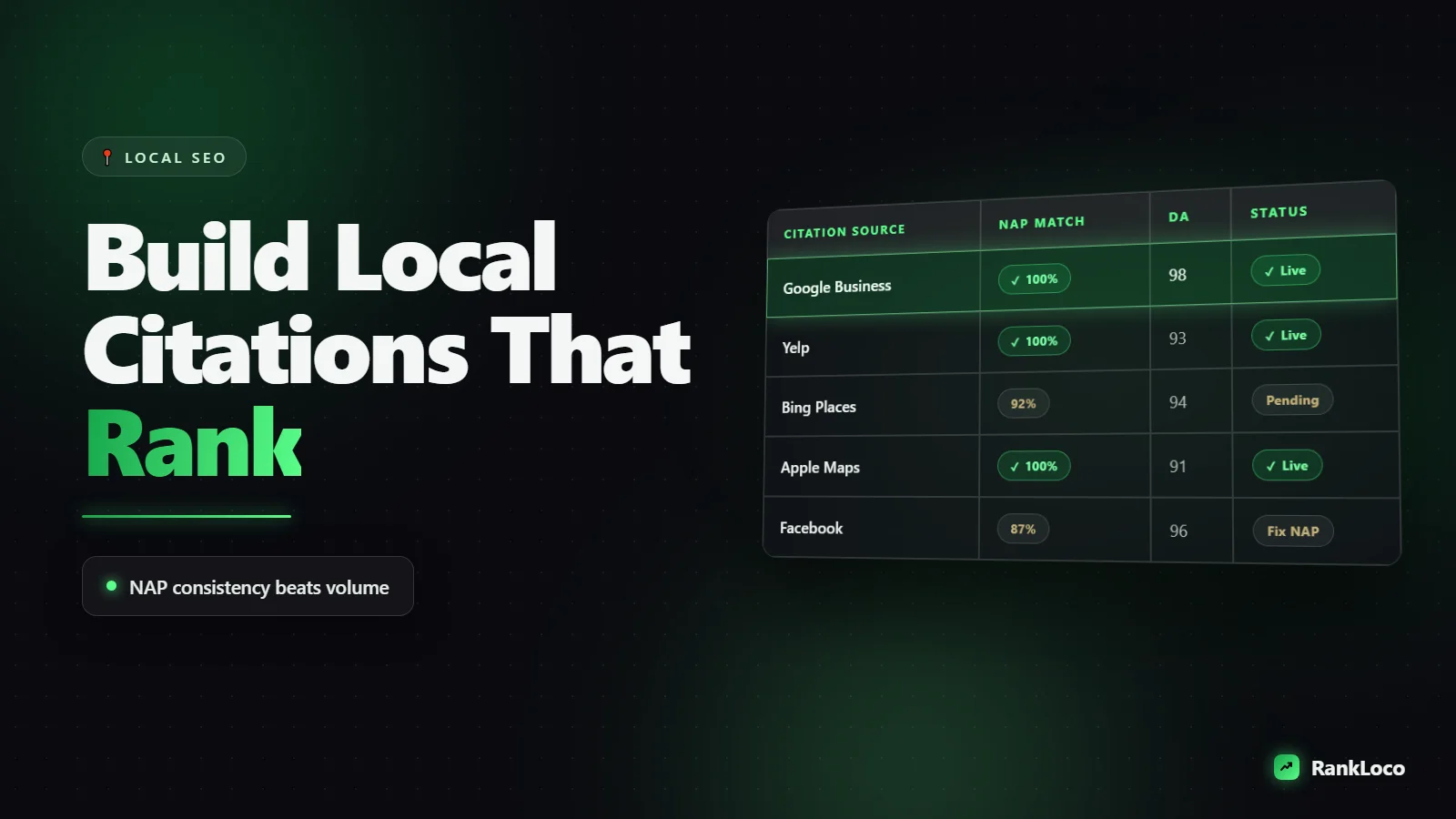
One of the most common local SEO problems is messy business data across the web. Maybe your old phone number is still listed in three directories. Maybe your suite number appears on some listings but not others. Maybe your business name changes slightly from site to site. These seem minor. They are not.
Google wants confidence that your business information is stable and trustworthy. Inconsistent citations weaken that confidence. They also create friction for customers trying to contact you.
Clean up your core listings first. Focus on major directories, data aggregators, industry-specific sites, and local business platforms where your audience actually looks. Do not chase hundreds of low-value directory links just to feel productive. Accuracy beats volume.
For multi-location businesses, this gets more complicated. Each location needs its own precise NAP data and supporting local landing page. Blending signals between locations can hurt all of them.
Your website has to support your map rankings
A strong Google Business Profile without a strong website is a ceiling, not a strategy. Google uses your site to validate what your business does, where you operate, and whether the experience deserves visibility.
Your homepage should clearly state your core service and location. If you serve multiple cities, build useful location pages instead of cloning the same thin content and swapping city names. Google is good at spotting lazy local pages.
This is where businesses often underperform. Their site says almost nothing specific. It talks in general marketing language and never clearly matches the searches they want to rank for. If you are a roofing company in Tampa, your site should make that obvious in titles, headings, body copy, and supporting content.
Technical basics matter too. Slow pages, broken internal links, poor mobile usability, and missing schema create drag. None of these alone explain every ranking problem, but when they pile up, local performance suffers.
Adding local business schema can help search engines understand your business details more clearly. It is not a shortcut to the top three, but it is part of a clean local SEO foundation.
How to improve map pack visibility with better local relevance
Relevance is where many businesses leave easy wins on the table. They assume proximity is everything, so they stop optimizing. Proximity matters, but it is not the only factor. Businesses regularly outrank closer competitors because their signals are stronger.
Start by matching your pages and profile to the actual search terms customers use. That means service plus city, service plus near me intent, and problem-based searches tied to local demand. A family dentist, personal injury lawyer, HVAC company, and pizza shop all need different keyword targeting because customer behavior is different.
Also pay attention to service depth. If you offer water heater repair, drain cleaning, and sewer line inspection, those services should appear clearly on your site and profile where appropriate. Businesses often rank poorly because Google sees a vague category, not a well-defined service offering.
Competitor analysis helps here. If the top map pack listings all have stronger service coverage, better review themes, more complete profiles, and better local landing pages, that is your benchmark. You do not need theory. You need to know where the gap is.
Local backlinks still move the needle
Backlinks are not the first thing to fix for every business, but they can be the difference when everything else is close. Local links from trusted, relevant sites help strengthen authority and geographic relevance.
Think local chambers, neighborhood organizations, local news mentions, partner businesses, sponsorships, and industry associations. These are usually better than random national directory spam. A few strong local links often beat a pile of weak ones.
This is another area where it depends. If your profile is half complete and your citations are a mess, backlinks are not your first priority. If your foundation is solid and rankings are stuck just outside the map pack, local authority signals may be the missing piece.
Speed matters, but so does fix order
The biggest mistake in local SEO is doing ten low-impact tasks while one major problem stays untouched. A business with duplicate listings, wrong categories, inconsistent NAP data, weak reviews, and no location relevance on-site should not spend the week debating photo captions.
Fix order matters. Usually that means starting with your Google Business Profile, citation consistency, core website relevance, reviews, then technical cleanup and authority building. The exact order changes based on the audit.
That is why fast diagnosis is so valuable. A tool like RankLoco can scan the core local ranking signals quickly and tell you what is hurting visibility most, without making you sort through a bloated dashboard full of noise. For owners and agencies, that speed turns confusion into action.
The map pack is competitive because it drives real business. Calls, foot traffic, quote requests, booked jobs. If you want to know how to improve map pack visibility, stop looking for one trick and start fixing the signals that actually decide who shows up. The businesses that win locally are usually not doing magic. They are just getting the fundamentals right, faster than everyone else.