Local Search Ranking Signals Guide for Maps
A competitor with fewer reviews should not be outranking you in Google Maps. Yet it happens every day because local visibility is not decided by one metric. This local search ranking signals guide shows what Google is looking for, what commonly drags businesses down, and where to focus first if you need more calls, visits, and booked jobs.
The goal is not to chase every possible SEO task. The goal is to remove the issues that make Google less confident your business is the best local result for a real customer search.
How local rankings actually work
Google’s local results are built around three broad ideas: relevance, distance, and prominence. Relevance is how closely your business and website match what a customer wants. Distance is how close your location is to the searcher or the location named in the search. Prominence is the evidence that your business is legitimate, known, and trusted.
You cannot control where a person is standing when they search. You can control whether Google understands your services, trusts your business data, and sees proof that customers choose you. That is why a clean Google Business Profile, accurate listings, a useful local website, and a credible reputation work together.
There is no fixed checklist that guarantees the number-one map position. Rankings vary by search term, neighborhood, competition, and location. But a business with missing information, conflicting addresses, and a thin website is giving competitors an easy win.
The local search ranking signals that deserve attention first
Your Google Business Profile
Your Google Business Profile is the foundation of map pack visibility. If its primary category is wrong, its hours are outdated, or its services are vague, Google has less reason to show it for high-value searches.
Start with the basics: use your real-world business name, correct address or service area, local phone number, current hours, website, and accurate primary category. Then add the secondary categories, services, products, appointment options, photos, and business description that genuinely apply.
Categories matter because they tell Google what you are. A plumber should not choose a broad category when a more precise one fits. A restaurant should not leave cuisine, ordering, or reservation details incomplete. Choose categories based on the work you actually perform, not every keyword you want to rank for.
Do not add keywords or city names to your business name unless they are part of the name used on your storefront, legal materials, and real-world branding. Keyword stuffing can trigger edits, suspensions, and customer distrust. It is a shortcut with a bad downside.
Consistent business information across the web
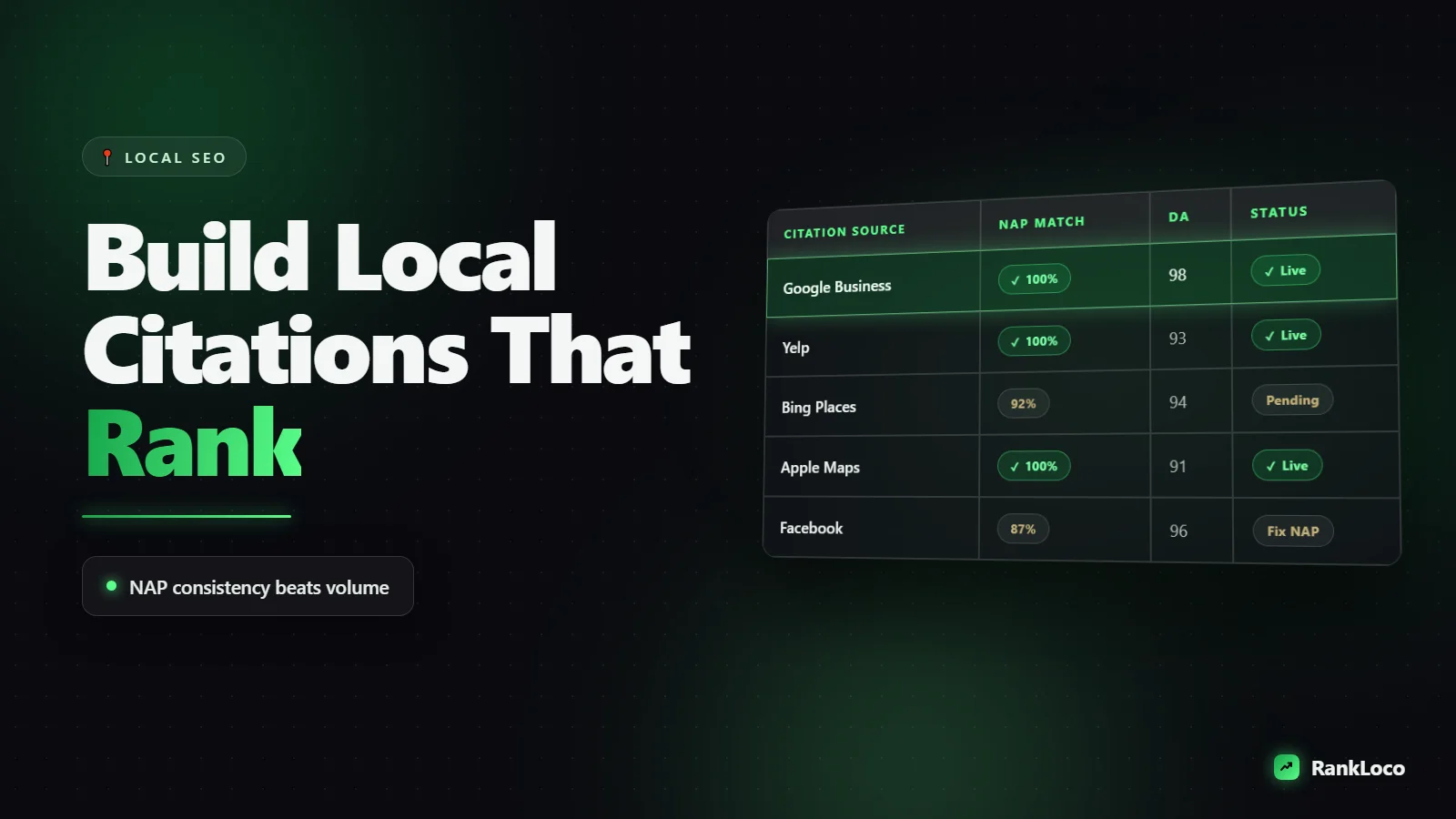
Google cross-checks your business details across directories, data sources, social profiles, and your own site. Your name, address, and phone number - often called NAP - need to be consistent enough that Google can confidently connect those mentions to one business.
Small differences are not always fatal. “Suite 200” versus “Ste 200” is usually less serious than an old phone number, a previous address, duplicate profile, or two versions of your business name. The bigger the conflict, the more likely it creates confusion for search engines and customers.
Fix your own website and Google profile first. Then correct the major directories and industry-specific listings that actually appear in searches for your business. Do not waste weeks submitting to hundreds of low-quality directories while your Google profile still has the wrong category or your contact page shows an old address.
Website relevance for local services
Your website gives Google the detail your profile cannot. A strong local site makes it obvious what you offer, where you offer it, and why a customer should choose you.
Each core service should have a useful page. A roofing company needs more than a homepage that says “quality roofing.” It should clearly explain roof repair, replacement, inspections, materials, service areas, and how to request help. A customer and a search engine should not have to guess.
Include your business name, address, phone number, hours, and service area where customers can find them. Use local terms naturally in page titles, headings, body copy, and image context when they describe the actual service location. Build pages around real customer intent, not a pile of near-identical city pages with swapped place names.
Location pages can work when each location has a real office, distinct staff, local proof, useful details, and a clear reason to exist. They fail when they are thin doorway pages created solely to capture nearby towns. If you are a service-area business, explain where you travel without pretending to have offices you do not have.
Reviews and reputation signals
Reviews affect both customer decisions and local visibility. Businesses with a steady pattern of authentic, recent feedback usually look more credible than businesses with a handful of old reviews.
Ask every satisfied customer for an honest review after the job, visit, or purchase. Make the request simple and consistent. Do not offer incentives for reviews, filter out unhappy customers, or ask employees and friends to manufacture praise. Those tactics can damage trust and create policy problems.
Respond to reviews like a real business owner. Thank positive reviewers specifically. Address negative feedback calmly, without exposing private details or starting an argument. A thoughtful response will not erase a bad review, but it shows prospective customers that you take service seriously.
Local authority and backlinks
Backlinks still matter, especially when they show that respected local or industry sources recognize your business. A link from a local chamber, neighborhood publication, trade association, supplier, community event, or relevant partner can reinforce your prominence.
Quality matters more than volume. Ten links from irrelevant, spam-heavy sites are not better than one legitimate mention from a trusted local organization. Focus on relationships and real activity: sponsor an event you actually support, contribute expertise to a local story, join relevant associations, or publish information people in your area can use.
Technical health and structured data
A slow, broken, or hard-to-use site costs leads even when it does not directly explain every ranking change. Mobile visitors should be able to call, request service, get directions, or book an appointment without fighting pop-ups and confusing navigation.
Check that key pages load quickly, work on phones, use HTTPS, and are indexable. Fix broken pages, redirect outdated URLs, and make contact information easy to read. Local business schema markup can help search engines interpret your business details, but it cannot rescue weak content or inaccurate listings. Treat it as supporting evidence, not a magic switch.
What to fix first when rankings are stuck
Do not start by publishing ten blog posts or buying a backlink package. Start with a diagnosis. Compare your business against the top map pack competitors for the searches that produce revenue, not vanity terms that never lead to calls.
Prioritize fixes in this order:
- Correct Google Business Profile errors, missing categories, incomplete services, hours, and duplicate listings.
- Resolve mismatched names, addresses, phone numbers, and old business data across major directories and your site.
- Strengthen the pages tied to your most profitable services and real service areas.
- Build a repeatable review process and respond to new customer feedback.
- Repair technical issues, then earn credible local and industry mentions over time.
This order is not absolute. If your site is blocked from Google or your business profile is suspended, that emergency comes first. If you serve a highly competitive city, you may need stronger local authority sooner. But for most small businesses, profile accuracy and website relevance produce the fastest clarity because they remove obvious reasons Google may be ignoring you.
Measure local visibility without fooling yourself
A single search from your office is not a ranking report. Results change based on the searcher’s location, device, search history, and the exact wording used. Track visibility across the neighborhoods you serve and across the service terms that matter most.
Watch more than ranking position. Look at calls, direction requests, website visits, form submissions, booked jobs, and revenue by location or service. A number-three map ranking for “emergency plumber near me” can be more valuable than a number-one ranking for a low-intent phrase.
Also watch competitors for changes. If a competitor suddenly rises, check whether they added reviews, improved categories, opened a closer location, earned local coverage, or rebuilt key service pages. The answer is usually visible once you inspect the right signals.
A fast audit can cut through the guesswork. RankLoco scans the local SEO issues that commonly hold businesses back and turns them into a practical fix-it list, so you can spend time fixing the leaks instead of staring at a vague score.
Your next customer is already searching for a business nearby. Make sure Google can verify who you are, what you do, and why you belong in the results before your competitor gets the call.