Google Maps Ranking Factors That Move You Up
If you are stuck below weaker competitors in the map pack, guessing will waste months. The truth about google maps ranking factors is simpler than most business owners are told: Google wants to rank the business that is most relevant, most trustworthy, and easiest to verify in a specific location. If your visibility is slipping, one of those three areas is usually broken.
That matters because Google Maps is not just a branding channel. It drives calls, direction requests, bookings, and walk-ins. When you drop from the top three to position five or six, the traffic drop is real. So instead of chasing random SEO tricks, focus on the ranking signals that actually move local results.
The 3 buckets behind google maps ranking factors
Google has described local ranking around relevance, distance, and prominence for years. That still holds up, but in practice those ideas are fed by dozens of signals.
Relevance is how closely your business matches the search. If someone searches for emergency plumber, Google looks at your primary category, secondary categories, services, business description, website content, reviews, and even the phrases used across the web to decide whether your listing fits.
Distance is more literal. Google wants to show businesses near the searcher or near the location named in the query. You cannot optimize your way into being physically closer than you are. What you can do is give Google stronger location signals so it feels confident showing you across the service area or city you actually serve.
Prominence is where most businesses fall behind. This is Google asking whether your business looks established, trusted, and active. Reviews, backlinks, citations, local mentions, brand searches, and website authority all feed that judgment.
Your Google Business Profile carries the most weight
If your Google Business Profile is weak, everything else has to work harder. For many local businesses, this is still the fastest place to improve rankings.
Your primary category is one of the biggest signals in the entire local algorithm. Pick the category that best matches the core service you want to rank for, not the one that sounds broad or impressive. A personal injury attorney should not lead with law firm if personal injury attorney is available. A garage door contractor should not default to contractor if a more precise category exists. The trade-off is obvious: broad categories can feel safer, but precise ones usually rank better for intent-driven searches.
Secondary categories matter too, but only when they reflect real services. Stuffing categories that do not match your business can dilute relevance. The same rule applies to services, products, and attributes. Fill them out completely, but keep them honest.
Profile completeness still matters because it helps Google verify what you do. Business hours, service areas, photos, descriptions, appointment links, and service menus all add context. None of these fields are magic by themselves. Together, they reduce ambiguity, and ambiguity kills rankings.
Reviews shape rankings and conversion at the same time
Reviews are one of the few signals that influence both visibility and customer action. A business with more high-quality reviews, steady review velocity, and strong keyword relevance in review text often has an edge.
Quantity helps, but freshness matters more than many owners realize. A profile with 200 reviews from three years ago can lose ground to a competitor adding five to ten real reviews every month. Google reads that as a living business with current customer activity.
Sentiment matters too. A 4.8 average with detailed service-specific reviews is stronger than a 5.0 average built on short, generic praise. Reviews that mention actual services, neighborhoods, and experience details give Google more relevance signals. They also help searchers choose you.
The fix is straightforward. Build a consistent review process after every completed job, purchase, or visit. Do not bribe customers or gate unhappy ones. Just ask fast, ask often, and make it easy.
Website signals still influence Google Maps rankings
A lot of business owners treat their website and their map rankings as separate things. They are not. Your website helps Google verify location, service relevance, authority, and trust.
If your homepage barely mentions what you do or where you do it, your Google Business Profile has less support. If your city pages are thin, duplicated, or stuffed with awkward keywords, they will not help much either. Google wants a clean connection between your profile and your site.
The basics still win here. Your site should clearly show your business name, address, phone number, core services, and service areas. It should have dedicated pages for major services and locations if those pages offer real value. It should load quickly, work well on mobile, and make it obvious how customers can contact you.
Schema markup helps with clarity, not miracles. A proper local business schema setup can reinforce key business details, but it will not overcome weak content, bad citations, or poor reviews. Same with page speed. A slow site can hurt trust and conversions, but shaving half a second off your load time will not beat a competitor with stronger local authority.
NAP consistency and citations still matter
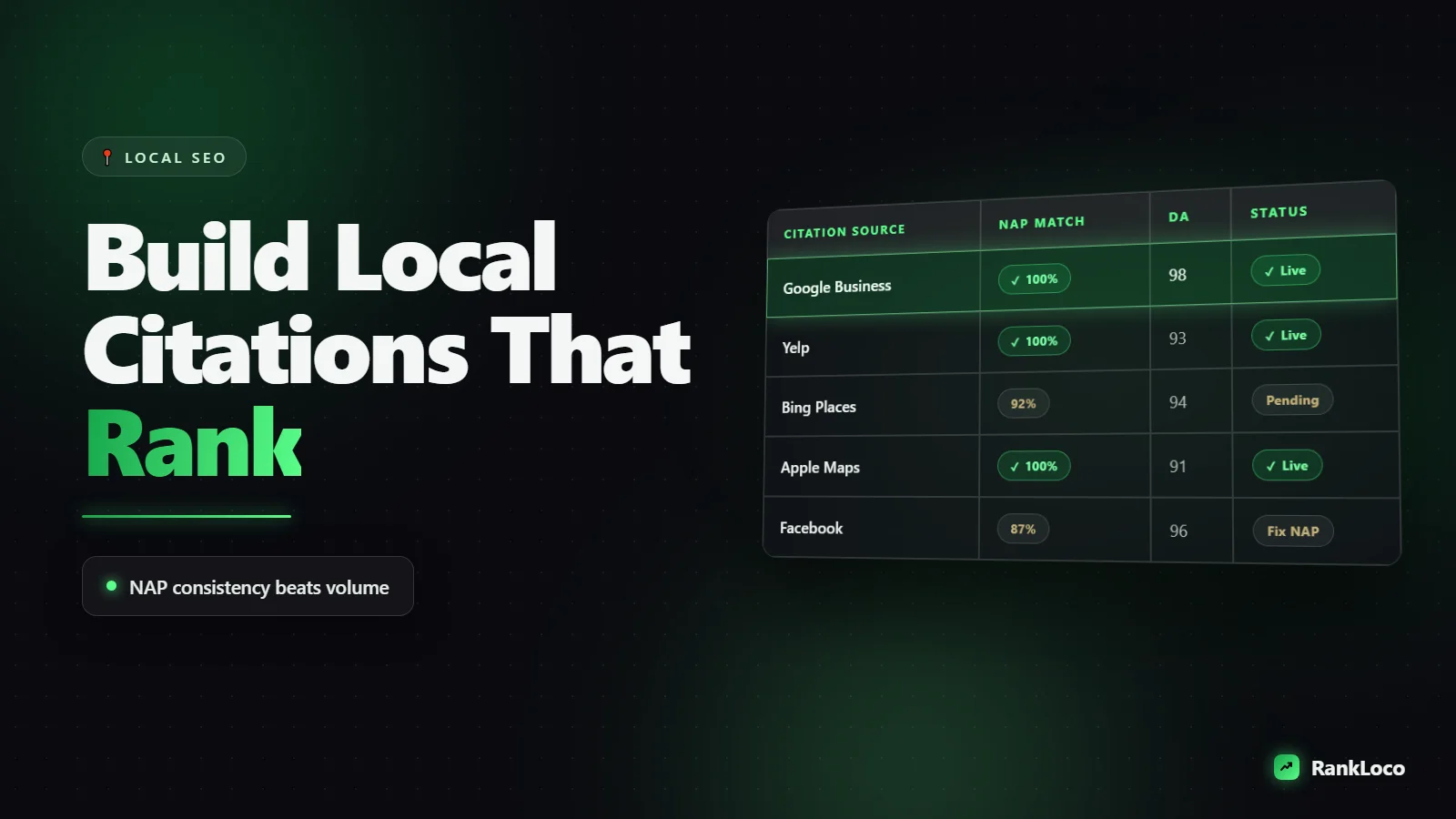
Name, address, and phone number consistency is not exciting, but bad citation data still causes ranking problems. When Google sees conflicting business information across directories, it has to work harder to trust the listing.
This is especially common after a rebrand, a move, a call tracking change, or a franchise ownership transition. You may think the wrong listing on an old directory does not matter. It can, especially when those errors are repeated in multiple places.
Consistency does not mean every citation has to match character for character. Small formatting differences are normal. What matters is that the core business identity stays the same across major platforms. If your suite number appears on some listings and not others, that is usually manageable. If your phone numbers, business names, or addresses are split across the web, that is a bigger problem.
For newer businesses, building accurate citations helps Google verify you faster. For established ones, cleaning up old messes often lifts trust more than adding a dozen new listings.
Backlinks and local authority separate winners from everyone else
When two businesses have decent profiles and solid reviews, authority usually becomes the tiebreaker. That is where backlinks and local mentions come in.
Google still uses links as a trust signal. A local business with relevant links from newspapers, chambers of commerce, industry sites, sponsorship pages, neighborhood blogs, and local organizations usually has stronger prominence than a business with no meaningful mentions beyond generic directories.
This is one area where quality beats volume. Ten real local links can do more than a pile of junky directory placements. The same goes for branded mentions even when they do not include a link. If your business is talked about in the local market, that helps reinforce prominence.
For agencies and owners, this is also where patience matters. Profile edits and review pushes can create faster movement. Authority building tends to compound over time.
Behavioral signals matter, but they are hard to fake
Google pays attention to how users interact with listings. Clicks, calls, direction requests, photo views, and engagement patterns can reinforce ranking over time. If searchers constantly skip your listing and choose another one, Google gets feedback.
That does not mean you should try to game user behavior. Fake traffic, fake clicks, and fake searches are short-term thinking. What works better is improving the listing so more people choose it naturally. Better photos, stronger reviews, accurate categories, and a sharper website all support that.
This is why ranking and conversion should be treated together. If your listing earns more action from real searchers, that often supports stronger visibility later.
What usually hurts rankings first
Most local businesses do not have one giant problem. They have five medium-sized ones dragging each other down.
The most common issues are the wrong primary category, incomplete or outdated profile data, inconsistent citations, weak service pages, low review velocity, and no local authority signals. Add a slow mobile site or poor on-page location relevance, and you have a profile that looks average even if the business itself is excellent.
That is why random fixes often disappoint. If you only post photos but your category is wrong, results stay flat. If you clean citations but your site barely mentions your main service, progress is limited. Local SEO works best when the core signals support each other.
Where to focus first if you want faster gains
Start with the pieces that affect both trust and relevance. Fix your primary category, complete every important field in your Google Business Profile, make sure your business information is consistent across major directories, and tighten your main service and location pages.
Then build momentum with a steady review process and a realistic local authority plan. If you need speed, scan the business like Google would and prioritize the highest-impact gaps first. That is the value of a local audit tool built for Maps performance, not a bloated report full of vanity metrics.
The businesses that win on Google Maps are usually not doing something mysterious. They are just easier for Google to trust. Get clear on what is broken, fix the signals in the right order, and let the market see the business you already built.