How to Analyze a Competitor Backlink Profile to Find Opportunities
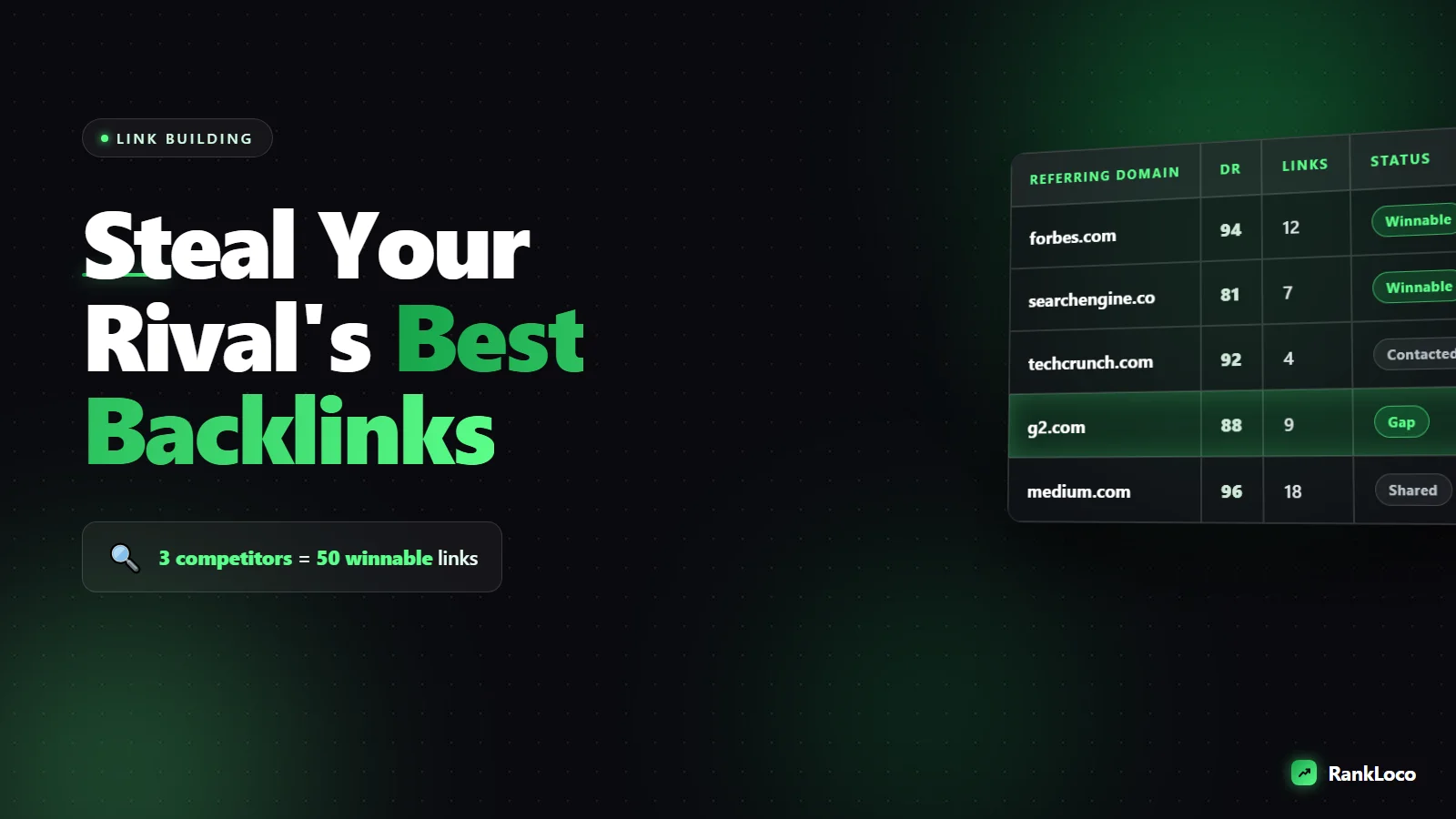
To analyze a competitor backlink profile, export their referring domains from a backlink tool, sort by link quality and relevance, then group the links into patterns you can replicate: directories, guest posts, resource pages, digital PR, and unlinked mentions. The goal is not to copy every link but to find the repeatable sources that already vouch for sites like yours, so you can pitch the same editors, directories, and roundup authors. Do this for two or three real competitors and a target list of 30 to 50 winnable links falls out fast.
Pick the right competitors before you pull a single link
Your biggest brand rival is often the wrong competitor to study. If they have a 15-year head start and a PR team, their link profile is full of coverage you cannot realistically earn. You want search competitors: sites ranking on page one for the keywords you are chasing, ideally close to your size.
Here is how to build that list:
- Take 5 to 10 of your priority keywords (the money terms and the informational ones you want to own).
- Search each one and note the domains that appear in the top 10 repeatedly, ignoring giants like Wikipedia, Amazon, and news sites.
- Prioritize domains that show up for multiple keywords. Those are the ones whose whole strategy overlaps with yours.
Aim for three competitors. One that is slightly ahead of you, one roughly your equal, and one you are beating so you can spot where you already have an edge. If you have not mapped who ranks against you yet, our guide on how to track competitor keyword rankings step by step will give you a clean starting list.
Export the backlink data you actually need
Pull the report from any backlink tool (Ahrefs, Semrush, Moz, or the backlink features inside RankLoco). Do not drown in individual links. At the domain level, one link from a site and 400 links from the same site are roughly the same opportunity. Work off referring domains, not total backlinks.
Export these columns for each competitor:
- Referring domain (the linking site)
- Domain Rating / Authority (rough strength signal)
- Target URL (which of their pages got the link)
- Anchor text
- Link type (dofollow vs nofollow)
- First seen date (how recent the link is)
Dump all three competitors into one spreadsheet with a column for which competitor each row belongs to. This lets you find link intersect opportunities: domains linking to two or three competitors but not to you. Those are your hottest targets, because a site linking to multiple sites in your niche is clearly open to linking to one more.
Filter out the noise so you only see winnable links
Most exported backlink data is junk you cannot use. Kill the noise before you analyze anything:
- Remove spam and PBN-looking domains. If a domain has a weird TLD, no real content, or an authority score near zero with thousands of outbound links, ignore it. You do not want those links anyway.
- Remove links you cannot replicate. A mention in a national newspaper from a founder interview is not a repeatable tactic for you today.
- Deduplicate to one row per referring domain. Keep the strongest or most relevant target URL.
- Filter by relevance. A link from a site in your industry or an adjacent one is worth ten random links.
What is left is your real opportunity pool. For most small sites this trims a 5,000-row export down to a few hundred domains worth looking at.
Categorize links into repeatable patterns
This is the step that turns a spreadsheet into a plan. Go through the surviving referring domains and tag each one by link type. You are looking for buckets you can systematically go after.
| Link category | How to spot it | How you replicate it |
|---|---|---|
| Directories and listings | Anchor is the brand name, page lists many businesses | Submit your business to the same directory |
| Resource / links pages | URL or title contains "resources," "links," "tools" | Pitch your relevant asset to the page owner |
| Guest posts | Competitor author byline on another site | Pitch the same publication a topic |
| Roundups and "best of" lists | Page compares or lists multiple providers | Ask to be added or created a reason to be |
| Unlinked / brand mentions | Editorial content, contextual anchor | Build an asset worth citing, then outreach |
| Digital PR / data | Links to a study, survey, or stat page | Publish your own linkable data asset |
Add a "category" column and tag every domain. When you sort by category, the patterns jump out. If one competitor has 40 directory links, you now have a directory submission list. If another keeps landing guest posts on the same five blogs, you have five outreach targets.
Find the pages earning the most links
Switch views and look at which of your competitor's pages attract links, not just which sites link out. In most tools this is the "best by links" or "top pages" report. This tells you what content the market actually links to.
You will usually find a handful of pages doing all the heavy lifting: a definitive guide, a free tool or calculator, an original stat roundup, a template. That is your content roadmap. If a "cost of X" data page pulled 60 referring domains for a competitor, a better version of that page is your single highest-leverage link asset. Reverse-engineering these winning pages pairs well with learning how to turn one blog post into a topic cluster that ranks, so the asset attracts links and supports a whole set of keywords.
Read the anchor text for intent and risk
Anchor text tells you two things. First, what a competitor is deliberately targeting: if their anchors lean heavily on one keyword, they are actively building links to rank for it, which flags a keyword worth your attention. Second, it reveals link risk. A natural profile is mostly branded anchors and URLs with a minority of keyword-rich anchors. If a competitor's anchors are 70% exact-match keyword, that is manipulated link building that can get penalized. Do not copy that pattern. Keep your own anchor mix natural: brand name, bare URL, and varied phrases.
Turn the analysis into an outreach action list
Analysis is worthless without a shortlist you will actually work. Build one final tab with these columns: referring domain, category, contact method, the angle, and status. Prioritize in this order:
- Link intersect domains (link to 2+ competitors, not you). Warmest leads.
- Directories and listings. Fastest wins, often free, no content needed.
- Resource and roundup pages. Need a relevant asset and a short pitch.
- Guest post targets. Higher effort, higher quality.
- Digital PR replication. Longest game, biggest payoff.
Knock out the directories and intersect links first to build momentum. Many of these overlap with tactics in our guide on how to get backlinks for a small business with no budget, which is where you should start if outreach is new to you.
A repeatable competitor backlink audit checklist
- Identify 3 true search competitors (ranking for your target keywords)
- Export referring domains, not total backlinks
- Combine all three into one sheet with a competitor column
- Filter out spam, unrepeatable, and irrelevant domains
- Deduplicate to one row per referring domain
- Flag link intersect domains (linking to 2+ competitors)
- Tag every domain by link category
- Pull each competitor's top pages by referring domains
- Review anchor text for target keywords and spam risk
- Build a prioritized outreach list and start with the fast wins
How often to repeat this and how to measure it
Run a full competitor backlink analysis once a quarter. Between audits, watch for new links your competitors earn (most tools have a "new backlinks" alert). A fresh link often signals a fresh campaign you can piggyback on within days, while the editor is still in link-adding mode.
Measure results by tracking your referring domain count against your competitors over time, alongside your keyword positions for the terms those links support. Rankings are the real scoreboard, so keep an eye on movement using rank tracking and check whether new links move the pages they point to. If you need a system for that, see how to track keyword rankings over time to measure progress, and browse more tactics in the RankLoco SEO guides.
Frequently Asked Questions
What is the best free way to see a competitor's backlinks?
Google Search Console only shows your own links, so for competitors use the free tiers of Ahrefs Webmaster Tools, Semrush, Moz Link Explorer, or Ubersuggest. Each caps how many referring domains you can see per day. Rotate between two or three free tools to piece together a fuller picture before committing to a paid export.
How many competitors should I analyze for backlinks?
Three is the sweet spot for most sites. Pick one competitor slightly ahead of you, one roughly equal, and one you are already outranking. Combining three profiles surfaces link intersect domains (sites linking to multiple competitors) which are your highest-probability targets, without drowning you in thousands of rows you will never work through.
What does link intersect mean in backlink analysis?
Link intersect finds domains that link to several of your competitors but not to you. Because those sites already link out to multiple companies in your niche, they are demonstrably open to linking to one more. These are the warmest outreach targets in any competitor backlink audit, so work them before cold prospects.
Should I try to copy every competitor backlink?
No. Copy the repeatable, relevant patterns: directories, resource pages, roundups, and guest posts. Skip one-off press hits, paid links, and anything with a spammy or over-optimized anchor profile. The goal is to identify the reliable link sources sites like yours can earn, not to chase every URL in the export.
How long does it take for new backlinks to affect rankings?
Google has to crawl the linking page, then recalculate value, which usually takes a few weeks to a couple of months. Links to pages that are already indexed and ranking near the top tend to show impact faster. Track the target page's position before and after so you can attribute movement to the link.
What backlink metrics matter most when judging a link opportunity?
Relevance first, then authority (Domain Rating or Authority), then whether the link is dofollow and editorially placed. A relevant, in-content dofollow link from a mid-authority site in your niche beats a high-authority link from an unrelated directory. Also check the linking page's own traffic, since links from pages people actually visit pass more value.