How to Turn One Blog Post Into a Topic Cluster That Ranks
To build a topic cluster for SEO, pick one broad topic your best-performing post already covers, turn that post into a pillar page targeting the head keyword, then create several supporting posts that each answer a specific subtopic and link back up to the pillar. Google reads that interlinked structure as topical authority, which lifts every page in the cluster instead of leaving your one post stranded on page two.
Most sites publish disconnected posts and wonder why nothing ranks. A cluster fixes that by concentrating relevance and internal links around a single theme. Here is exactly how to do it, starting from one post you already have.
What a topic cluster actually is (hub and spoke)
A topic cluster has three parts:
- Pillar page: a broad, comprehensive page targeting a high-volume head keyword (example: "email marketing"). It covers the topic wide but not deep.
- Cluster (spoke) pages: narrower posts that each target one subtopic in depth (example: "email subject line best practices," "welcome email sequence template").
- Internal links: every spoke links up to the pillar, the pillar links down to every spoke, and related spokes link to each other where it makes sense.
The point is coverage. When you own the pillar plus 8 to 15 spokes, you stop competing for one keyword and start competing for the entire topic. That is what signals authority to Google. It also means one strong spoke can pass link equity to the whole group.
Step 1: Pick the right post to expand into a cluster
Do not start from scratch. Start from a post that already has traction, because Google already trusts it a little. Open Google Search Console or your analytics and look for a post that:
- Ranks somewhere on pages 1 to 3 for a broad keyword
- Gets impressions for many different queries, not just one
- Covers a topic broad enough to have 8+ subtopics
That last point matters. A post about "how to unclog a drain" is too narrow. A post about "drain maintenance" can spawn a real cluster. If you need help spotting which pages are worth the investment, our guide on how to find your top organic landing pages walks through the exact reports to check.
Turn that post into the pillar
If the post is already broad, it becomes your pillar. If it is a deep, narrow post, it becomes a spoke and you write a new broader pillar above it. Be honest about which one it is. A pillar should read like a complete overview of the topic that naturally points readers to deeper reads.
Step 2: Build the keyword map for the whole cluster
This is where most clusters fall apart: people guess at subtopics. Do the research instead. Take your head keyword and pull every related query and question people search around it.
Where to find spoke keywords:
- Google autocomplete and People Also Ask: type your head term and record every suggestion and expanded question.
- Search Console queries: the searches your existing post already gets impressions for are proven spoke ideas.
- Competitor coverage: see which subtopics the sites outranking you have covered that you have not.
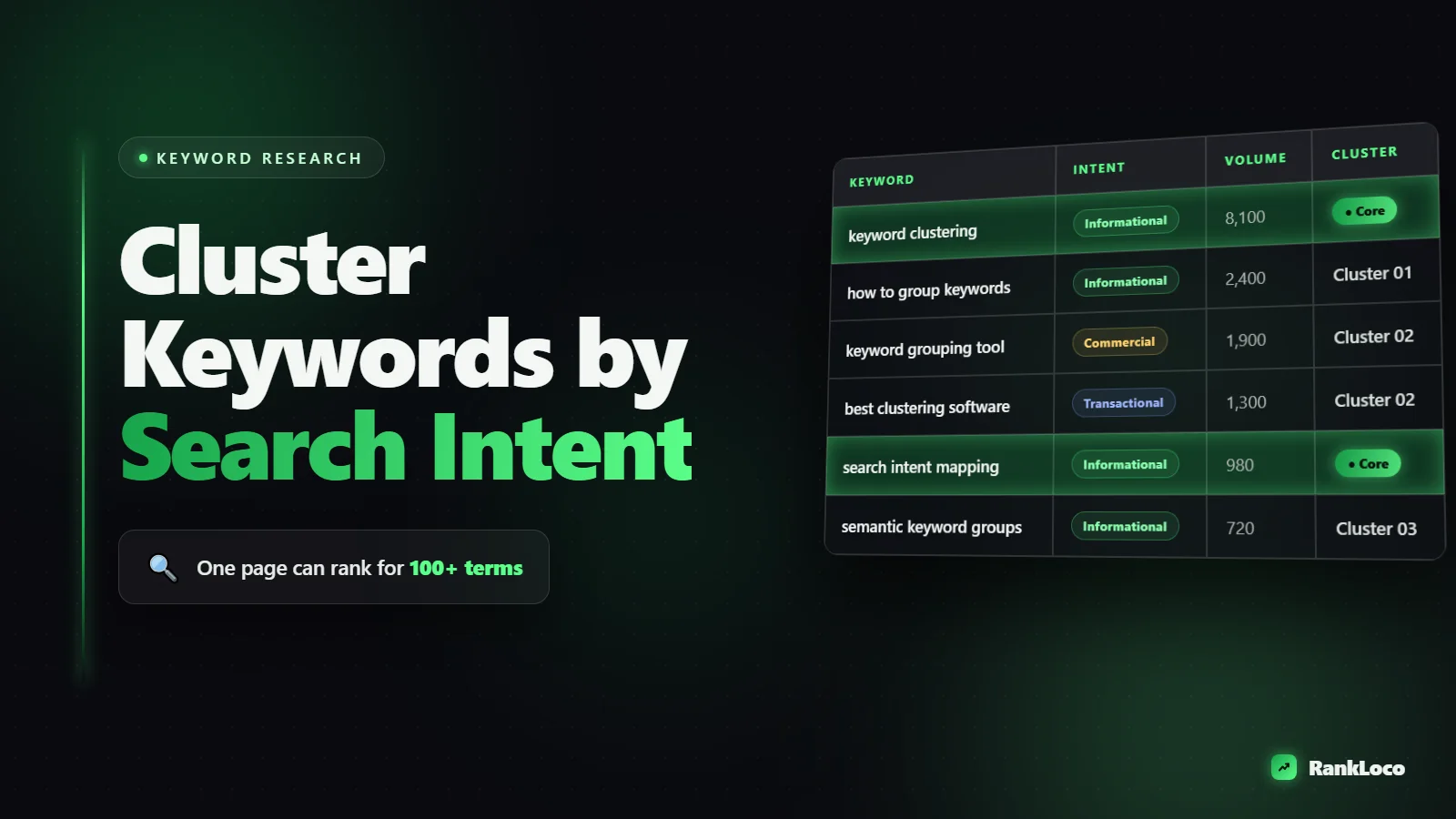
Once you have a list, group the keywords by intent so each spoke owns one search intent, not five. This is keyword mapping, and it is non-negotiable for clusters. Follow our process for keyword mapping for a small website so you assign one primary keyword per page and avoid two posts fighting over the same term (keyword cannibalization).
For a deeper walkthrough of assembling the keyword set itself, see how to build a keyword cluster that covers an entire topic. The keyword cluster is the raw material; the topic cluster is the published, interlinked result.
Example cluster map
| Page type | Target keyword | Intent |
|---|---|---|
| Pillar | content marketing strategy | Informational, broad |
| Spoke | content calendar template | Tool / template |
| Spoke | how to repurpose blog content | How-to |
| Spoke | content marketing metrics to track | Comparison / list |
| Spoke | b2b vs b2c content marketing | Comparison |
Step 3: Find the content gaps before you write
Before you commit to a list of spokes, run a gap check. Look at what is ranking on page one for your head keyword and each subtopic. If three of your planned spokes are already dominated by huge sites with a hundred backlinks each, deprioritize them and pick easier long-tail angles first. Our guide to content gap analysis against competitors shows how to find the subtopics your rivals rank for that you are missing entirely. Those gaps are your fastest wins.
Prioritize spokes by difficulty. Publish the low-competition, high-intent ones first to build momentum, then tackle the harder head terms once the cluster has internal authority behind it.
Step 4: Write the pillar and spokes with the right depth
Depth is the whole game. Match each page to its job:
- Pillar: 1,800 to 3,000 words. Cover every major subtopic in a paragraph or two, then link out to the spoke that goes deep. Think of it as a table of contents with substance.
- Spokes: 1,200 to 2,000 words each, laser-focused on one keyword and its close variants. Answer the query completely so a reader never needs to bounce back to Google.
Open every page with a direct answer to the query in the first two or three sentences. That earns featured snippets and keeps bounce rates low. If you want to systematically grab those boxes, apply the tactics in our guide to optimizing content for featured snippets across your spokes.
Step 5: Wire up internal links correctly
The interlinking is what turns a pile of posts into a cluster. Get this wrong and you just have scattered content. Do all of the following:
- Every spoke links up to the pillar using descriptive anchor text (the pillar's target keyword or a close variant).
- The pillar links down to every spoke in the relevant section.
- Related spokes cross-link where a reader would genuinely want the next step.
- Use varied, natural anchor text, not the exact same phrase every time.
Anchor text matters more than people think. Repeating the identical exact-match anchor on every link looks manipulative. Vary it naturally, the same way you would for external links (see how to write anchor text without getting penalized). Keep your URL structure clean too, because tidy slugs reinforce the hierarchy for both users and crawlers.
Internal linking checklist
- Pillar has a link to each published spoke
- Each spoke links back to the pillar within the first few paragraphs
- No orphan spokes (every page has at least two internal links pointing to it)
- Anchor text is descriptive and varied
- Links open contextually, not stuffed into a footer
Step 6: Add an FAQ block to each page
People Also Ask questions are free cluster real estate. Every pillar and spoke should end with an FAQ that answers 4 to 6 real questions tied to that page's intent. These capture long-tail queries you would never rank for otherwise, and they feed FAQ schema. Learn how to structure them in our guide to writing FAQ content that ranks for question keywords. Pull the actual questions from autocomplete and PAA so you are answering what people search, not what you assume they search.
Step 7: Track the whole cluster, not one keyword
Once the cluster is live, judge it as a unit. A single spoke moving from position 30 to 12 might look small, but if the whole cluster is climbing and the pillar is gaining impressions across dozens of queries, the strategy is working. Set up rank tracking for the pillar keyword plus every spoke keyword so you can see the group trend. RankLoco lets you group keywords by cluster and watch the pillar and spokes together, which makes it obvious when a new spoke lifts the pages around it. If you are still on a shoestring, here is how to track keyword rankings for free while you get started.
Common topic cluster mistakes to avoid
- Too-narrow pillar: if you can only think of three subtopics, it is a spoke, not a pillar.
- Keyword cannibalization: two spokes targeting the same intent will split your rankings. One keyword, one page.
- Publishing everything at once and never linking: the links are the point. Build them as you publish.
- Thin spokes: a 400-word spoke that half-answers a query undermines the whole cluster's authority.
- Ignoring the pillar after launch: update it as you add spokes so the internal links stay complete.
Build clusters, not orphan posts, and you stop gambling on individual articles. Each new spoke strengthens the pillar, and the pillar lifts every spoke. For more frameworks on structuring content that ranks, browse our full library of SEO guides.
Frequently Asked Questions
How many pages do I need for a topic cluster?
Start with one pillar and at least three to five spokes, then grow to 8 to 15 spokes over time. There is no hard maximum. The right number depends on how many distinct subtopics and search intents exist under your head keyword. More quality spokes generally means more topical authority.
What is the difference between a pillar page and a blog post?
A pillar page covers a broad topic wide but shallow and links out to deeper posts, while a standard blog post (spoke) targets one narrow keyword in depth. The pillar acts as the hub; spokes are the detailed articles that support it and link back up to it.
How long should it take to build a topic cluster?
Expect several weeks to a few months, publishing one to three spokes per week. Do not rush thin content out to hit a number. Google rewards depth and interlinking, so a small cluster of strong, well-linked pages beats a large pile of shallow ones every time.
Can I turn an existing old post into a pillar page?
Yes, and it is often the best move. Take a broad post that already ranks, expand it to cover every subtopic at a summary level, add links out to your spokes, and refresh the content. Reusing a page with existing authority ranks faster than starting cold.
Do topic clusters help with keyword cannibalization?
They prevent it when mapped correctly. By assigning one primary keyword and intent to each page in the cluster, you stop multiple posts from competing for the same term. Proper keyword mapping before you write is what keeps a cluster from cannibalizing itself.
How do I measure if a topic cluster is working?
Track the pillar and all spoke keywords as a group, then watch total impressions, average position across the cluster, and clicks to the pillar. If the whole group trends up over two to three months, even as individual pages fluctuate, the cluster is building authority.