How to Track Keyword Rankings Over Time to Measure Progress
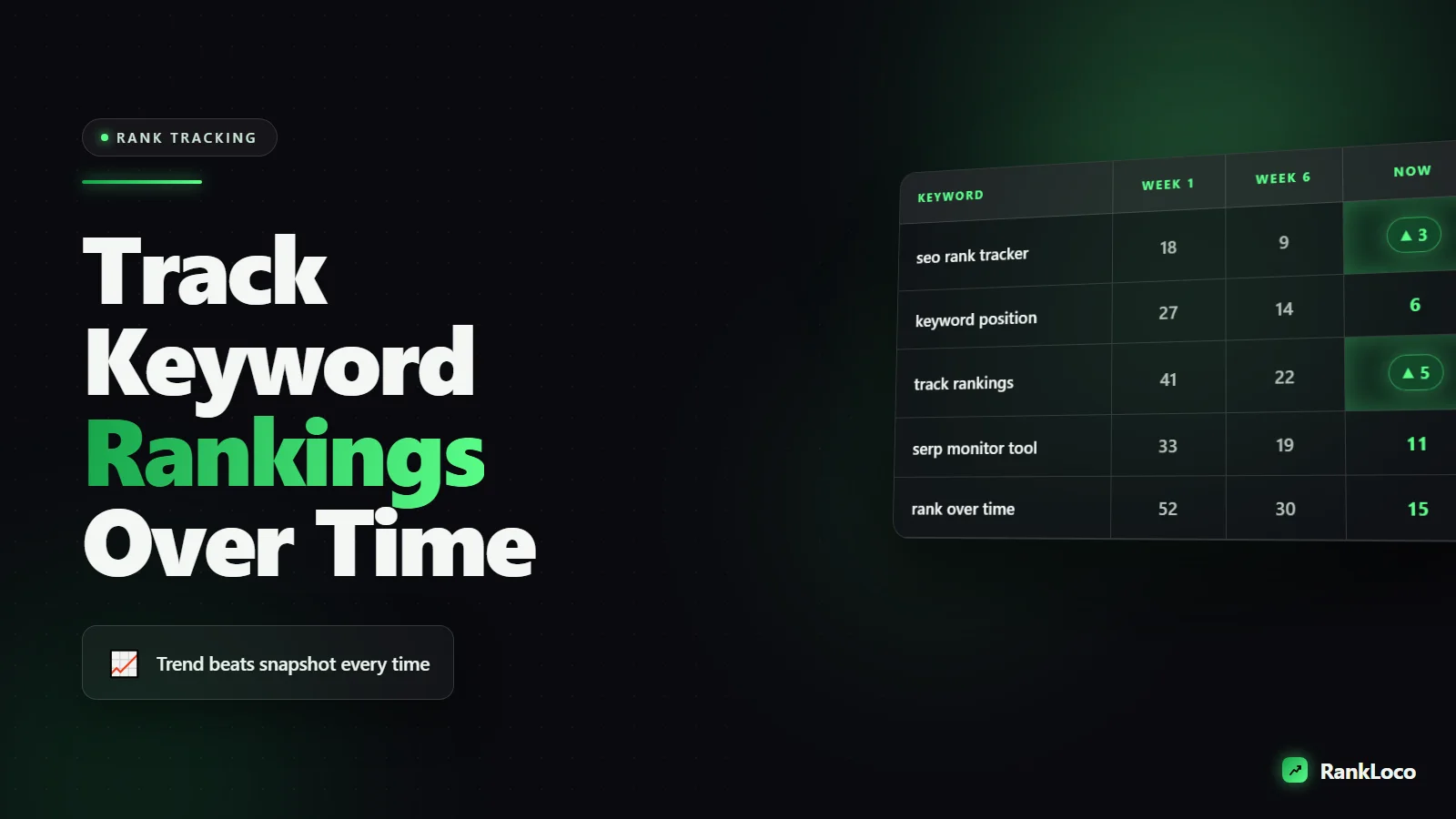
To track keyword rankings over time, pick a fixed set of target keywords, record a baseline position for each, then re-measure on a consistent schedule (weekly for most sites, daily for competitive or fast-moving terms) using the same location and device every time. Store each snapshot with a date so you can compare movement over weeks and months, not just one number in isolation. That trend line, not today's ranking, is how you actually measure SEO progress.
Most people check a keyword once, see it at position 14, and panic or celebrate. Rankings bounce daily. A single check tells you almost nothing. What matters is the direction over 4, 8, and 12 weeks. Here is how to set up tracking that gives you a real signal instead of noise.
Choose which keywords are worth tracking
Do not track 500 keywords. You will drown in data and never look at it. Track the terms that map to money and momentum.
Build your tracking list from four buckets:
- Primary money keywords: the 10 to 30 terms your key service pages and product pages need to rank for. These directly drive revenue.
- Content keywords: the head terms and 2 or 3 supporting phrases for each important blog post or cluster.
- Branded terms: your business name and variations. If these slip, you have a bigger problem.
- Rising opportunities: keywords sitting on page 2 (positions 11 to 20). These move fastest and show whether your work is paying off.
If you are starting a new site, be realistic about targets. Chasing high-volume head terms out of the gate gives you a flat line for months. Start with low competition keywords for a brand new website so you have movement to actually measure. For a service business, ground your list in real demand using proper keyword research for a local service business.
Set a baseline before you measure progress
You cannot show progress without a starting point. Before you optimize anything, record the current position for every keyword on your list, with the date. This is your baseline.
Two ways to get baseline data:
- Google Search Console: free and pulled from real searches. Go to the Performance report, filter by query, and note the average position for each target term over the last 28 days. If your site is new, set up Google Search Console first so data starts collecting today.
- A rank tracker: a tool that checks a specific position on demand from a chosen location and device. This gives you a cleaner, repeatable number than Search Console averages.
Both matter. Search Console tells you the truth about how you actually appear across all searchers. A rank tracker gives you a controlled measurement you can repeat identically week after week. Use Search Console for reality and a tracker for consistency.
Lock your tracking variables so the data is comparable
The number one reason rank data looks chaotic: people compare positions taken under different conditions. Rankings change by location, device, whether the user is logged in, and search history. If you check from your phone in a coffee shop one week and your laptop at home the next, you are comparing apples to oranges.
Fix these variables and never change them mid-campaign:
- Location: country, or city and zip for local terms.
- Device: mobile and desktop tracked separately. They rank differently.
- Language: match your audience.
- Personalization: use incognito or a tool that strips search history.
If you serve customers in specific areas, this is non-negotiable. Walk through how to set up rank tracking by location and device so your reported positions match what a real local customer sees, not what you see logged in at your desk.
Pick the right tracking cadence
How often you check depends on the keyword's competitiveness and how much it moves.
| Keyword type | Check frequency | Why |
|---|---|---|
| Competitive money terms | Daily | Small moves affect revenue; you want to catch drops fast |
| Standard content keywords | Weekly | Enough signal without daily noise |
| Long-tail / low volume | Every 2 weeks | They move slowly and rarely surprise you |
| Branded terms | Weekly | Cheap insurance against unexpected drops |
Whatever you pick, be consistent. Manual daily checks are unsustainable, which is why an automated rank tracker like RankLoco pays off: it snapshots your list on schedule, from your chosen location and device, and stores the history so the trend line builds itself.
What to actually record in each snapshot
Position alone is not enough context to make decisions. For each keyword, capture:
- Date of the check
- Position (exact rank, not "page 1")
- URL that ranked (this catches cannibalization when the wrong page shows up)
- Search volume so you can weight movement by potential traffic
- SERP features present (featured snippet, local pack, image carousel) since these change how much traffic position 3 actually earns
The ranking URL is easy to ignore and hugely useful. If Google keeps swapping which of your pages ranks for a term, you likely have keyword cannibalization and two pages competing against each other. Tracking the URL over time makes that obvious.
How to read the trend and separate signal from noise
Do not react to a single day's movement. Rankings fluctuate 1 to 3 positions naturally. Here is how to interpret what you see:
Steady climb over weeks
Your optimization is working. Keep doing more of it. Note what you changed (new content, internal links, backlinks) so you can repeat it on other pages.
Flat line for 8+ weeks
You are stuck. The page is probably good enough to hold a position but not strong enough to pass competitors. This is when you add internal links, refresh content, or build authority. A stalled page on page 2 often just needs a push.
Sudden drop across many keywords
This is a site-wide signal, not a content problem: a technical issue, an algorithm update, or a manual action. Diagnose it systematically instead of guessing. Our guide on why organic traffic is dropping walks through the checks in order.
Ranking but no clicks
You hit page 1 but traffic did not follow. The problem is your snippet, not your rank. Rewrite for clicks using the tactics in optimizing your meta title and description for higher click through rate.
Connect rankings to traffic and conversions
Rankings are a means, not the end. A number one position that drives zero leads is worse than position five that converts. Tie your rank data to outcomes:
- Overlay Search Console clicks and impressions. Rising impressions with flat clicks means a CTR problem. Rising position with rising clicks means real progress.
- Watch position and traffic together per page. Identify your top organic landing pages and track their key terms most closely; they drive most of your results.
- Segment by intent. Movement on buyer-intent terms matters more than informational ones. If your service pages are climbing, report that loudly.
Build a simple reporting rhythm
Data you never review is wasted. Set a review cadence:
- Weekly (5 minutes): scan for any keyword that dropped more than 5 positions. Investigate only those.
- Monthly (30 minutes): compare this month's average positions to last month and to your baseline. Count how many keywords are in the top 3, top 10, and page 2. These bucket counts are the cleanest progress metric.
- Quarterly: review your keyword list itself. Drop terms that never move or do not convert. Add new opportunities.
The top-3 / top-10 / page-2 bucket count is the single best way to show progress to a boss or client. "We went from 4 keywords in the top 10 to 19 in three months" is a story anyone understands, and it smooths out the daily noise on individual terms.
Common rank tracking mistakes to avoid
- Tracking too many keywords. Focus beats coverage. 30 tracked well beats 300 ignored.
- Changing your measurement setup mid-campaign. Switching location or device breaks the trend line.
- Checking rankings logged into Google. Personalized results lie to you.
- Reacting to one bad day. Wait for a trend across multiple checks.
- Ignoring the ranking URL. You miss cannibalization and wrong-page issues.
- Only tracking your own site. Context matters. Set up competitor keyword rank tracking so you know whether you are gaining or the whole SERP is shifting.
Track the right keywords, lock your variables, measure on a steady schedule, and read the trend instead of the snapshot. Do that and your rank data stops being anxiety and starts being a decision-making tool. For more setups and checklists, browse our SEO guides.
Frequently Asked Questions
How long does it take to see keyword rankings improve?
For a new site, expect 3 to 6 months before meaningful movement on competitive terms. Low-competition and long-tail keywords can rank in weeks. Existing sites with authority often see changes within days to a few weeks after on-page updates. Track weekly and judge progress over 8 to 12 weeks, not days.
Is Google Search Console enough to track rankings over time?
Search Console is great for real-world average positions and it is free, but it averages across all locations and devices, which blurs the picture. It also only reports queries you already rank for. Pair it with a dedicated rank tracker for consistent, location-specific measurements and to monitor keywords you do not yet rank for.
How often should I check my keyword rankings?
Weekly is the sweet spot for most sites. Daily tracking suits competitive money terms where you need to catch drops fast. Long-tail and low-volume terms only need a check every two weeks. The key is consistency: pick a cadence and stick to it so your trend data stays comparable.
Why do my rankings show different positions on different devices?
Google ranks mobile and desktop results separately, and mobile SERPs often include different local packs, ads, and layouts. Location and personalization add more variance. Always track mobile and desktop as separate keywords and lock your location so you are comparing the same conditions each time.
What is a good metric to prove SEO progress to a client?
Use bucket counts: how many tracked keywords sit in the top 3, top 10, and on page 2, compared month over month against your baseline. This smooths out daily noise and tells a clear story. Pair it with Search Console clicks and impressions to connect rankings to actual traffic.
My keyword ranks on page 1 but gets no traffic. What is wrong?
Ranking and clicks are different problems. If you rank well but get few clicks, your title and meta description are not compelling, or a SERP feature (featured snippet, local pack) is absorbing the clicks above you. Rewrite your snippet for clarity and intent, and target the featured snippet if one exists.