How to Find Low Competition Keywords for a Brand New Website
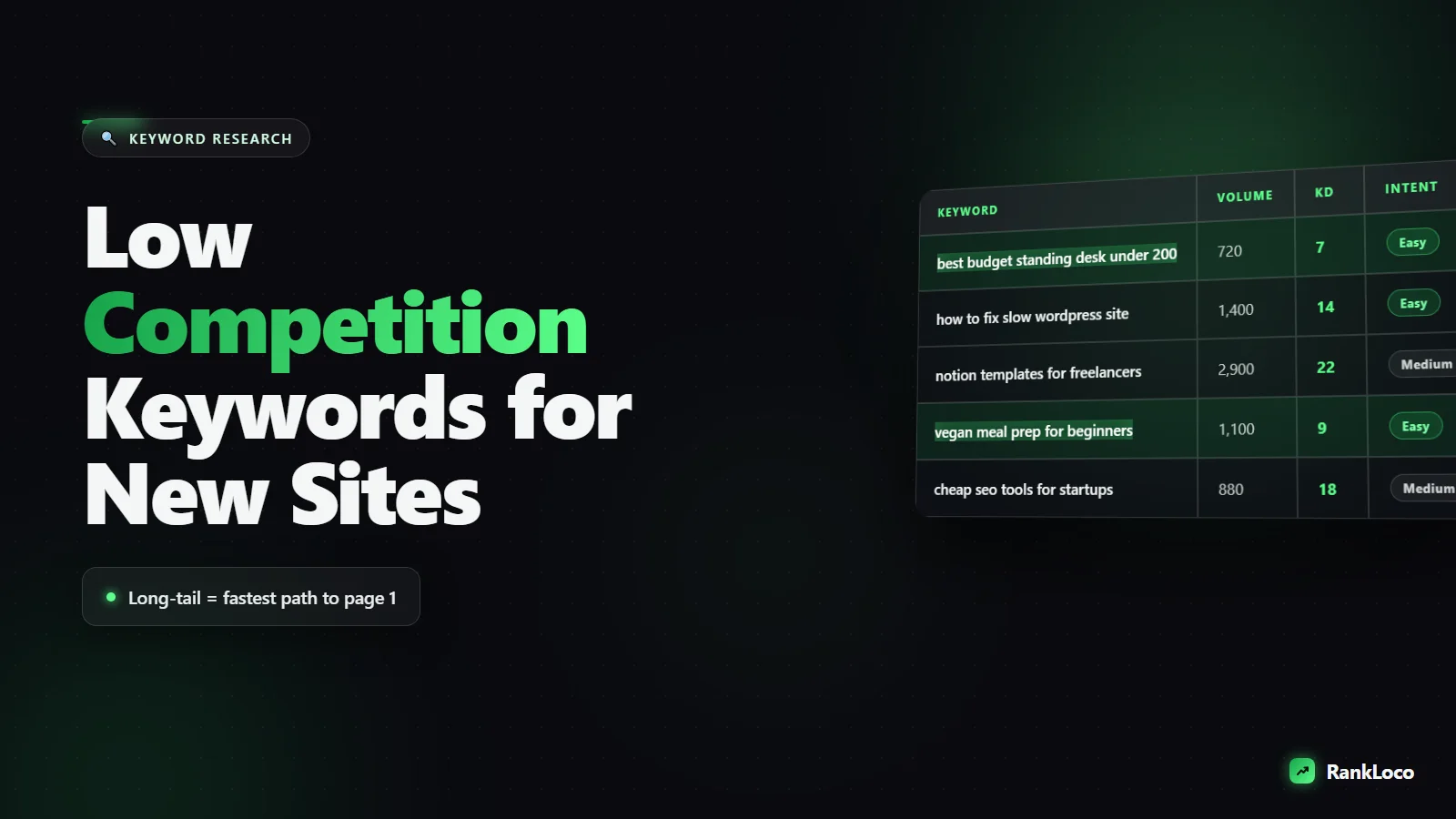
To find low competition keywords for a new website, target long-tail phrases (4+ words) with clear intent, low keyword difficulty, and search results dominated by weak pages instead of big brands. New sites have almost no authority, so you rank by picking keywords where the competition is beatable, not by chasing high-volume head terms. The process: brainstorm seed topics, expand them into specific queries, check who currently ranks, and score each keyword on difficulty versus your realistic chances.
Below is the exact workflow I use to build a keyword list for a site with zero backlinks and no track record. Follow it and you will end up with 20 to 50 keywords you can win in your first few months.
Why New Websites Can Only Rank for Low Competition Keywords at First
Google trusts sites that have earned links, age, and a history of satisfying searchers. Your new site has none of that. If you target "best crm software" on day one, you are competing with pages that have thousands of backlinks and years of ranking data. You will not win.
Low competition keywords work because the search results for them are weak. You will see forum threads, thin pages, outdated posts, or results that do not fully match the searcher's intent. That is your opening. When you can objectively write a better, more specific page than what ranks now, you have a real shot, even from zero authority.
The goal is not to avoid competition forever. It is to win small keywords first, build topical authority and links from that early traffic, and then move up to harder terms. Every established site started this way.
What "Low Competition" Actually Means (Beyond the Difficulty Score)
Most tools show a keyword difficulty (KD) score from 0 to 100. It is useful but incomplete. A keyword is genuinely low competition when several of these are true:
- Low KD number: aim for under 20 to 30 for a brand new site.
- Weak ranking pages: the top 10 includes forums, Q&A sites, or pages that do not directly answer the query.
- Low referring domains: the top results have few or no backlinks pointing at the specific page.
- Specific intent: long-tail queries with 4+ words are almost always less contested than short head terms.
- No brand lock-in: the results are not all owned by huge authority sites in your niche.
Never trust the KD score alone. Always eyeball the actual search results. The SERP tells you the truth that a single number cannot.
Step 1: Build Your Seed Topic List
Start with 5 to 10 broad topics your business or blog covers. If you sell handmade candles, seeds might be "soy candles," "candle care," "scent types," "candle gifts," and "home fragrance." These are too broad to rank for, but they are the roots you will branch from.
Pull ideas from:
- Your products and services, written the way customers describe them
- Questions customers email or ask you in person
- Reddit threads, Facebook groups, and Quora in your niche
- Amazon reviews and forum posts where people describe problems
Step 2: Expand Seeds Into Long-Tail Keywords
Now turn each seed into dozens of specific queries. The longer and more specific the phrase, the lower the competition tends to be. Use these free expansion sources:
- Google autocomplete: type your seed and note every suggestion.
- People Also Ask: the accordion boxes in the SERP are pure keyword gold.
- Related searches: scroll to the bottom of Google results.
- Google Search Console: once your site has any impressions, mine real queries here. Set it up early using our guide to setting up Google Search Console for a new website.
Question keywords are especially valuable for new sites because they are specific and often ignored by big brands. Our walkthrough on finding question keywords your customers are actually searching shows how to turn these into content.
Step 3: Get Search Volume and Difficulty
Now attach numbers to your list. You want to know roughly how many people search each term and how hard it is to rank. A keyword research tool like RankLoco gives you volume and difficulty side by side so you can sort your list fast. If you are still working free, our guide on estimating search volume without a paid tool covers workarounds.
For a new site, do not fear low volume. A keyword with 50 to 200 monthly searches and a KD of 10 is far more valuable than a 5,000-volume term you will never crack. Ten small keywords ranking in the top 3 beat one big keyword stuck on page 5.
Step 4: Manually Check the SERP for Every Candidate
This is the step most people skip, and it is the most important. For each promising keyword, open an incognito window and search it. Ask:
- Do forums, Reddit, or Quora rank on page one? That signals weak competition.
- Are the top pages actually about this exact query, or loosely related? Loose matches mean an opening.
- How old and thorough are the ranking pages? Thin, dated content is beatable.
- Are the results all giant brands? If so, skip it for now.
If you see two or more weak signals, add the keyword to your "go" list. This manual SERP check is what separates a good keyword list from a wishlist.
Step 5: Score and Prioritize Your Keywords
Put everything in a spreadsheet and score each keyword. Here is a simple framework:
| Factor | What to look for | Weight |
|---|---|---|
| Difficulty (KD) | Under 20 ideal, under 30 acceptable | High |
| SERP weakness | Forums, thin pages, loose matches | High |
| Intent match | Query matches what you offer | High |
| Search volume | 50+ is fine for a new site | Medium |
| Business value | Does it attract buyers or subscribers? | Medium |
Prioritize keywords that score high on difficulty, SERP weakness, and intent first. Volume matters less than you think early on.
Types of Low Competition Keywords That Work for New Sites
Long-tail informational queries
Phrases like "how to remove candle wax from a wool sweater" are specific, low competition, and pull in people who trust you once you help them. These build topical authority fast.
Comparison and alternative keywords
"X vs Y" and "alternatives to X" queries often have weaker competition than pure product terms and attract people close to buying.
Local and niche modifiers
Adding a city, industry, or use case shrinks competition dramatically. If you run a service business, our guide to keyword research for a local service business breaks this down further.
Buyer-intent long-tail terms
"Affordable soy candles for sensitive noses" has low volume but high conversion. For service pages, pair this with the tactics in optimizing a service page for buyer intent keywords.
Turn Winning Keywords Into a Content Plan
Do not create a random page for every keyword. Group related keywords into clusters where one main page targets the primary term and supporting posts cover the sub-questions. This builds authority faster than scattered one-off posts. Learn the method in our guide on turning one blog post into a topic cluster.
For each target keyword:
- Map one keyword to one page to avoid competing with yourself.
- Match the content format to intent (guide, list, comparison, product page).
- Write to fully answer the query better than the current top results.
- Link related pages together with descriptive anchor text.
- Track the ranking so you know what is working.
Once your pages are live, monitor movement with RankLoco so you can double down on the keywords gaining traction and revise the ones that stall. For more research and on-page tactics, browse our full library of SEO guides.
Common Mistakes When Targeting Low Competition Keywords
- Trusting KD scores blindly: always check the live SERP.
- Ignoring intent: a low KD keyword you cannot satisfy is worthless.
- Chasing zero-volume terms only: some low-volume keywords are fine, but a whole site of them will not move revenue.
- Publishing thin content: low competition still means you must be the best answer.
- Skipping internal links: new pages need internal support to get crawled and ranked.
Frequently Asked Questions
How long does it take a new website to rank for low competition keywords?
For genuinely low competition keywords with weak SERPs, a new site can rank in the top 10 within 2 to 4 months, sometimes faster once the page is indexed. Highly specific long-tail terms move quickest. Building a few internal links and earning any early backlinks speeds this up considerably.
What keyword difficulty score is safe for a brand new site?
Aim for keywords with a difficulty under 20, and treat under 30 as your ceiling for the first few months. But the number is only a guide. If the actual top results are forums, thin pages, or loose matches, you can often beat a slightly higher difficulty score than the tool suggests.
Do low volume keywords actually make a difference?
Yes. Twenty keywords each pulling 100 searches a month can outperform one 3,000-volume term you never rank for. Low-volume keywords also tend to have stronger intent and higher conversion rates, and ranking for them builds the topical authority that lets you win bigger terms later.
Should I target the same keyword on multiple pages?
No. Targeting one keyword with several pages causes keyword cannibalization, where your own pages compete and Google struggles to pick the right one. Map one primary keyword per page. If you already have overlap, read our guide on finding and fixing keyword cannibalization.
How do I find low competition keywords for free?
Use Google autocomplete, People Also Ask boxes, related searches, and Google Search Console once your site has impressions. These surface real long-tail queries at no cost. You will still need to check the SERP manually, but you can build a solid starter list without paying for a tool.
Are question keywords good for a new website?
They are among the best choices. Question keywords are specific, usually low competition, and often ignored by big brands focused on head terms. Answering them well can also win featured snippets, which is a fast way for a new site to grab visibility above bigger competitors.