Best Backlink Sources for Local Service Businesses That Actually Work
The best backlink sources for local service businesses are the ones tied to your geography and industry: local business directories and citations, supplier and partner pages, local sponsorships and event listings, trade association memberships, and local press. These links are cheaper, more durable, and more relevant than anything you can buy, and they move both your organic rankings and your Map Pack visibility. Below is exactly where to get them and how.
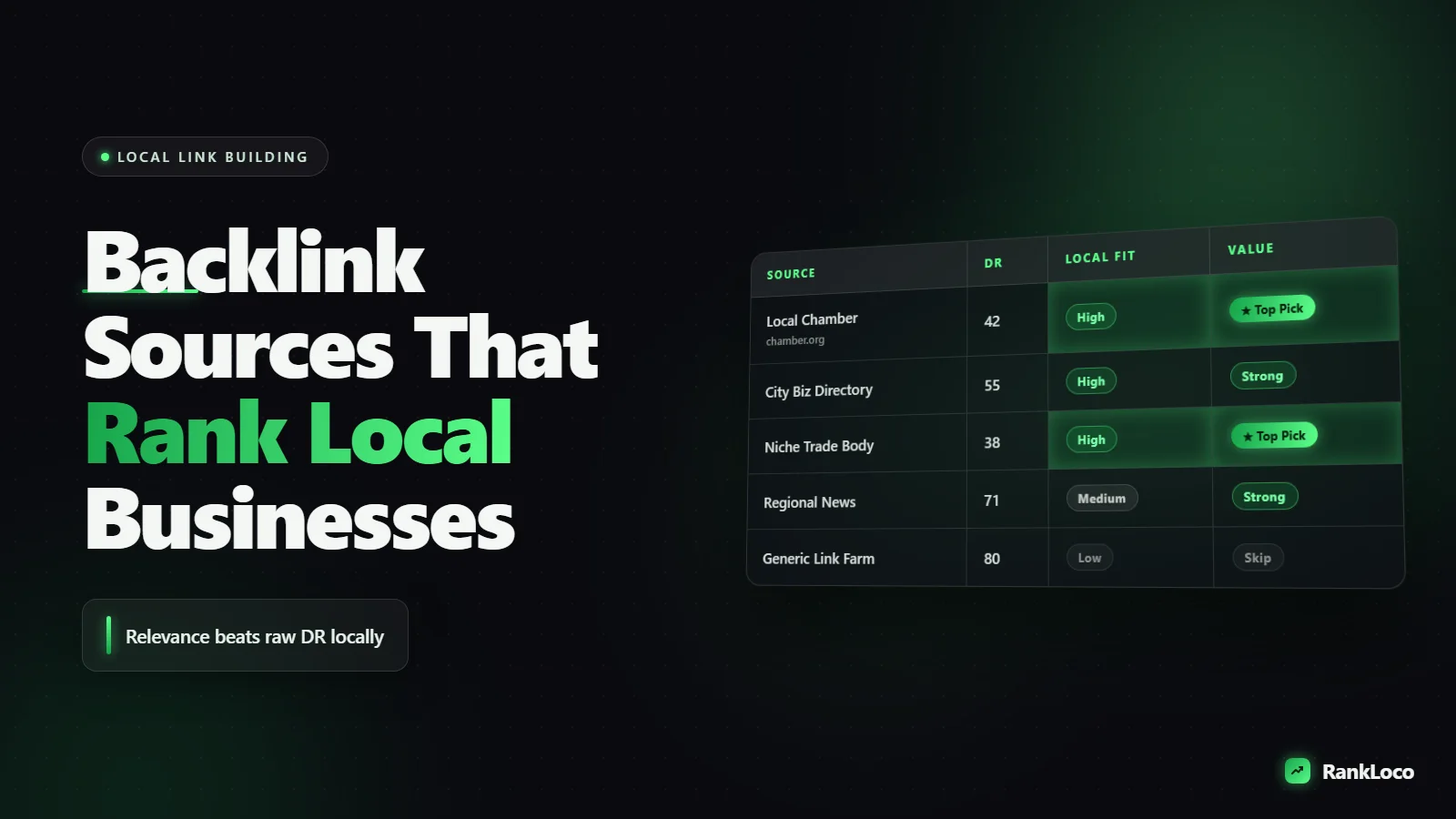
Forget buying links from random blogs in another country. For a plumber, HVAC company, roofer, dentist, or law firm, relevance and location beat raw authority almost every time. A link from your city's chamber of commerce does more for a local service business than a generic guest post on a high-DR site that has nothing to do with your town or trade.
Why local relevance beats raw domain authority for service businesses
Google's local algorithm leans heavily on three things: relevance, distance, and prominence. Backlinks feed prominence, but for local search the signal is strongest when the linking site is also local or industry-specific. A link from a site in your service area tells Google you operate there. A link from a trade body tells Google you're a legitimate player in your field.
This changes your whole link strategy. Instead of chasing the highest Domain Rating you can find, you chase links that a competing business in your city would struggle to replicate. Those are the links that actually move you up the pack.
Local citations and business directories
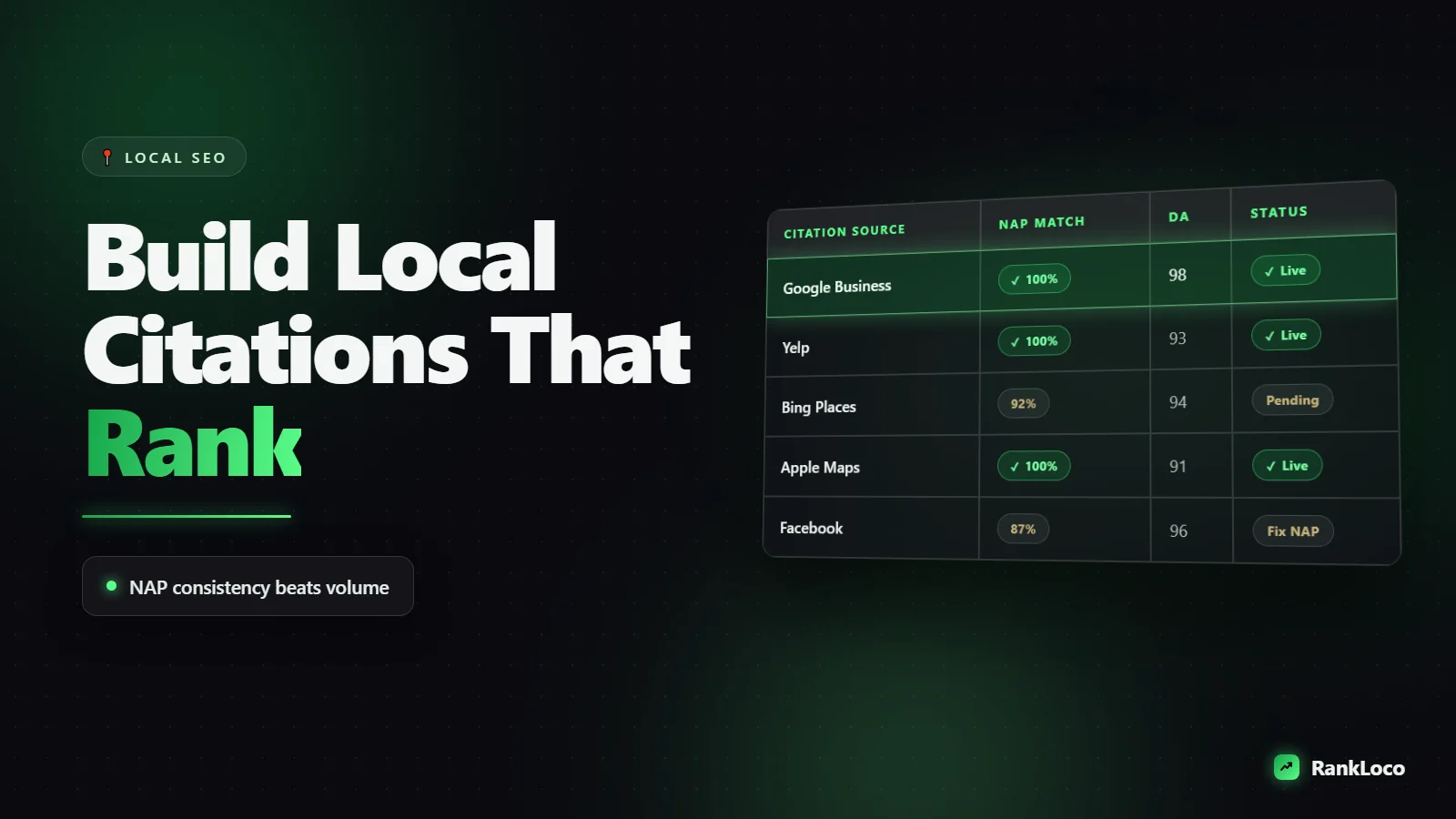
Citations are mentions of your business name, address, and phone number (NAP), usually with a link. They're the foundation of local link building because they're easy to get and they reinforce your location.
The citation sources worth your time
- Google Business Profile: Not a backlink, but non-negotiable. Claim and fully optimize it first.
- Core aggregators and directories: Yelp, Bing Places, Apple Business Connect, Yellow Pages, Facebook, and Nextdoor.
- Industry-specific directories: Angi, Houzz, and Thumbtack for home services; Avvo and Justia for lawyers; Healthgrades and Zocdoc for medical.
- Local directories: Your city's business listing sites, local blogs with directory sections, and regional chamber directories.
The rule that matters more than volume: keep your NAP identical everywhere. Same spelling, same suite number, same phone format. Inconsistent citations confuse Google and dilute the benefit. If your business runs from home or has no storefront, read our guide on how to rank a local business without a physical store address before you blast out citations.
Supplier, vendor, and partner backlinks
This is the most underused link source for service businesses, and it's close to free. The companies you already pay money to often have a dealer locator, a "where to buy," or a partners page. Ask to be listed.
- A contractor who installs a specific brand of windows, HVAC units, or flooring can get listed on the manufacturer's "find an installer" page.
- A pest control or cleaning company using a certified product line can appear on the product's certified-pro directory.
- Software and franchise relationships almost always have partner directories.
These links are powerful because they're relevant to your trade and usually sit on established, trusted domains. Make a list of every brand, supplier, and software you pay for, then email each and ask: "Do you have a dealer or installer directory I can be added to?" Most say yes.
Local sponsorships, events, and community links
Sponsor something local and you earn a link plus genuine community goodwill. These are hard for competitors to copy because they require actual money or participation.
Sponsorship link opportunities
- Youth sports teams and leagues: Most post a sponsors page with logos and links.
- Local charity runs, food drives, and fundraisers: Event pages list and link donors.
- School booster clubs and PTAs: Often link sponsors on their sites.
- Local festivals and chamber events: Vendor and sponsor pages carry links.
- Scholarships: Offer a small local scholarship and get listed on school resource pages (do this authentically, not as a link scheme).
To find these, search Google for things like "your city" + sponsors, "your city" + "our sponsors", or "your city" + event + donate. These search operators surface pages that already link to local sponsors, which means they're proven to link out.
Trade associations and professional memberships
Nearly every trade has a national or regional association with a member directory: the local bar association, a plumbing and heating contractors group, a realtor board, a dental society. Membership usually comes with a profile and a backlink from a highly relevant, high-trust domain.
Beyond the association itself, look at licensing boards, certification bodies (think NATE for HVAC or specific manufacturer certifications), and the Better Business Bureau. These carry strong trust signals that help both rankings and conversions, since real customers check them too.
Local press, news, and journalist outreach
Local newspapers, regional business journals, and neighborhood news sites are hungry for stories. You don't need to be famous to earn coverage.
- Pitch a local angle: A free service day for seniors, hiring in the area, or a response to a seasonal problem (frozen pipes in winter, AC failures in a heat wave).
- Use HARO-style services: Respond to journalist queries where you can offer expert commentary in your trade.
- Provide expert quotes: Reporters covering home improvement, health, or legal topics need credible local sources.
One local news feature can earn a link that outranks dozens of directory links. It also drives real referral traffic and phone calls.
Reclaiming mentions and competitor link gaps
Two tactics squeeze more links out of work you've already done or your competitors have done for you.
First, find places that mention your business name without linking to you (a local blog post, an event recap, a review roundup) and ask for the link to be added. This is one of the fastest wins in SEO. We break down the full process in our guide on finding and reclaiming unlinked brand mentions.
Second, study the businesses outranking you. If a competing roofer has links from three local directories and two supplier pages you're missing, that's your target list. Run their profile through a tool and work the gaps methodically. Here's how to analyze a competitor backlink profile to find opportunities without wasting hours.
Comparison: which local backlink sources deliver the most
| Source | Effort | Cost | Local relevance | Durability |
|---|---|---|---|---|
| Citations and directories | Low | Free to low | High | High |
| Supplier and partner pages | Low | Free | Very high | Very high |
| Local sponsorships | Medium | Low to medium | Very high | Medium |
| Trade associations | Low | Membership fee | Very high | Very high |
| Local press | High | Free | High | Very high |
| Unlinked mention reclaim | Low | Free | Varies | High |
A 30-day local link building checklist
- Week 1: Claim and fix your NAP across the top 10 directories for your industry and city.
- Week 1: List every supplier, brand, and certification you hold. Email each asking for a directory listing.
- Week 2: Join your chamber of commerce and relevant trade association. Complete your member profile with a link.
- Week 2: Run a competitor backlink analysis and build a target list of links you're missing.
- Week 3: Search for local sponsor pages and pick one or two events or teams to sponsor.
- Week 3: Find unlinked brand mentions and send reclaim requests.
- Week 4: Pitch one local story or expert quote to a regional publication.
- Ongoing: Track which new links correlate with ranking movement.
If you're starting with zero budget, pair this with our deeper playbook on how to get backlinks for a small business website with no budget. And if you're deciding between outreach styles, our breakdown of guest posting vs broken link building helps you spend time where it pays off.
Don't forget reviews and the Map Pack connection
Links are only one prominence signal. For local service businesses, reviews carry enormous weight in the Map Pack, often more than a handful of extra backlinks. Build your link profile and your review flow in parallel. See our guide on how to get more Google reviews to rank higher locally, and if you operate across several cities, read how to rank in the Google Map Pack for a multi-location business.
Measure what actually moves rankings
Link building without measurement is guessing. After each batch of links goes live, watch your target keyword positions over the following weeks. Some sources will clearly move the needle and others won't, and that tells you where to double down. Use RankLoco to track your local keyword rankings over time and tie ranking jumps to the links you built. For the process side, here's how to track keyword rankings over time to measure progress. You can also find more local SEO playbooks across the RankLoco blog, or start a free audit on the RankLoco homepage.
Frequently Asked Questions
How many backlinks does a local service business need to rank?
There's no fixed number. Most local service businesses rank well with 20 to 50 relevant, location-tied links, not hundreds. Relevance and consistency matter far more than volume. Matching or slightly beating the link quality of the businesses in your Map Pack is a realistic target.
Are paid directory listings worth it for local SEO?
Some are. Industry directories like Angi, Houzz, or Avvo can drive both links and real leads, which can justify the fee. Avoid low-quality paid directories that exist only to sell links, since they offer little relevance and can look spammy. Judge each by whether real customers actually use it.
Do nofollow links from directories still help local rankings?
Yes, in a local context. Even nofollow citations reinforce your NAP consistency and business legitimacy, which supports Map Pack prominence. A natural profile includes a mix of followed and nofollow links. Don't skip a relevant local listing just because the link is nofollow.
How fast will new backlinks improve my rankings?
Expect weeks, not days. Google needs to crawl the linking page, index it, and factor the link into its calculations, which can take two to eight weeks. Local rankings also fluctuate daily, so track movement over a month or more before judging whether a link source worked.
Can I get local backlinks if I run a home-based business with no storefront?
Yes. Supplier pages, trade associations, sponsorships, and press don't require a public address. Use a service-area business setup in Google Business Profile and keep your NAP consistent. Many of the best local backlink sources never display or depend on a physical location.
Should I use the same anchor text for all my local backlinks?
No. Over-optimized anchor text that repeats your exact keywords looks manipulative. Let anchors vary naturally between your brand name, your URL, and plain phrases. The same principle applies to your own site, which you can learn in our guide on optimizing anchor text for internal links without over-optimizing.