How to Find and Reclaim Unlinked Brand Mentions for Backlinks
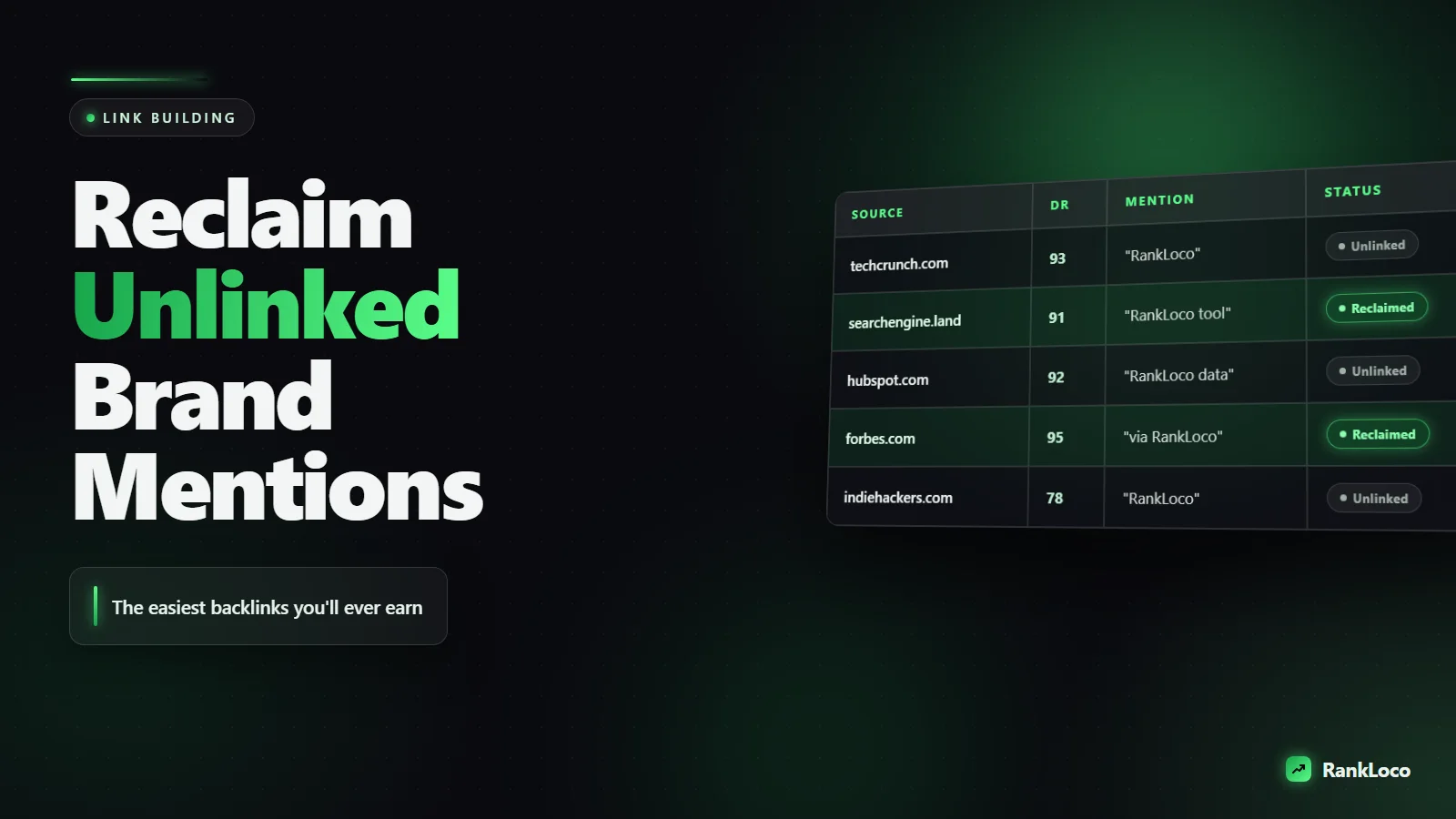
To find unlinked brand mentions, search Google for your brand name in quotes while excluding your own domain (for example: "RankLoco" -site:rankloco.com), set up Google Alerts and a mention monitoring tool to catch new ones, then check each result to see if the mention links back to you. When you find a mention with no link, email the author with a short, specific request to add one. These are the easiest backlinks you will ever earn because the site already talked about you on purpose.
Unlinked mentions are the lowest-hanging fruit in link building. Someone already decided your brand, product, or founder was worth naming. They just forgot to hyperlink it. Your job is to find those spots and ask. Conversion rates on this outreach are far higher than cold link requests, because you are not begging for a favor, you are offering to make their content more useful.
What counts as an unlinked brand mention
An unlinked mention is any place online that names you without linking to your site. The most valuable types to chase:
- Brand name mentions: "We switched to [YourBrand] last year" in a blog post or roundup.
- Product or feature mentions: someone describing a tool or feature you own by name.
- Founder or team mentions: quotes, interviews, or references to key people.
- Data or research citations: a site referencing a study, stat, or report you published.
- Image or asset use: someone using your chart, infographic, or screenshot without crediting the source.
- Misspellings and variations: common typos of your brand that still clearly reference you.
Not every mention is worth your time. A spammy scraper site or a forum comment buried on page 40 is not going to move your rankings. Focus on pages on real sites with their own traffic and some domain authority.
How to find unlinked brand mentions (step by step)
1. Run advanced Google searches
This is free and surprisingly effective. Open Google and run searches like these, swapping in your real brand:
- "YourBrand" -site:yourbrand.com finds mentions anywhere except your own site.
- "Your Founder Name" -site:yourbrand.com catches interviews and quotes.
- "YourProductName" -site:yourbrand.com finds product references.
- "YourBrand" -site:yourbrand.com -site:twitter.com -site:facebook.com strips out social noise.
Work through the results page by page. For each one, open the page and use Ctrl+F to find your brand name, then check whether it is hyperlinked. If the text is plain, you have found an unlinked mention. Add the URL to a spreadsheet.
2. Set up Google Alerts for ongoing monitoring
Finding mentions once is good. Catching them as they publish is better, because fresh pages are easier to edit and the author still remembers writing about you. Create Google Alerts for your brand name, product names, founder names, and common misspellings. Set delivery to "as it happens" or daily. When an alert lands, check the page for a link the same way.
3. Use a mention monitoring or backlink tool
Google Alerts misses plenty. A dedicated tool crawls more sources and lets you filter by domain authority so you are not wading through junk. This is where it helps to already understand your link landscape. If you have been through the process of how to analyze a competitor backlink profile to find opportunities, you already know how to read a backlink report, and the same skills apply here: filter, prioritize by authority, ignore spam.
You can also monitor mentions alongside your rankings. RankLoco lets you track which pages mention your brand and watch how newly earned links move your positions over time, so you can see which reclaimed links actually pay off.
4. Reverse image search your visual assets
If you publish original charts, infographics, product photos, or screenshots, people reuse them. Drop your most-shared images into Google Images reverse search (or search by image URL) to find every page using them. Many will use the image with zero credit. Those are prime reclamation targets: ask for a source link under the image.
5. Check scholarly and news databases for citations
If you have ever published original research or data, search Google News and Google Scholar for the stat or report title in quotes. Journalists and bloggers cite numbers constantly without linking to the source. A quick email pointing them to the original is usually welcomed.
Build a prioritized mention spreadsheet
Dump everything into one sheet so you can work it like a pipeline. Track these columns:
| Column | What to record |
|---|---|
| Page URL | The exact page where the mention appears |
| Domain | Root domain for dedupe and authority checks |
| Mention type | Brand, product, founder, data, image |
| Authority | Rough domain strength (skip anything tiny or spammy) |
| Contact | Author email, editor email, or contact form |
| Status | Found, emailed, followed up, linked, declined |
| Target URL | The exact page on your site you want them to link to |
Deciding the target URL matters. Point the link to the most relevant page, not always your homepage. If someone mentions a specific product, link to that product page. If they cite a stat, link to the post with the data. A relevant deep link is more valuable and easier for the author to justify adding.
How to reach out and reclaim the link
The outreach is simple because your ask is reasonable. Keep it short, specific, and free of marketing fluff. Find the right person first: the article author if there is a byline, otherwise an editor or the general contact. Here is a template that works:
Subject: Quick fix on your [topic] article
Hi [Name], thanks for mentioning [Brand] in your piece on [topic] ([link to their page]). Noticed the mention isn't linked. Would you mind pointing it to [your target URL]? Makes it easy for your readers to find us. Either way, appreciate the shout-out.
Why this works: you lead with a genuine thank you, you make the fix trivial (one link, one URL), and you close without pressure. Do not send a wall of text or attach a media kit. The easier you make it, the higher your conversion.
Follow up once, then move on
About a quarter of your wins come from a single polite follow-up. Wait five to seven business days, reply to your own thread, and keep it to one line: "Just floating this back to the top of your inbox in case it got buried." If they do not respond after that, mark it declined and move on. Chasing further burns goodwill.
Which mentions convert best
Not all requests get yes. In practice, these convert highest:
- Recent posts: published in the last few months, so the author is still engaged.
- Positive or neutral context: they said something good or factual about you.
- Editorial sites with bylines: a named author you can email directly.
- Data and image reuse: adding a source link is clearly the right thing to do.
Lower conversion: huge publications with locked CMS workflows, old archived posts, and anything behind a generic info@ inbox. Still worth a shot, just set your expectations.
Make this a repeatable system, not a one-off
The first sweep clears your backlog. After that, the goal is to catch mentions as they happen so reclaiming becomes a 10-minute weekly habit. Block time every week to review alerts, log new mentions, and fire off two or three outreach emails. New mentions are far easier to convert than six-year-old archive pages.
Unlinked mention reclamation pairs well with other low-cost link tactics. If you are building links on a tight budget, combine it with the plays in our guide on how to get backlinks for a small business website with no budget, and weigh it against other outreach methods in our breakdown of guest posting vs broken link building for small sites. For more link and ranking tactics, browse our full library of SEO guides, or check RankLoco if you want to monitor mentions and rankings in one place.
Track the results so you know it is working
Reclaimed links are only worth the effort if they move something. Note the date each link goes live, then watch two things: whether the linking page starts sending referral traffic, and whether your target page gains positions for its main keywords. New backlinks can take weeks to be crawled and credited, so do not expect overnight jumps. Keeping a consistent record of rankings before and after lets you prove the ROI and justify spending more time on it. Our walkthrough on how to track keyword rankings over time to measure progress covers the setup.
Common mistakes to avoid
- Asking for links from negative mentions: if someone criticized you, a backlink amplifies that page. Skip it.
- Sending identical bulk emails: reference the specific article and the specific sentence. Generic outreach gets deleted.
- Linking everything to the homepage: match the link to the context for more relevance and higher acceptance.
- Ignoring domain quality: a link from a scraper or link farm can hurt. Prioritize real sites.
- Giving up after one send: one follow-up roughly doubles your response rate.
Frequently Asked Questions
Are unlinked brand mentions worth chasing for SEO?
Yes. They have one of the highest conversion rates in link building because the site already chose to mention you. You are not cold-pitching a stranger, you are asking an existing fan for a tiny edit. A batch of relevant editorial links from real sites can meaningfully lift rankings for the pages you point them to.
How often should I search for new brand mentions?
Run a full manual sweep quarterly and rely on Google Alerts plus a monitoring tool to catch new mentions daily or weekly in between. New mentions are the easiest to convert because authors still remember writing the piece, so acting fast while the content is fresh gets you more yeses.
What is the difference between a linked and unlinked mention?
A linked mention is when a site names your brand and hyperlinks the text to your website, passing SEO value. An unlinked mention names you as plain text with no hyperlink. Unlinked mentions give you brand visibility but no direct link equity, which is exactly why reclaiming them is worthwhile.
Do I need a paid tool to find unlinked mentions?
No. Google advanced search operators plus free Google Alerts will find most mentions on real sites at zero cost. A paid tool saves time, crawls more sources, and lets you filter by domain authority, but a small business can run this entire process for free with a spreadsheet and a few searches a week.
How do I find the right contact to email?
Check the article for a byline and look up that author's email on the site's about or team page, LinkedIn, or a free email finder. If there is no byline, use the editor or a topic-relevant contact rather than a generic info@ inbox. Emailing the actual person who wrote the piece gets far better response rates.
What should I do if a site refuses to add the link?
Thank them anyway and move on. A no is not a loss: the mention still builds brand awareness, and burning the relationship by pushing harder can cost you future coverage. Keep them in your spreadsheet marked declined, and focus your energy on the many mentions that will convert.