Guest Posting vs Broken Link Building: Which Is Better for Small Sites?
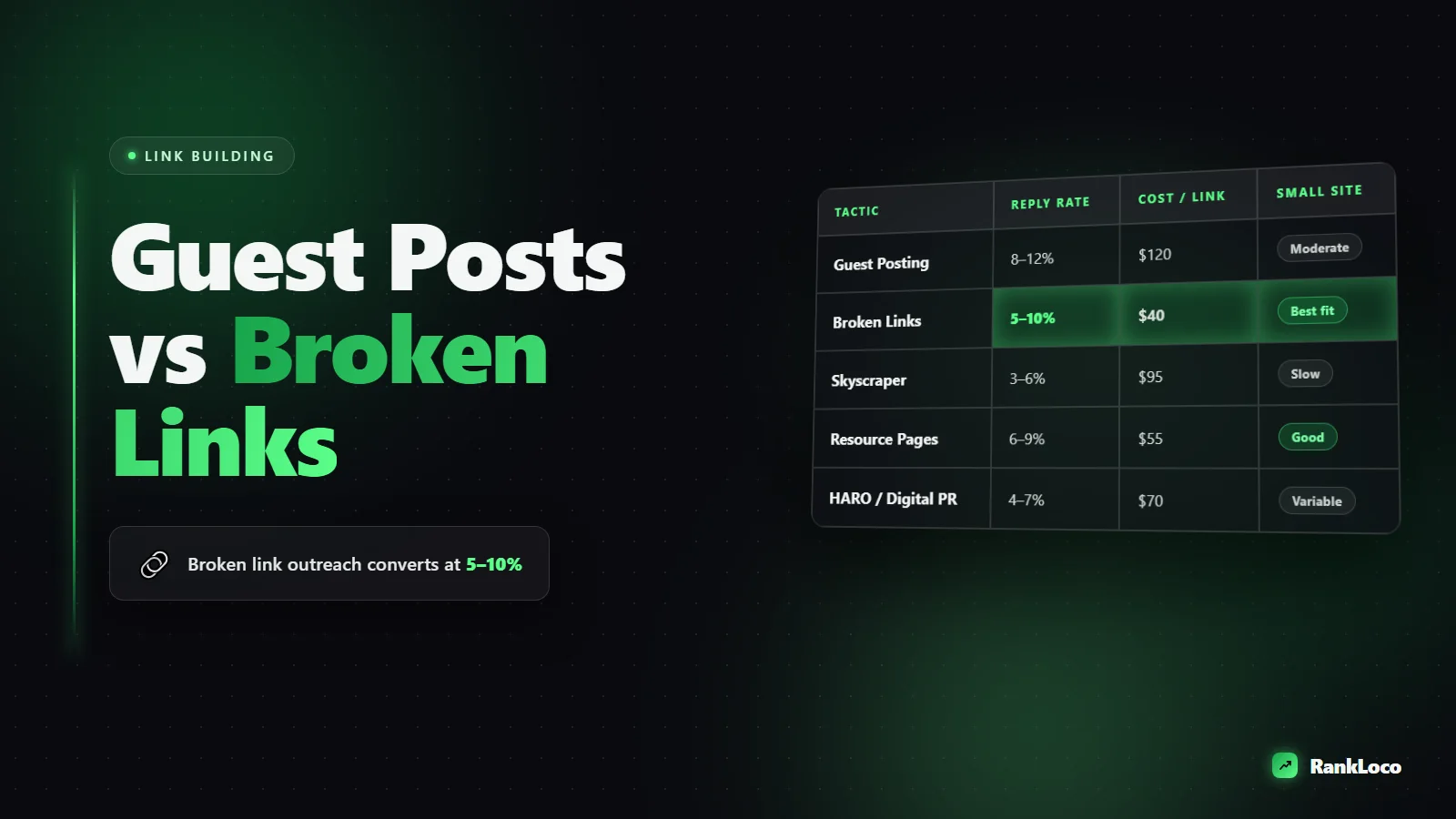
For most small sites, guest posting is the better starting point because it gives you full control over the anchor text, the surrounding content, and the page it lives on, and it reliably lands links even from a standing start. Broken link building produces cleaner, more editorial links and scales better once you have a decent replacement asset, but it converts at a lower rate and depends on your content already being good enough to swap in. The smart move is to lead with guest posting to build a foundation, then layer in broken link building once you have publishable assets worth linking to.
Below I break down both tactics on the metrics that actually matter for a small site: cost, speed, link quality, scalability, and risk. Then I show you exactly how to run each one so you can decide where to spend your limited hours.
What Each Tactic Actually Is
People throw these terms around loosely, so let's be precise before we compare them.
Guest posting
You write an article for another website in your niche, and in exchange you get a byline link and usually one or two contextual links back to your own pages. The site owner gets free content, you get a link and (sometimes) referral traffic. The link is embedded in content you wrote, which is why you control the anchor and the context.
Broken link building
You find dead links on other people's pages (links pointing to URLs that now return a 404 or a dead redirect), then you email the site owner, point out the broken link, and suggest your own working page as a replacement. You're doing them a favor by fixing their broken page, and the payoff is an editorial link inside content they already wrote.
Both are outreach-driven. Both require you to email strangers and ask for something. The difference is what you offer in return: with guest posting you offer labor (an article), with broken link building you offer a fix (a working replacement).
Guest Posting vs Broken Link Building: The Head-to-Head
| Factor | Guest Posting | Broken Link Building |
|---|---|---|
| Cost (time) | High per link (you write a full article) | Medium (you find links and pitch, no writing if asset exists) |
| Cost (money) | Often $0, but many sites now charge | Usually $0 |
| Speed to first link | Fast for small sites (many niches accept new writers) | Slower (lower reply and conversion rate) |
| Link control | High (you pick anchor and target page) | Low (site owner controls placement) |
| Link quality | Variable (depends on the host site) | Usually strong (aged, contextual, editorial) |
| Scalability | Limited by your writing time | Scales once you have a link magnet asset |
| Risk | Higher if you chase low-quality guest post farms | Low (natural, editorial by design) |
| Prerequisite | You need to be able to write | You need an existing page worth linking to |
Why Guest Posting Usually Wins for Brand-New Sites
If your site is young and thin on content, broken link building has a chicken-and-egg problem: you're asking someone to replace a broken link with your page, but your page has to be at least as good as what used to be there. If your library is bare, you have nothing to offer.
Guest posting sidesteps that. You don't need an existing asset. You just need the ability to write something useful for another site's audience. That makes it the faster path to your first few links when you're starting from zero.
Guest posting also gives you control that broken link building never will. You choose the anchor text (within reason), you choose which of your pages to link to, and you place the link in relevant context. When you're trying to move a specific money page or a new pillar article, that control is worth a lot. Just make sure the pages you point links at are already optimized, because a link to a weak page wastes the effort. If you haven't tightened up your on-page work yet, start with how to write SEO friendly blog content that reads naturally so the target page can actually convert the link into rankings.
Where guest posting goes wrong
- Chasing volume over relevance. A link from a generic "write for us" site in an unrelated niche does almost nothing. One link from a respected site in your exact niche beats ten from content farms.
- Paying for placements dressed up as guest posts. Plenty of sites now quietly charge. A single paid link isn't going to sink you, but building your whole profile on paid "guest posts" is a footprint Google can spot.
- Thin, spun content. If your guest article is garbage, editors won't publish it, and if it does go up, it won't drive anything. Treat every guest post like it's going on your own site.
Why Broken Link Building Produces Cleaner Links
The links you earn from broken link building tend to be higher quality for one simple reason: they're editorial. The site owner already decided that topic deserved a link. You're just updating the destination. That's exactly the kind of link Google is built to reward.
These links are also often on aged, established pages that already have authority and traffic. Replacing a dead resource link on a page that's ranked for years can pass real value, more than a fresh guest post on a page nobody has linked to yet.
The catch is conversion rate. Most of your outreach emails will be ignored. You need volume in your prospecting, a genuinely good replacement asset, and patience. It's a numbers game, but the numbers pay off once you have a page worth pointing people to.
Where broken link building goes wrong
- No replacement asset. If your closest page doesn't actually match what the broken link covered, your pitch falls flat. The replacement has to be a real substitute.
- Suggesting an obviously self-serving swap. If the broken link was to a free tool and you pitch your sales page, you'll get ignored. Match content type to content type.
- Giving up after 20 emails. A 5 to 10 percent success rate is normal. You need to prospect hundreds of pages to build a meaningful number of links.
How to Run a Guest Posting Campaign Step by Step
- Build a target list. Search your niche plus terms like "write for us," "guest post," or "contribute." Better: find sites already linking to your competitors and pitch them, because they clearly link out to sites like yours. Here's how to analyze a competitor backlink profile to find opportunities.
- Qualify each site. Is it actually in your niche? Does it get organic traffic? Does it link out with normal, dofollow links? Skip anything that reads like a link farm.
- Pitch a specific topic. Don't send "can I write for you." Send three concrete headline ideas that fill a gap on their site. Show you read it.
- Write something you'd publish yourself. Real value, real examples, no fluff. Editors remember good writers and invite them back.
- Place your link contextually. One or two links max, pointing to genuinely relevant pages, with natural anchor text. No exact-match anchor stuffing.
How to Run a Broken Link Building Campaign Step by Step
- Find resource pages and dead links in your niche. Search for "[your topic] resources" or "[your topic] links" and scan those pages for dead links using a broken-link checker. Competitor backlink profiles also surface links pointing to dead URLs you could replace.
- Confirm the link is actually broken. Load the URL. A 404, a parked domain, or a timeout all qualify.
- Check what the dead page used to be about. Use the Wayback Machine to see the original content so your replacement genuinely matches.
- Match or create the replacement asset. If you already have a page that fits, great. If not, note the gap. This is where a content gap analysis against your competitors helps you decide what's worth building.
- Send a short, helpful email. Point out the exact broken link, mention you noticed it while reading (be specific), and offer your page as a fix. Keep it under six sentences.
- Follow up once. A single polite follow-up after a week roughly doubles replies. Don't nag beyond that.
The Verdict: What Small Sites Should Actually Do
Don't pick one forever. Sequence them.
- Months 1 to 3: Lead with guest posting. It's the fastest way to get your first links and referral traffic when you have little content to leverage. Use it to point authority at your best pages.
- Months 3 onward: As your content library grows, add broken link building. Now you have real assets to offer as replacements, and the editorial links compound your foundation.
- Always: Combine both with the no-budget basics like digital PR, unlinked mentions, and directory citations. See more tactics in our guide to getting backlinks for a small business with no budget.
Whichever mix you run, track whether the links are actually moving rankings. Building links without measuring outcomes is how people waste months. Set up rank tracking in RankLoco so you can watch your target keywords move after each batch of links lands, and read how to track keyword rankings over time to measure progress so you attribute gains to the right work.
For more link building and on-page playbooks, browse the rest of our SEO guides.
Frequently Asked Questions
Is guest posting still effective for SEO in 2025?
Yes, when done right. Relevant, high-quality guest posts on niche sites with real audiences still pass value and drive referral traffic. What no longer works is mass-producing thin guest posts on unrelated content farms for the link alone. Focus on relevance and content quality, and it remains one of the most reliable link sources for small sites.
How many links can I realistically get from broken link building?
Expect roughly a 5 to 10 percent success rate on qualified outreach. If you prospect 200 good broken-link opportunities and send solid pitches, that's about 10 to 20 links. The number climbs when your replacement asset is clearly better than what was there before, so invest in one strong page rather than spraying weak pitches.
Are guest post links or broken links safer with Google?
Broken link building is inherently lower risk because the links are editorial by design: the site owner chose to link and you only updated the destination. Guest posting is safe when the content is genuine and relevant, but risky if you rely on paid or spun placements at scale. Keep your anchor text natural in both cases.
Do I need a paid tool to find broken links?
Not to start. Free browser extensions and broken-link checkers will scan resource pages, and the Wayback Machine shows what dead pages used to contain. A paid backlink tool speeds up prospecting by revealing which dead URLs already have many links pointing at them, but you can run a small campaign entirely with free tools first.
Should a brand-new website do link building at all yet?
Do a little, but content comes first. A new site with five thin pages has nothing worth linking to. Publish 10 to 15 solid articles targeting achievable keywords, then start guest posting to build initial authority. If you're picking targets, see how to find low competition keywords for a brand new website before you chase links.
How long until link building shows up in rankings?
Usually 4 to 12 weeks after links are indexed and crawled, depending on competition and your page's existing strength. Links to already-optimized pages move faster. Track the specific keywords tied to each linked page so you can tell whether the link worked, rather than judging your whole site's traffic at once.