What Is a Good Click Through Rate for Organic Search Results
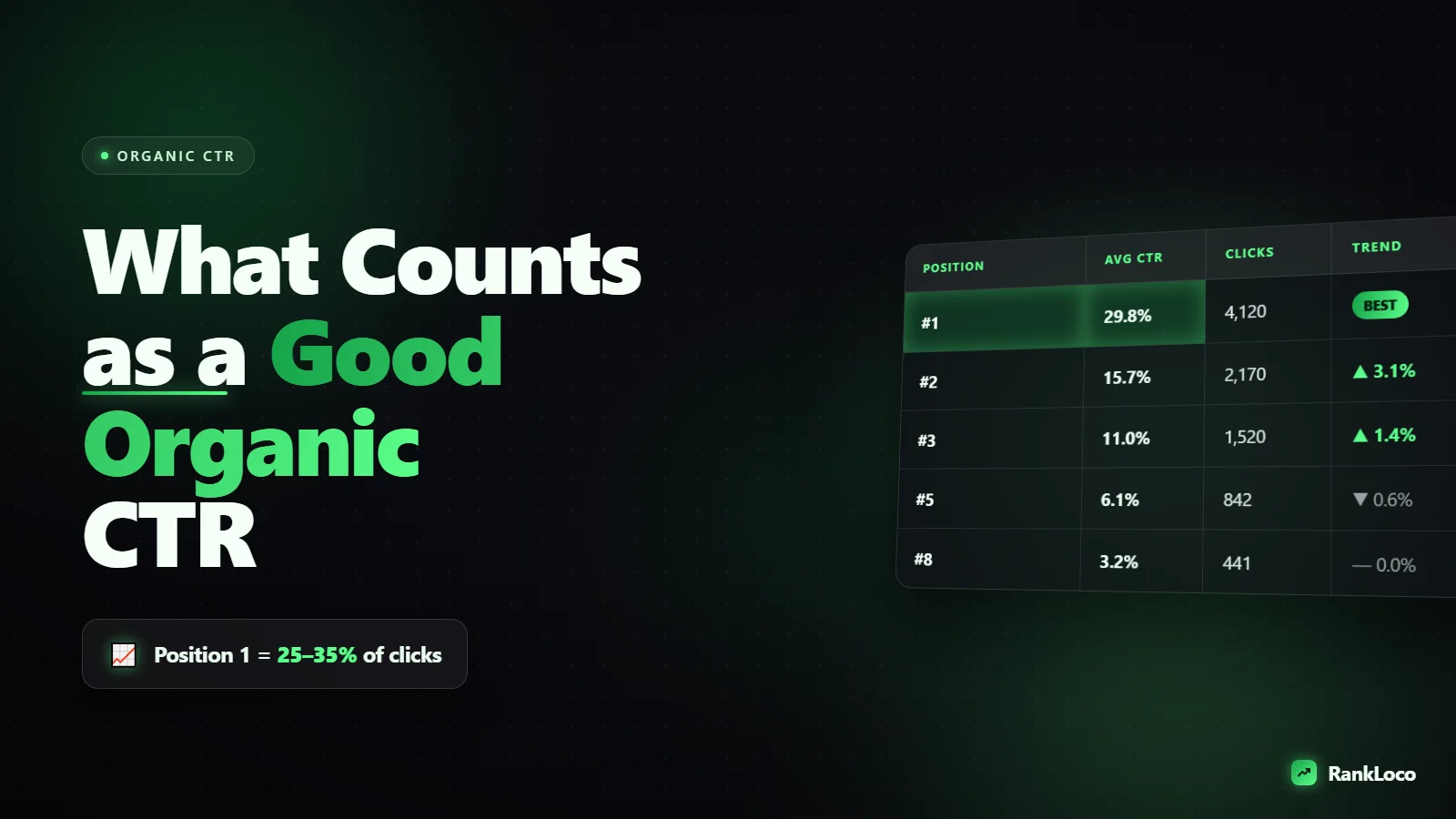
A good organic click through rate (CTR) depends almost entirely on your ranking position. For position 1, a healthy CTR is roughly 25 to 35 percent. Position 2 to 3 lands around 10 to 20 percent, and anything past position 5 usually sits under 5 percent. The honest answer: "good" means beating the expected CTR for the position you actually hold, not hitting some universal number.
Below I will give you real benchmarks by position, show you how to find your true CTR in Google Search Console, and walk through what to do when your numbers are lower than they should be. CTR is one of the few SEO metrics you can improve without building a single link, so it is worth getting right.
Organic CTR Benchmarks by Search Position
Every CTR study shows the same shape: clicks collapse fast as you move down the page. The exact percentages vary by industry and search type, but these ranges are reliable enough to judge your own pages against.
| Average position | Typical organic CTR |
|---|---|
| 1 | 25% to 35% |
| 2 | 12% to 18% |
| 3 | 8% to 12% |
| 4 | 5% to 8% |
| 5 | 3% to 6% |
| 6 to 10 | 1% to 3% |
| Page 2 (11 to 20) | under 1% |
Use these as a sanity check, not gospel. The point is relative: if you rank number 1 and your CTR is 8 percent, something is broken. If you rank number 6 and pull 5 percent, you are over-performing and that page deserves more effort to push it higher.
Why there is no single "good" number
Two pages ranking in position 3 can have wildly different CTRs. A query with a big AI overview, four ads, a featured snippet, and a People Also Ask box pushes your blue link far down the real estate, so your CTR drops even though your rank stayed the same. A clean, text-only SERP with no distractions gives that same position 3 a much higher CTR. Context changes everything.
What Affects Organic Click Through Rate
Before you try to fix your CTR, understand what actually moves it. Some of these you control. Some you do not.
- Ranking position. The single biggest factor. Moving from 5 to 3 does more for CTR than any title tweak.
- SERP features. Ads, featured snippets, AI overviews, image packs, map packs, and video carousels all steal clicks. The more crowded the SERP, the lower your realistic ceiling.
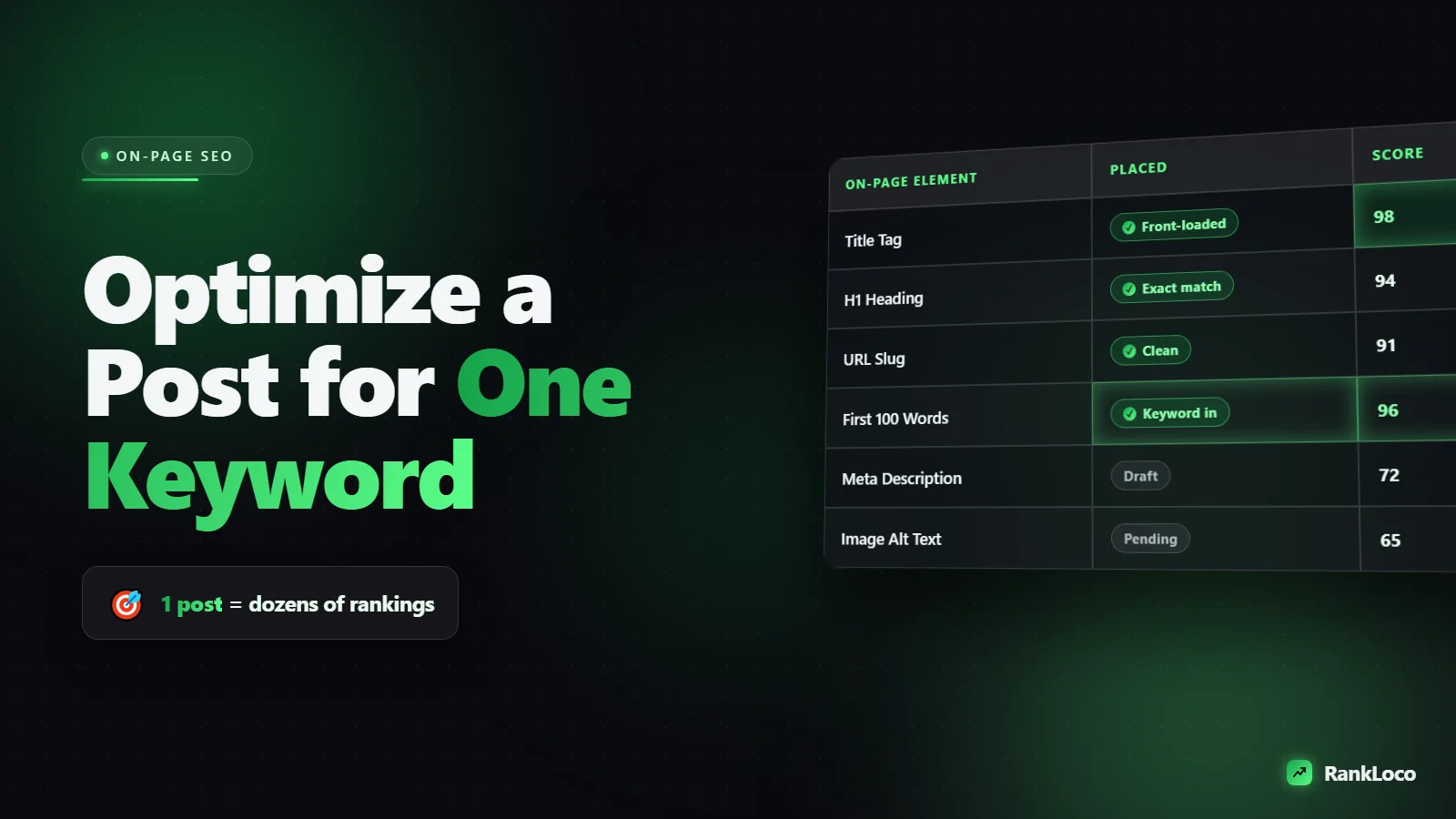
- Title tag and meta description. Your actual pitch to the searcher. This is the lever you control most directly.
- Search intent match. If your title promises something the searcher does not want, they skip you even at position 1.
- Brand recognition. Known brands get clicked more. A searcher who recognizes your name trusts the result.
- URL structure. A clean, readable URL signals relevance. Messy slugs with parameters look spammy.
- Rich results. Star ratings, FAQ snippets, recipe cards, and other schema can make your listing visually bigger and more clickable.
How to Find Your True Organic CTR in Search Console
Stop guessing. Google Search Console gives you exact CTR for every query and page, for free. Here is how to pull it properly.
- Open Search Console and go to the Performance report under Search results.
- Make sure Average CTR and Average position are both toggled on, alongside Clicks and Impressions.
- Set the date range to the last 3 months for a stable sample. Short windows are noisy.
- Switch to the Queries tab to see CTR per search term, or the Pages tab to see CTR per URL.
- Sort by impressions descending so you focus on the queries that actually matter.
Now compare each query's CTR against the benchmark for its average position. Any query where your CTR is clearly below the expected range is an opportunity. Flag those. They are your to-do list.
Watch for the averaging trap
Average position in Search Console is a blended number. A query showing "position 4.2" might actually rank 2 on desktop and 8 on mobile, averaged together. Before you panic about a low CTR, break the data down by device and country using the filters. A page with a great desktop CTR can look mediocre because mobile positions drag the average down. For a cleaner read on where you really rank, set up rank tracking by location and device so you are comparing CTR against accurate positions.
How to Spot an Underperforming Page
Here is the quick filter I use to find pages leaking clicks. A page is underperforming on CTR if all three are true:
- It has a meaningful impression count (at least a few hundred per month, otherwise the data is too thin).
- Its CTR is at least 30 percent below the benchmark for its average position.
- The SERP is not dominated by a feature you cannot win (if there is an AI overview and four ads above you, low CTR is expected, not a bug).
Pages ranking 5 to 10 with decent impressions are your sweet spot. You are already relevant enough to show up. A better title and description can earn clicks right now, and higher engagement sometimes nudges rankings up too.
How to Improve Your Organic CTR
Once you have your list of underperformers, work through these fixes. They are ordered from highest impact to lowest.
Rewrite the title tag to match intent and promise value
Your title is 80 percent of the click decision. Lead with the keyword, make the benefit obvious, and add a reason to pick you over the other nine results. Numbers, years, and specificity win. "Email Marketing Tips" loses to "11 Email Marketing Tips That Doubled Our Open Rate." Keep it under about 60 characters so it does not truncate. I go deep on exact formulas in this guide to optimizing meta titles and descriptions for higher CTR.
Write a meta description that sells the click
Google rewrites descriptions roughly 60 percent of the time, but when it keeps yours, a good one lifts CTR. Treat it as ad copy. State the payoff, address the searcher's problem, and include the keyword so it bolds in the results. Aim for 140 to 155 characters. Do not stuff it, just make a clear promise the page keeps.
Add structured data for rich results
Schema markup can make your listing physically bigger and more trustworthy with star ratings, FAQ dropdowns, and other enhancements. A result that takes up more vertical space and shows a 4.8 star rating pulls eyes and clicks. If you are on WordPress, you can add it manually following this walkthrough on adding schema markup without a plugin.
Clean up the URL slug
A short, readable URL that includes the keyword reinforces relevance right under your title. Searchers do scan it. Swap parameter-heavy or auto-generated slugs for clean ones that describe the page.
Target the featured snippet or People Also Ask
If you cannot beat the top organic result, win the box above it. Answer the core question in 40 to 55 words near the top of your page, use a clear question as a subheading, and structure lists and tables so Google can lift them. Capturing the snippet can quadruple your effective CTR from the same position.
Build brand familiarity
This is slow but real. The more a searcher sees your brand across the SERP, social, and other sites, the more likely they click you out of recognition. Consistent naming and showing up for related queries compounds over time.
Track CTR Changes Over Time, Not in a Vacuum
A single CTR snapshot tells you little. The signal is in the trend. After you rewrite a title, wait two to four weeks, then compare CTR for that query before and after while holding position roughly constant. If CTR rose and position did not drop, the change worked. If CTR fell, roll it back.
This is where a dedicated tool beats manual spreadsheet work. RankLoco lets you watch position and CTR trends together so you can tell whether a bump in clicks came from better copy or just a better ranking. For the broader framework, see how to track keyword rankings over time to measure progress, and make sure your GA4 setup is tracking organic search traffic so downstream conversions back up the click data.
When a Low CTR Is Actually Fine
Not every low CTR needs fixing. Context matters more than the raw number:
- Informational queries with instant answers. If the SERP answers the question in a snippet (like a conversion or a quick fact), nobody needs to click. Low CTR is normal and not your fault.
- Brand queries you do not own. Ranking for a competitor's brand name will always convert poorly.
- Very high positions on tiny-volume terms. A 10 percent CTR on a query with 15 impressions a month is noise. Ignore it.
- Crowded commercial SERPs. Four ads plus a shopping carousel caps your realistic ceiling. Judge yourself against organic-only expectations.
Focus your energy on high-impression queries where you rank in striking distance and the SERP is winnable. That is where CTR work pays off. For more guides on squeezing more traffic from the rankings you already have, browse the RankLoco blog.
Frequently Asked Questions
Is a 5 percent organic CTR good?
It depends on your position. At position 5 or 6, a 5 percent CTR is solid and roughly on benchmark. At position 1 or 2, 5 percent is poor and signals a weak title, a mismatched intent, or a SERP crowded with ads and features stealing your clicks. Always compare CTR against your actual ranking.
Does click through rate affect SEO rankings directly?
Google has stated CTR is not a direct ranking factor, and it is too easy to manipulate to trust as one. That said, a higher CTR means more traffic, more engagement signals, and more chances for links and shares, all of which can help indirectly. Improve CTR for the clicks, not because it magically boosts rank.
Why is my CTR dropping even though my rankings improved?
Usually the SERP changed. An AI overview, a new featured snippet, more ads, or a People Also Ask box can push your result lower on the visible page even when your organic position number went up. Check the live SERP for your query to see what is competing for attention above your listing.
How long does it take to see CTR improve after rewriting a title?
Give it two to four weeks. Google needs time to re-crawl the page, re-serve the new title across enough impressions, and accumulate a stable sample. Compare the same query's CTR before and after while position stays roughly constant so you isolate the effect of the copy change.
What is the average CTR for the number one organic position?
Across most studies, position 1 averages somewhere between 25 and 35 percent, though it ranges higher on clean informational SERPs and lower on crowded commercial ones. If you hold position 1 and sit well below 25 percent, your title and description are likely underselling, or SERP features are eating your clicks.
Does mobile or desktop have a higher organic CTR?
It varies by query, but mobile CTRs are often lower because the screen shows fewer results above the fold and more SERP features dominate the first scroll. Always segment your Search Console data by device before judging performance, since a blended average can hide a strong desktop CTR dragged down by mobile.