How to Do a Content Gap Analysis Against Your Competitors
A content gap analysis is the process of finding keywords and topics your competitors rank for that you don't, so you can create content to capture that traffic. To do one: pull the ranking keywords for 3 to 5 competitors, subtract the keywords you already rank for, filter the remaining list by relevance and search intent, then prioritize the gaps you can realistically win and build content around them. That's the whole game. Everything below is how to execute it without wasting a week on a spreadsheet nobody uses.
What a Content Gap Analysis Actually Finds
People confuse three different "gaps." Get these straight before you start or you'll chase the wrong thing:
- Keyword gaps: Specific search terms competitors rank for and you don't. This is the most common and most actionable.
- Topic gaps: Whole subject areas you haven't covered at all. A plumber with no page on "water heater repair" while every competitor has one.
- Content quality gaps: Pages you already have that rank on page 2 because a competitor's version is deeper, fresher, or better structured. These are often faster wins than net-new content.
A real analysis surfaces all three. Don't stop at the keyword export.
Step 1: Pick the Right Competitors (Not the Ones You Think)
Your business competitors and your search competitors are usually different companies. The site outranking you for "best crm for contractors" might be a review blog, not a rival software vendor. You want the sites that show up on page one for your money keywords.
Build your competitor list like this:
- Take your 10 most important keywords.
- Search each one (in an incognito window, set to your target location).
- Write down every domain that appears in the top 10 more than once.
- The domains that keep showing up are your real search competitors. Pick 3 to 5.
Mix in one "aspirational" competitor (a bigger site dominating your space) and two or three at your level. The big site shows you the full topic universe. The peers show you what's actually winnable. If you want to automate the tracking side of this, our guide on how to track competitor keyword rankings walks through the setup.
Step 2: Pull Competitor Keywords and Subtract Your Own
This is the core mechanic. You need two lists: everything your competitors rank for, and everything you already rank for. The gap is what's on their list but not yours.
With a tool like RankLoco, you enter your domain plus your competitor domains and it returns the keywords they rank for where you're absent or sitting past position 20. That's your raw gap list. If you're doing it manually, export each competitor's ranking keywords from a keyword tool, dump them into one sheet, remove duplicates, then remove any term where your site already ranks in the top 10.
Prefer free tools while you're getting started? We rounded up the best free keyword research tools for small business that can pull ranking data without a subscription. They're rougher but they get you a usable list.
What your raw gap list should contain
| Column | Why it matters |
|---|---|
| Keyword | The actual search term |
| Search volume | Rough monthly demand |
| Keyword difficulty | How hard it is to rank |
| Competitor position | Where they rank (top 3 means proven demand) |
| Your position | Blank, or a page 2+ ranking to improve |
| Ranking URL | The competitor page to study |
Step 3: Filter the Noise Out of Your Gap List
A raw export can be thousands of rows. Most of it is garbage for you: branded terms, irrelevant topics, keywords with zero commercial value. Cut hard.
- Remove competitor brand terms. You're never going to rank for their company name, and you don't want to.
- Remove off-topic keywords. A big competitor ranks for things unrelated to what you sell. Delete them.
- Kill zero-volume junk unless it's an obvious high-intent long-tail phrase where volume tools undercount. If you're unsure how to judge demand, here's how to estimate search volume without a paid tool.
- Flag terms two or more competitors rank for. When multiple rivals cover a topic and you don't, that's a validated gap, not a fluke.
What's left should be a few hundred keywords at most, all relevant to your business.
Step 4: Group Keywords by Topic and Intent
Don't plan one page per keyword. That's how you end up with 40 thin articles cannibalizing each other. Cluster the gaps into topics first.
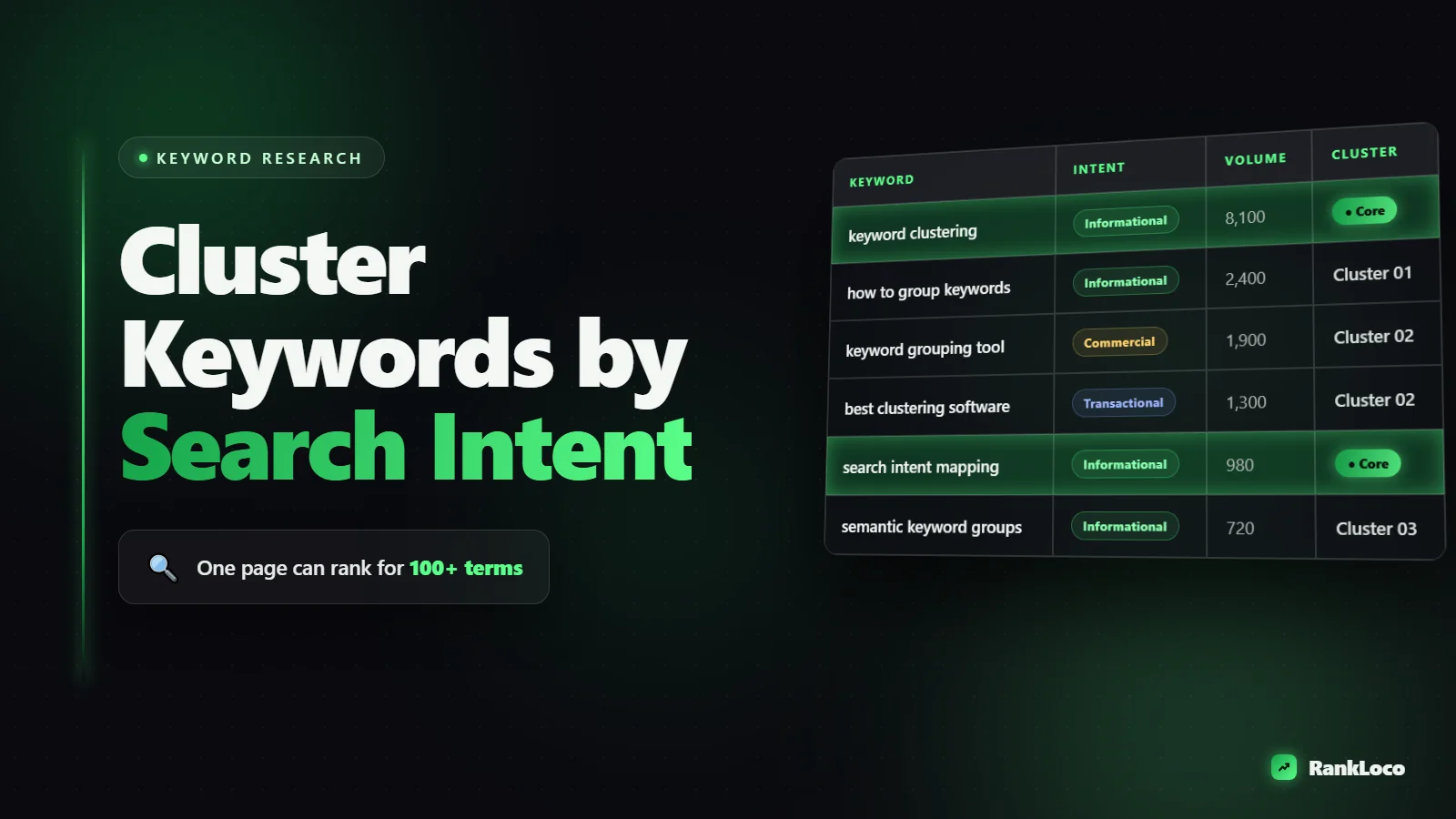
Sort your filtered list alphabetically and group terms that would be answered by the same page. "How to clean gutters," "gutter cleaning tips," and "clean gutters without a ladder" are one article, not three. Then tag each cluster by intent:
- Informational: how-to, what is, guides. Top of funnel, blog content.
- Commercial: best, top, reviews, comparisons. People close to buying.
- Transactional: buy, price, near me, service pages.
Intent decides the page type. A commercial "best" query needs a comparison page, not a how-to. Get this wrong and you won't rank no matter how good the writing is. Our breakdown of how to write a blog post outline from search intent shows how to match structure to what searchers actually want.
Step 5: Prioritize Gaps by Winnability, Not Just Volume
The biggest mistake in content gap analysis is charging at high-volume keywords a bigger site will always beat you on. Score every cluster on three factors:
- Business value (1 to 5): Does this keyword bring people who might buy? A high-volume informational term with no path to revenue scores low.
- Winnability (1 to 5): Can you actually rank? Look at difficulty, your domain strength, and who's ranking now. If the top 10 is all major brands, that's a 1.
- Demand (1 to 5): Search volume, banded not exact.
Add the scores, sort descending, and work top down. New or small sites should weight winnability hardest. Chasing low-competition terms first is how you build momentum. We cover finding those in the guide on low competition keywords for a new website.
A simple prioritization example
| Topic cluster | Value | Winnability | Demand | Total |
|---|---|---|---|---|
| Gutter guard comparison | 5 | 4 | 3 | 12 |
| How to clean gutters | 2 | 2 | 5 | 9 |
| Gutter repair cost | 4 | 4 | 3 | 11 |
The high-volume how-to loses to the two commercial topics because it's harder to win and drives fewer customers. Volume is not the tiebreaker. Fit is.
Step 6: Study the Ranking Pages Before You Write
For every cluster you're targeting, open the competitor URLs that rank for it. You're reverse-engineering what Google already rewards. Note:
- Format: listicle, tutorial, tool page, calculator, video-heavy?
- Depth: word count, subtopics covered, questions answered.
- What's missing: outdated info, no images, weak examples, no data, no FAQ. This is your angle to beat them.
Your goal isn't to copy the top result. It's to make the most complete, useful version of that page. Cover everything they cover, then add what they missed. When you write it, keep it readable and natural: our guide on how to write SEO friendly content that reads naturally keeps you from stuffing keywords and tanking the piece.
Step 7: Turn the Analysis Into a Content Plan
A gap list is not a plan until it has owners, deadlines, and target keywords per page. For each prioritized cluster, create a row with:
- Primary keyword and 3 to 5 secondary keywords
- Page type (blog post, service page, comparison)
- Target URL slug
- Internal links to add from existing pages
- Publish date and owner
Map each cluster to a single URL so you never target the same keyword with two pages. That's the fastest route to keyword cannibalization, which quietly caps your rankings. If you're organizing a lot of content, the process in our keyword mapping guide pairs perfectly with a gap analysis output.
For high-value clusters, don't publish one page and move on. Build a hub. Our walkthrough on how to turn one blog post into a topic cluster shows how to own a whole topic instead of a single keyword, which is what actually moves you past bigger competitors.
Step 8: Track, Measure, and Refresh
Content gap analysis isn't a one-time project. After you publish, watch the target keywords. Some will rank in weeks, some take months, and some won't move because you misjudged winnability. That's data, not failure. Use it to recalibrate the next round.
Set up rank tracking for your target keywords so you can see progress instead of guessing. The guide on how to track keyword rankings over time covers the cadence. Re-run the full gap analysis every quarter: competitors publish new content, you close old gaps, and new ones open up constantly.
Content Gap Analysis Checklist
- Identify 3 to 5 real search competitors from the SERPs, not your assumptions
- Pull their ranking keywords and subtract your own
- Filter out brand terms, off-topic, and zero-value keywords
- Cluster remaining keywords by topic and tag by intent
- Score each cluster on value, winnability, and demand
- Study the pages currently ranking for your top targets
- Map one target URL per cluster to avoid cannibalization
- Build content, add internal links, and track rankings
- Refresh the analysis every quarter
Do this properly and you stop guessing what to write. You have a prioritized queue of topics with proven demand that your competitors have already validated for you. For more playbooks like this, browse our SEO guides, or run your gap list through RankLoco to pull the competitor keyword data and track what you build.
Frequently Asked Questions
How often should I do a content gap analysis?
Run a full analysis quarterly. Competitors publish new content constantly and your own rankings shift, so a list from six months ago is stale. For fast-moving niches, monthly spot checks on your top competitors catch new opportunities before they get crowded.
Can I do a content gap analysis for free?
Yes, but it's slower. Use free keyword tools and Google Search Console to see what you already rank for, then manually check competitor pages and note topics you're missing. Free methods work fine for a handful of competitors; paid tools save hours when you're comparing large keyword sets.
How many competitors should I include in a content gap analysis?
Three to five is the sweet spot. Fewer than three and you miss topics; more than five and the list becomes unmanageable with too much noise. Include one larger aspirational site for the full topic map and a few peers at your level for winnable targets.
What's the difference between a keyword gap and a content gap?
A keyword gap is a specific search term a competitor ranks for and you don't. A content gap is broader: it includes missing topics, weaker existing pages, and format mismatches. Keyword gaps are one input into a full content gap analysis, not the whole thing.
Should I target keywords with high search volume first?
No. Prioritize by winnability and business value, not raw volume. A high-volume term dominated by major brands wastes months of effort. Low-competition keywords that attract buyers rank faster and drive revenue sooner, which is especially important for newer sites building authority.
How do I know if a content gap is worth pursuing?
Score it on three things: does it bring potential customers (value), can you realistically rank given the current SERP (winnability), and is there real search demand. If two or more competitors already rank for it, demand is validated. Pursue clusters that score high on all three.