How to Optimize Anchor Text for Internal Links Without Over Optimizing
To optimize anchor text for internal links, use descriptive phrases that tell both Google and readers exactly what the linked page is about, keep the phrasing varied across the site, and avoid stuffing the same exact-match keyword into every link. The goal is to pass topical relevance while reading naturally. Over-optimization happens when every internal link uses identical commercial keyword anchors, which looks manipulative and dilutes the signal.
Internal anchor text is one of the few ranking levers you fully control. Unlike backlinks, you decide the exact words that point from one page to another. Used well, it tells search engines which page should rank for which topic. Used badly, it confuses crawlers and wastes link equity. Here is how to get it right.
What internal anchor text actually does for SEO
Anchor text is the clickable words in a link. When you link from Page A to Page B, the words you use are a strong hint to Google about what Page B is about. Internal links do three jobs at once:
- Pass relevance signals. Descriptive anchors tell Google the topic of the destination page.
- Distribute link equity. Links funnel authority from strong pages to pages that need a boost.
- Guide users and crawlers. They create a path through your site so important pages get discovered and visited.
Because you control internal anchors completely, Google treats them a little differently from external backlinks. You can be more deliberate with keywords internally than you ever could with inbound links. But deliberate does not mean robotic. There is still a line, and crossing it hurts you.
How to write descriptive internal anchor text
The best internal anchor text describes the destination page in the words a person would use to search for it. If the target page is about reducing bounce rate, the anchor should contain some version of that idea, not "click here" and not a bare URL.
Use the target page's primary topic, not the exact title
You do not need to paste the full page title into the link. Pull the core concept. If the target ranks for "core web vitals WordPress," good anchors include "improve Core Web Vitals on WordPress" or "speed up your WordPress Core Web Vitals." Both carry the keyword without being identical.
Keep anchors between two and six words
One word is usually too vague. A whole sentence buries the signal. Two to six words hits the sweet spot: enough to be specific, short enough to stay readable. For example, when I want to point readers to a deeper resource, I write something like our guide on writing SEO friendly blog content rather than linking a ten word phrase.
Make the link make sense out of context
If someone skims your page and reads only the links, they should understand where each one goes. "Read this" fails that test. "How to track keyword rankings over time" passes it. Accessibility and SEO agree here.
How to avoid over-optimizing anchor text
Over-optimization is the trap. It happens when your internal links look engineered rather than editorial. Here is what triggers it and how to stay clean.
Do not use the same exact-match anchor everywhere
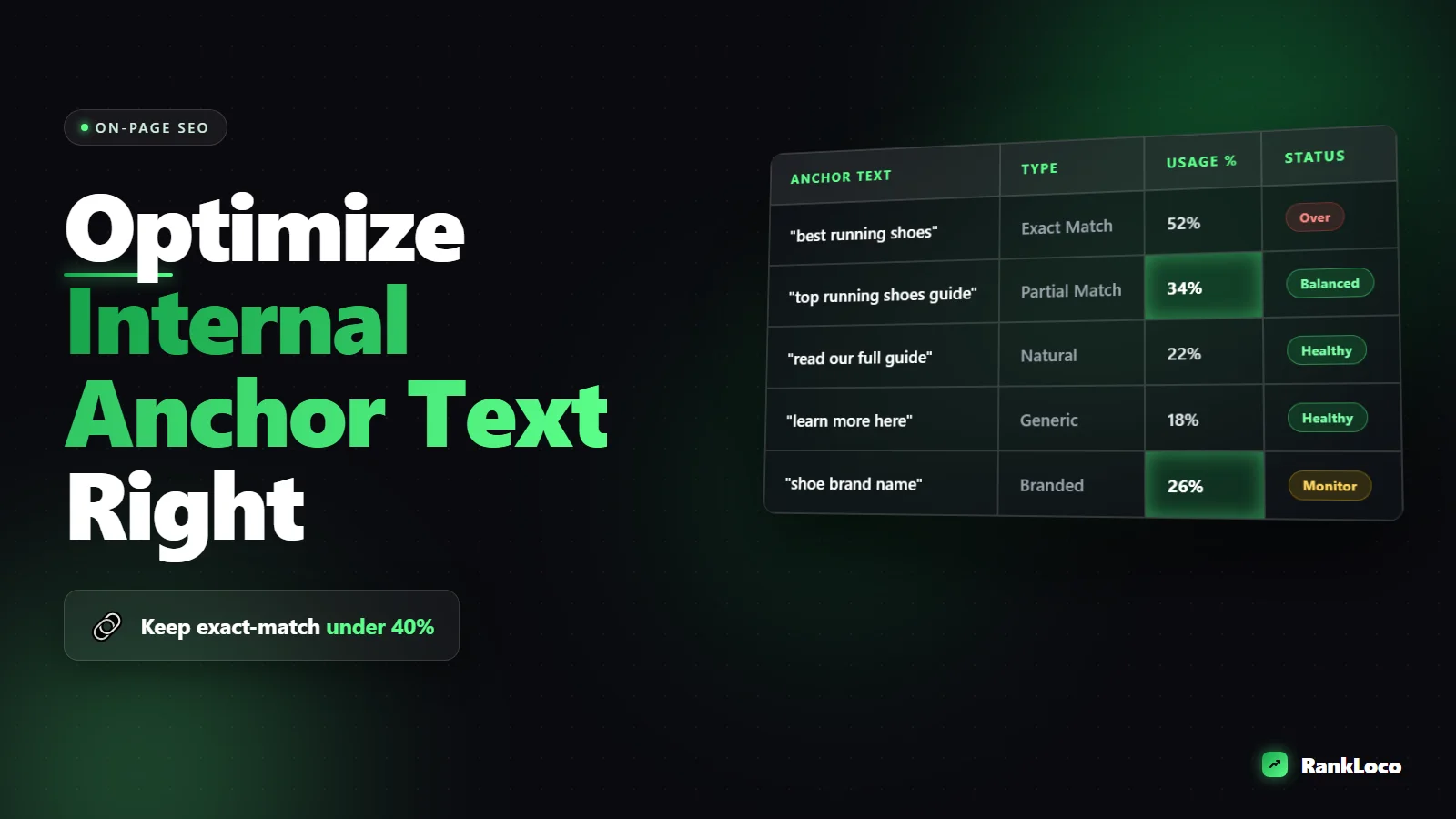
If forty pages all link to one page using the identical anchor "best running shoes," that pattern looks manufactured. Vary it. Use "best running shoes," "top running shoes for beginners," "choosing running shoes," and "running shoe buying guide" across different pages. Same destination, natural variety.
Build a healthy anchor text mix
A natural internal linking profile uses several anchor types. Aim for a spread rather than 100 percent keyword-rich anchors.
| Anchor type | Example | Rough share |
|---|---|---|
| Exact or partial keyword | optimize anchor text for internal links | 30-40% |
| Keyword variation | how to write better link anchors | 20-30% |
| Branded or descriptive | RankLoco rank tracker | 10-20% |
| Natural sentence phrase | this breakdown of search intent | 15-25% |
| Generic (use sparingly) | learn more, see the full guide | under 10% |
These are guidelines, not laws. The point is proportion. If every anchor on your site is an exact-match money keyword, you have a problem.
Match anchor intent to the destination
Do not point a keyword anchor at a page that has nothing to do with that keyword. If you anchor "content gap analysis" but link to your pricing page, you send a mixed signal that helps no one. Link the phrase to the page that actually covers it, like our walkthrough on how to do a content gap analysis.
Avoid stuffing multiple links to the same page in one block
Linking to the same destination three times in one paragraph with slightly different keyword anchors is a classic over-optimization tell. Google typically only counts the first link to a URL on a page anyway, so extra keyword-stuffed links just look spammy. One clear link per destination per page is plenty.
A practical internal anchor text workflow
Here is the process I run when optimizing internal links on a site, step by step.
- Map your target pages to keywords. List every page you want to rank and the primary keyword for each. This is your anchor reference sheet.
- Find linking opportunities. Search your own site for the keyword (site:yourdomain.com "keyword") to find pages that mention the topic but do not yet link to the target.
- Write a varied anchor for each. Pull a natural phrase from the existing sentence rather than forcing an exact keyword in.
- Link from strong pages to weak ones. Prioritize sending equity from high-authority pages to the pages that need help ranking.
- Check for cannibalization. If two pages target the same keyword, decide which one wins and point anchors there consistently.
- Audit the pattern. Review your anchors in bulk. If one exact-match phrase dominates, rewrite some into variations.
A tool helps at scale. You can use a crawler to export every internal link and its anchor text, then spot pages with weak "click here" anchors or over-repeated keywords. RankLoco's site audit flags thin or missing internal links so you can tighten the structure fast.
Anchor text mistakes that quietly hurt rankings
Linking the same keyword to two different pages
This splits the signal. Google cannot tell which page you want to rank for that term. Pick one canonical target per keyword and route all internal anchors to it. If you have duplicate pages competing, you may also need to fix duplicate content with canonical tags to clean up the confusion.
Using image links without alt text
When you link with an image, Google reads the image's alt attribute as the anchor text. If the alt is blank, you pass no relevance signal at all. Always write descriptive alt text on linked images, which also helps if you want to optimize images for SEO.
Burying important pages too deep
If a key page needs five clicks from the homepage to reach, both users and crawlers struggle to find it. Good internal anchor text means nothing if the link lives on a page nobody visits. Keep important pages within three clicks and link to them from your popular content.
Over-relying on navigation and footer links
Sitewide nav and footer links use the same anchor on every page, which dilutes their weight. In-content links placed inside relevant body text carry more topical punch. Use both, but do not expect your footer to do the heavy lifting.
How many internal links per page is right
There is no magic number, but a few principles hold. Link when it genuinely helps the reader go deeper, not to hit a quota. A typical 1,500 word article can comfortably support five to fifteen internal links. More than that and the links start competing for attention and losing their signal. Fewer than three on a long article usually means you are leaving relevance and equity on the table. For more tactics across technical and content SEO, browse our library of SEO guides or start with the RankLoco toolset to audit your current link structure.
Frequently Asked Questions
Does internal anchor text matter as much as backlink anchor text?
Internal anchor text carries less weight than backlinks from other sites, but it is more reliable because you control it fully. It is one of the strongest on-site signals for telling Google which page should rank for a topic, so it absolutely matters, especially for larger sites with many pages.
Can I use exact-match keywords in internal anchor text?
Yes, exact-match anchors are fine and expected for internal links, more so than for backlinks. The risk is using the identical exact-match phrase on every single link to a page. Mix in variations and natural phrasing so the pattern looks editorial rather than engineered.
Will over-optimized internal links get my site penalized?
Internal over-optimization rarely triggers a manual penalty on its own, but it can dampen the relevance signal and make pages compete with each other. The bigger risk is wasted opportunity. Natural, varied anchors simply perform better than a wall of identical keyword links.
Should I update old anchor text when I publish new content?
Yes. When you publish a new page, go back and add contextual links to it from existing relevant pages using descriptive anchors. This helps the new page get discovered and indexed faster, and it strengthens the topical cluster around the subject.
What anchor text should I use for navigation menu links?
Keep navigation anchors short, clear, and category-based, like "Pricing" or "Keyword Research." Do not stuff keywords into your main menu. Save the keyword-rich, descriptive anchors for in-content links inside your articles where they read naturally and carry more topical weight.
How do I find internal linking opportunities on my site?
Search Google with site:yourdomain.com plus a keyword in quotes to find pages that mention the topic. Those pages are candidates to link to your target page. A site crawl or audit tool speeds this up by listing every page, its internal links, and the anchor text used.