How to Optimize Google Business Profile Posts for Local Search
To optimize Google Business Profile posts for local search, publish keyword-rich updates at least once a week, lead with your city and service in the first sentence, add a high-quality image, and end with a clear call-to-action button that points to a relevant landing page. Posts do not directly move your ranking the way reviews or NAP consistency do, but they keep your profile active, feed engagement signals, and win clicks in the Map Pack and knowledge panel where a static profile loses them.
Here is the exact system I use to turn Google Business Profile posts into a steady local traffic channel instead of a box you forget to check.
What Google Business Profile Posts Actually Do for Local Rankings
Let's kill a myth first: posting three times a day will not vault you to the top of the Map Pack. Google's local ranking factors are relevance, distance, and prominence. Posts touch relevance and prominence indirectly by keeping your profile fresh, giving Google more text and images to associate with your business, and increasing engagement (views, clicks, calls, direction requests) that signals an active, legitimate business.
Where posts genuinely earn their keep:
- Real estate in the SERP. Posts appear in your knowledge panel on branded searches and in the local finder. That is free space to pitch an offer.
- Freshness. A profile that posts weekly looks alive. One that went silent 8 months ago looks abandoned to both Google and customers.
- Keyword surface area. Every post is more indexed text tied to your location and services.
- Click behavior. A compelling offer post pulls clicks and calls that a plain listing would not, and those behavior signals matter for prominence.
Treat posts as a supporting play alongside the heavy hitters: reviews, categories, and citations. If you want the full ranking picture, pair this with our guide on how to rank in the Google Map Pack for multiple locations.
The 5 Google Business Profile Post Types and When to Use Each
Google gives you a few post formats, and each has a job. Using the wrong type for your goal is why most posts flop.
| Post type | Best used for | How often |
|---|---|---|
| What's New (Update) | General news, tips, service highlights, keyword-rich content | Weekly |
| Offer | Time-bound promos with a coupon code and expiry | When you run a promo |
| Event | Workshops, sales, open houses with start/end dates | Per event |
| Product | Specific products with price, name, and description | Ongoing catalog |
| Booking / Call to action | Driving a specific action tied to your booking link | As needed |
For most local service businesses, a rotation of Update posts with the occasional Offer and Event does 90% of the work. E-commerce and retail should lean on Product posts too.
How to Optimize Google Business Profile Posts Step by Step
Here is the repeatable checklist. Run every post through it before you hit publish.
1. Front-load your primary keyword and city
Only the first 75 to 80 characters of a post show before the "Read more" cut. Put the important words there. If you are a plumber in Denver, do not open with "We are excited to announce." Open with "Emergency drain cleaning in Denver: same-day appointments this week." Say what you do and where in the first line.
2. Write 150 to 300 words of useful copy
You get up to 1,500 characters. Do not waste them, but do not stuff either. Aim for 150 to 300 words that answer a real question or describe a specific offer. Mention your service, your area, and a benefit. Write like a human, not a keyword list. Natural mentions of your target terms are enough.
3. Add one strong, original image
Posts with images out-click text-only posts every time. Use a real photo of your work, team, storefront, or product, not a generic stock image. Recommended size is around 1200 x 900 pixels (4:3), landscape. Before uploading, name the file descriptively and compress it. Our guide on how to optimize images for SEO and faster page speed covers the file naming and compression steps.
4. Pick the right call-to-action button
Every post can carry a button: Book, Order Online, Buy, Learn More, Sign Up, or Call Now. Match it to the intent. An offer post should use Book or Order. An educational update can use Learn More. Point the button to a specific, relevant landing page, not your homepage. If you send offer traffic to a page built to convert, you get more leads. See how to optimize a service page to rank for buyer-intent keywords so that landing page pulls its weight.
5. Use UTM tags on every link
Add UTM parameters to your button URL so you can see post traffic in GA4. Example: ?utm_source=gbp&utm_medium=organic&utm_campaign=weekly-post. Without this you have no idea whether posts drive anything. If you have not connected the dots on measuring results, read how to set up conversion tracking to prove SEO ROI.
6. Match the offer to search intent
Think about what a local searcher wants right now. Seasonal service? Emergency? Limited-time deal? A post that maps to real demand gets clicked. Pull ideas from the questions your customers actually type by using the same approach in our guide to finding question keywords your customers are searching.
7. Publish on a consistent schedule
Consistency beats volume. One quality post a week for a year beats a burst of ten posts then six months of silence. Batch-write a month of posts in one sitting and schedule them. Google Business Profile posts (except Offers and Events) expire from prominent display after about 7 days, which is exactly why weekly cadence works.
A Google Business Profile Post Optimization Checklist
- First line: primary keyword + city in the first 75 characters
- Length: 150 to 300 words of specific, useful copy
- Image: one original landscape photo, compressed, descriptively named
- CTA button: chosen to match intent, linked to a relevant page
- UTM tags: applied to the button link for tracking
- Offer details: code, terms, and expiry filled in for Offer posts
- Dates: accurate start/end for Event posts
- Spelling and NAP: business name, phone, hours all correct
- No banned content: no phone numbers in the body, no excessive emojis, no misleading claims
- Cadence: scheduled at least once per week
Content Ideas That Keep the Posting Calendar Full
The number one reason people stop posting is running out of ideas. Build a rotating bank so you never stare at a blank box:
- Service spotlights: one post per core service, explaining what it includes and who it is for
- Before-and-after: project photos with a short story (great for contractors, salons, detailers)
- FAQs: turn one common customer question into one post
- Seasonal offers: tie deals to weather, holidays, or local events
- Team and behind-the-scenes: builds trust and humanizes the brand
- Reviews and results: quote a happy customer (with permission) and link to book
- Local tie-ins: mention neighborhoods, landmarks, or community events you serve
Reviews deserve a special mention because they carry far more ranking weight than posts. Point some post CTAs at asking for feedback, and lean on our guide to getting customer reviews that boost your local SEO to build that engine.
Common Mistakes That Kill Google Business Profile Posts
- Recycling the same generic update. Google may filter near-duplicate posts. Vary the copy and image.
- Linking every button to the homepage. You dilute intent and lose conversions.
- Stuffing keywords. "Denver plumber Denver plumbing Denver drain" reads like spam and can get a post rejected.
- Ignoring the image. Text-only posts underperform badly.
- Putting a phone number in the body. Google can reject posts with phone numbers in the text; use the Call button instead.
- Not tracking anything. Without UTMs and rank tracking, you are flying blind on what works.
How to Measure Whether Your Posts Are Working
Do not judge posts on ranking alone. Track a few things over 60 to 90 days:
- Post insights: views and clicks per post inside Google Business Profile. Kill formats that get zero engagement.
- UTM traffic in GA4: sessions and conversions from your gbp campaign source.
- Local pack position for target keywords: watch whether your visibility trends up as your profile stays active.
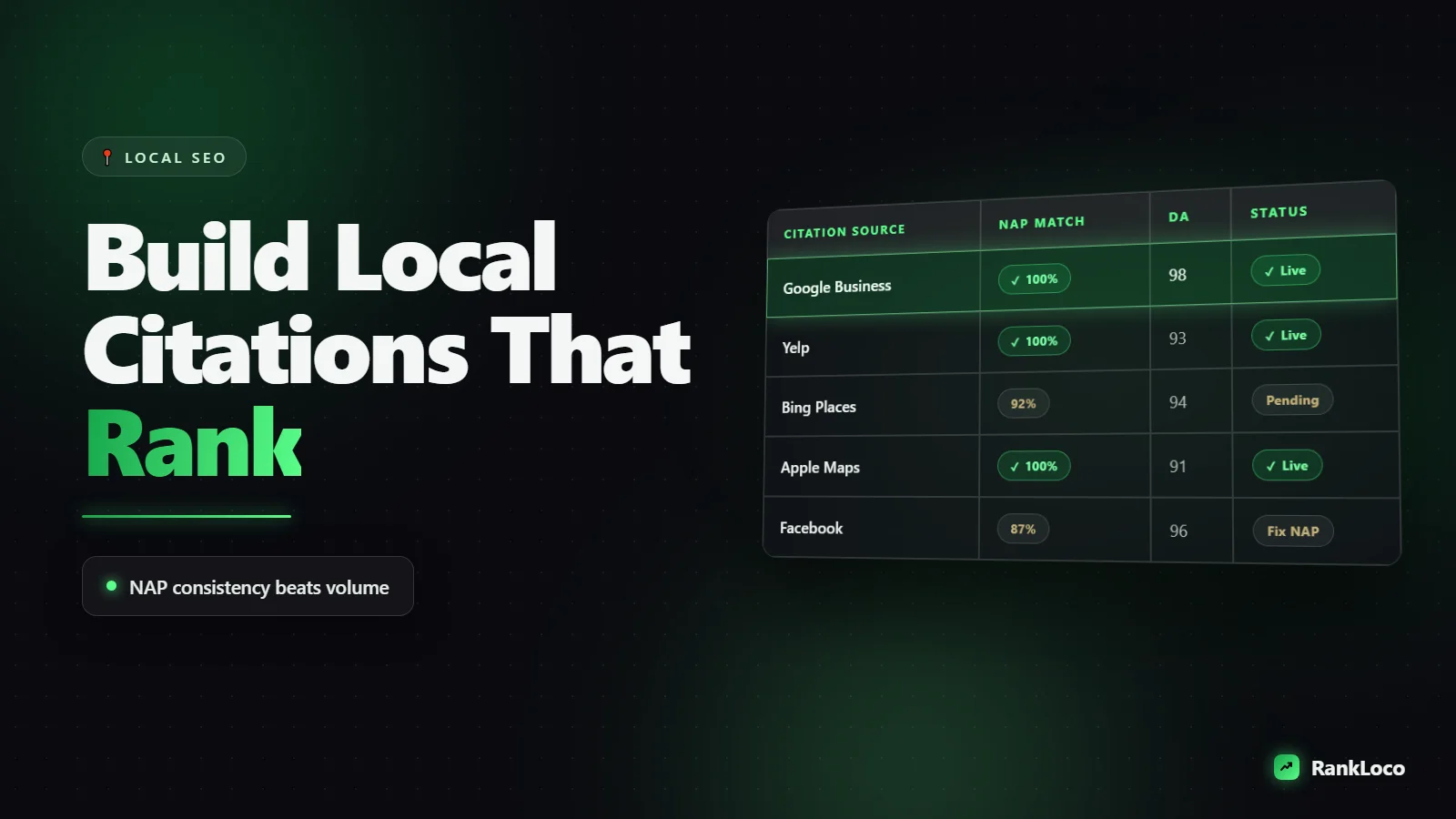
Consistent local rank tracking is where a tool pays off. RankLoco lets you track your Map Pack and local organic positions by keyword and city so you can tie posting cadence to actual movement. If you are choosing a tool on a tight budget, compare options in our roundup of the best rank tracking tools for local businesses. And since posts are only one lever, keep your citations clean too: consistent NAP data across the web is a bigger deal, covered in our guide to building local citations and keeping your NAP consistent.
Want more local and on-page playbooks? Browse the full library of SEO guides and build posting into a broader local strategy rather than treating it as a standalone task.
Frequently Asked Questions
How often should I post on my Google Business Profile?
Post at least once a week. Standard "What's New" updates stop showing prominently after about seven days, so a weekly cadence keeps fresh content visible without overwhelming your audience. Consistency matters more than volume: one quality post every week beats a burst followed by months of silence.
Do Google Business Profile posts improve local rankings?
Not directly. Posts do not carry the ranking weight of reviews, categories, or NAP consistency. They help indirectly by keeping your profile active, adding keyword-relevant text and images, and driving clicks and calls. Those engagement signals support prominence, one of Google's three local ranking factors.
What size should Google Business Profile post images be?
Use landscape images around 1200 x 900 pixels in a 4:3 ratio, with a minimum of 400 x 300. Upload original photos of your work, team, or products rather than stock images. Compress files before uploading so they load fast and name them descriptively for a small extra SEO benefit.
Why did Google reject my Business Profile post?
Common reasons include a phone number in the body text, excessive keyword stuffing, misleading or prohibited content, low-quality or watermarked images, and near-duplicate copy. Remove phone numbers (use the Call button instead), write natural copy, and vary each post's text and image to pass review.
How long do Google Business Profile posts stay live?
Standard update posts remain on your profile but drop from prominent display after about seven days. Offer and Event posts stay featured until their end date. Older posts still live under a "Posts" or "Updates" section, so nothing is deleted, it just moves down.
Should I use the same post on my website and social media?
You can repurpose the idea, but do not paste identical text everywhere. Tailor each channel: shorten for social, expand into a full article for your blog, and keep the Business Profile version local and action-focused with a clear CTA. Repurposing one idea across channels is efficient without triggering duplicate-content concerns.