How to Build Local Citations for Small Business (and Keep Your NAP Consistent)
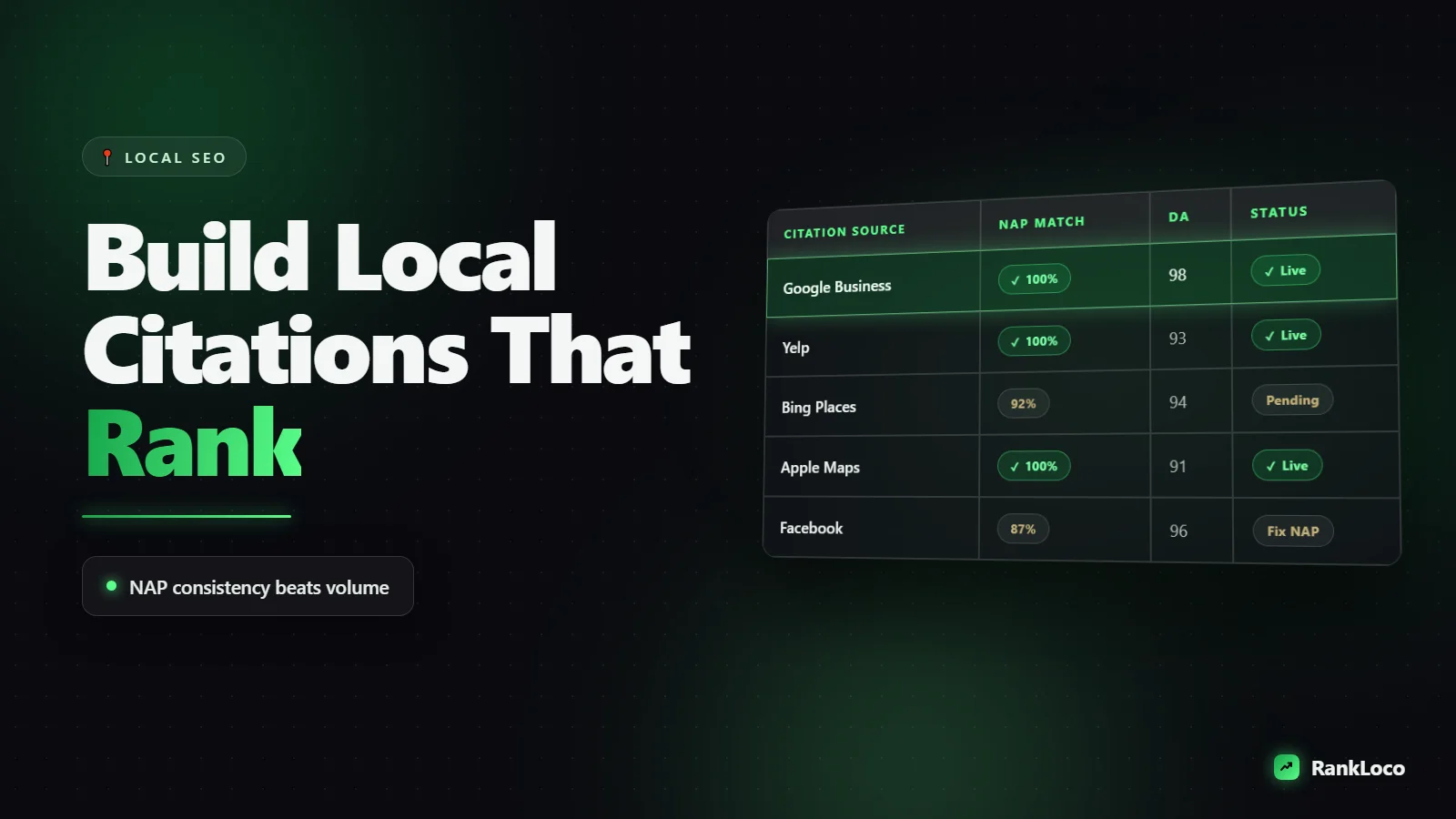
To build local citations for a small business, list your exact business name, address, and phone number (NAP) on trusted directories like Google Business Profile, Apple Maps, Bing Places, Yelp, and your top industry and city-specific sites, using identical formatting everywhere. Consistency matters more than volume: search engines trust businesses whose NAP data matches across the web, and mismatched listings can suppress your Map Pack rankings. Start with the core aggregators, then work through niche and local directories.
Below is the full process: what a citation actually is, which directories are worth your time, how to keep NAP data identical everywhere, and how to find and clean up the duplicate and wrong listings that are quietly hurting you.
What a Local Citation Is and Why It Matters
A local citation is any online mention of your business's name, address, and phone number. It can be a full listing on a directory (Yelp, Yellow Pages), a mention in a local news article, or a profile on a chamber of commerce site. Some citations include a link to your website; some do not. Both count.
Citations do two jobs. First, they confirm to Google that your business exists at a specific location, which supports your visibility in the local Map Pack. Second, they put your business in front of people who search on those directories directly. Someone looking for a plumber on Yelp never touches Google.
Here is the part most guides skip: citations are a trust signal, not a growth hack. You do not rank higher by stacking 300 low-quality listings. You rank higher by having accurate, consistent listings on the sites Google already trusts, plus strong reviews and a well-optimized profile. If you want the bigger picture on the profile side, read our guide on how to rank your Google Business Profile higher in local search.
Nail Your NAP Before You Build Anything
NAP stands for Name, Address, Phone. Before you create a single new listing, lock down the exact format you will use everywhere. This is the step that saves you months of cleanup later.
Write down your canonical NAP in a document and treat it as the single source of truth:
- Business name: Use your real, registered name exactly. No keyword stuffing ("Joe's Plumbing Denver Best Plumber" will get flagged). If your legal name is "Joe's Plumbing LLC" but you operate as "Joe's Plumbing," pick one and stick to it.
- Address: Decide on Suite vs Ste, Street vs St, and stick to it. Match what appears on your Google Business Profile.
- Phone: Use one local number with a consistent format. A local area code beats an 800 number for local trust.
- Website: Pick www or non-www and https, and use the same URL everywhere.
Small differences matter more than people think. "Ste 200" on one site and "Suite #200" on another creates ambiguity. You want a machine reading both listings to conclude they are the same business without guessing.
Add the extras that strengthen a listing
Wherever a directory allows it, fill in business hours, categories, a description, photos, and payment methods. Complete listings get more clicks and signal a real, active business. Match your primary category to what you chose on Google Business Profile.
The Citation Hierarchy: Where to List First
Do not start with a random directory blast. Work in tiers, from highest impact to lowest.
Tier 1: The data aggregators and core platforms
These feed data to hundreds of smaller sites. Get them right and a lot of the ecosystem corrects itself.
- Google Business Profile
- Apple Maps (Apple Business Connect)
- Bing Places
- Data aggregators like Data Axle, Localeze/Neustar, and Foursquare
Tier 2: The big general directories
- Yelp
- Yellow Pages
- Better Business Bureau
- Nextdoor
- Angi (for home services), TripAdvisor (for hospitality), etc.
Tier 3: Industry and local directories
This tier is where you separate from competitors. Find directories specific to your niche (a legal directory like Avvo for lawyers, Healthgrades for doctors) and specific to your city (chamber of commerce, local business associations, city visitor sites). These are harder for competitors to copy and often carry real referral traffic.
| Tier | Examples | Priority |
|---|---|---|
| Aggregators + core | Google, Apple, Bing, Foursquare, Data Axle | Do first, non-negotiable |
| General directories | Yelp, YP, BBB, Nextdoor | High |
| Industry-specific | Avvo, Healthgrades, Houzz | High for your niche |
| Local/geo | Chamber, city sites, local blogs | Medium, high value if relevant |
How to Find Industry and Local Directories Worth Pursuing
The fastest way to find good citation opportunities is to see where your competitors are already listed. Search Google for your competitors' exact business name and phone number in quotes. Every result is a citation source you can likely get on too.
Also run these searches, swapping in your city and service:
- "your city" + "your industry" + directory
- "your city" business directory
- your industry association + directory
This is essentially a citation gap analysis. If you want to apply the same competitor-comparison thinking to your content and links, our walkthrough on how to do a content gap analysis against your competitors uses the same mindset.
How to Build Citations Step by Step
- Create your canonical NAP document with name, address, phone, website, hours, categories, and description.
- Claim and optimize Google Business Profile first. Everything else references it.
- Set up the Tier 1 aggregators and platforms. Give these a few weeks to propagate.
- Work through Tier 2 general directories one at a time, copying your NAP exactly.
- Add Tier 3 industry and local directories found through competitor research.
- Log every listing in a spreadsheet with the URL, login, and date created so you can maintain them.
- Verify each listing (phone, postcard, or email) so it goes live and stays trusted.
Build these manually where you can. Automated services push data fast but can create listings you do not control, which becomes a problem if you ever move or change your number. Manual listings with logged credentials are yours to update forever.
Finding and Fixing NAP Inconsistencies
Most small businesses already have citations they never created: auto-generated listings from aggregators, old addresses from a previous location, or a phone number from before they switched providers. These inconsistencies actively work against you.
Here is how to audit them:
- Search your business name in quotes on Google and scan the first five pages for every listing.
- Search your phone number in quotes to catch listings with an outdated name or address.
- Search old addresses and phone numbers if you have moved or rebranded.
- Check for duplicate Google listings, which are common and damaging. If you find two profiles for one location, request a merge or removal.
For each wrong listing, either claim and correct it or request removal. Prioritize the high-authority sites (Yelp, Bing, Apple) first, since those carry the most weight and often feed other sites.
Keep a maintenance rhythm
NAP consistency is not a one-time project. Re-audit every quarter, and immediately update every listing whenever you move, change your phone number, or adjust hours. This is exactly the kind of ongoing work that pays off, similar to how you have to keep updating old blog posts to regain lost traffic: the sites that maintain accuracy win over time.
How Citations Fit Into Your Wider Local SEO
Citations are one leg of a three-legged stool. The other two are reviews and links. Consistent NAP data gets you eligible to rank; reviews and relevance decide how high. Make sure you are also working on getting customer reviews that boost your local SEO and earning backlinks for your local business website, since some of your best citation sources double as link sources.
If you serve several areas, citations get more complex because each location needs its own consistent NAP set. Our guide on how to rank in the Google Map Pack for multiple locations covers how to structure that without cannibalizing yourself.
Track whether all this work is moving the needle. Set up local rank tracking so you can see your Map Pack and local organic positions change as citations clean up. You can start with our roundup of rank tracking tools for local businesses on a budget, or use RankLoco to monitor local keywords and run a site audit alongside your citation cleanup. For a broader library of tactics, browse more SEO guides.
Citation Building Checklist
- Canonical NAP documented and identical everywhere
- Google Business Profile claimed and fully optimized
- Tier 1 aggregators and platforms set up
- Yelp, BBB, and major general directories completed
- Industry-specific directories added
- Local and geo directories (chamber, city sites) added
- Competitor citations audited and matched
- Duplicate Google listings merged or removed
- Old address and phone listings corrected
- Every listing logged in a spreadsheet with credentials
- Quarterly re-audit scheduled
Frequently Asked Questions
How many local citations does a small business need?
There is no magic number. Focus on the top data aggregators plus 20 to 50 high-quality, relevant listings rather than hundreds of low-value ones. A local coffee shop needs fewer citations than a multi-location law firm. Consistency across your core listings matters far more than raw volume for ranking.
Do citations still help SEO in 2024?
Yes, but their role has shifted. Citations are now more of a foundational trust and accuracy signal than a way to climb rankings. Inconsistent or missing NAP data can hold you back, while accurate listings keep you eligible. Reviews, proximity, and relevance now do more of the ranking work.
What happens if my NAP is inconsistent across the web?
Inconsistent NAP data confuses search engines about which information is correct, which can lower confidence in your listing and suppress Map Pack visibility. It also sends customers to wrong addresses or dead phone numbers, costing you real business. Auditing and fixing inconsistencies is one of the highest-value local SEO tasks.
Should I use a paid citation service or build them manually?
Build your core listings manually so you own the logins and can update them forever. Paid services are useful for speed and for pushing data to aggregators, but they can create listings you do not control. If you use one, make sure you can access and edit every listing it creates.
How long does it take for citations to affect rankings?
Expect several weeks to a few months. Aggregators need time to propagate data to smaller sites, and Google needs time to recrawl and reconcile the information. Cleaning up damaging inconsistencies often shows results faster than adding brand new listings.
Do citations need a link back to my website?
Not necessarily. A citation counts even without a link, because the NAP mention itself is the signal. That said, listings that include a followable link give you a small bonus as a local backlink. Grab the link when a directory offers it, but do not skip strong citation sources just because they do not.