How to Rank in the Google Map Pack for Multiple Locations
To rank in the Google Map Pack for multiple locations, create a separate, fully verified Google Business Profile for each physical address, build a dedicated location landing page on your website for every one of those profiles, and earn location-specific reviews, citations, and links tied to each city. Google ranks Map Pack results one location at a time based on relevance, distance, and prominence, so you have to treat every branch as its own local SEO campaign instead of one big generic effort.
Multi-location ranking is not harder in theory, it is just more work. The same signals that rank a single location rank ten locations. The mistake most businesses make is trying to shortcut it with one profile, one page, and one set of reviews for the whole company. That does not work. Below is how to do it right.
Why One Google Business Profile Cannot Rank Multiple Cities
The Map Pack is location-based. When someone searches "plumber near me" in Austin, Google looks for verified businesses with a real presence in or near Austin. If your only profile is registered in Dallas, you will not show up in Austin no matter how strong your brand is. Proximity to the searcher is one of the three core ranking factors, alongside relevance and prominence.
That means every city you want to rank in needs its own Google Business Profile tied to a genuine physical location in that city. Google's guidelines require a real address staffed during business hours (service-area businesses can hide the address, but you still need a legitimate location). Fake addresses, virtual offices, and mailbox stores get suspended, and a suspension can wipe out rankings you spent months building.
The rule of thumb for multi-location eligibility
- Storefront businesses (restaurants, clinics, retail) need one profile per address customers visit.
- Service-area businesses (plumbers, cleaners, landscapers) can create a profile per location where they have a staffed office, and set the service areas around it.
- Do not create multiple profiles for the same address to target different keywords. That is duplicate-listing territory and gets flagged.
Set Up and Verify a Separate Profile for Each Location
Start by claiming or creating a profile for every branch. Use the Google Business Profile Manager to organize them under one account or agency dashboard so you can manage them all in one place. For businesses with ten or more locations, you can apply for bulk verification, which speeds things up considerably.
For each profile, get the fundamentals identical in structure but unique in detail:
- Business name: exactly the same across all locations (do not stuff the city into the name unless it is your legal name).
- Address and phone: a local address and, ideally, a local phone number for each city.
- Primary category: the same core category, with secondary categories adjusted if a branch offers different services.
- Hours, photos, services, and description: unique to each location, using real photos of that specific storefront or team.
Consistency of your name, address, and phone (NAP) matters, but each profile needs its own local NAP. Fill every field. A complete profile ranks better and converts better. If you are not sure what is missing, work through our guide to improving your Google Business Profile completeness score for each listing.
Build a Dedicated Landing Page for Every Location
This is where most multi-location strategies fall apart. You cannot point ten Business Profiles at one homepage or one generic "locations" page and expect strong rankings. Each profile should link to its own location page, and each page should be a real, useful page, not a thin template with the city name swapped in.
What a strong location page includes
- City in the H1, title tag, and URL (for example, /locations/austin). Write these to earn clicks, not just to match keywords. Our guide on title tags and meta descriptions covers this.
- Unique body copy about that location: the team, the neighborhoods served, local landmarks, parking, directions.
- The exact NAP that matches the Business Profile, marked up with LocalBusiness schema.
- An embedded Google Map centered on that branch.
- Location-specific reviews or testimonials from customers in that area.
- Local services and pricing if they differ by market.
The biggest risk here is duplicate content. When you spin up 20 near-identical pages, Google may ignore most of them. Write genuinely different copy for each. If you run an ecommerce or franchise setup with templated pages, read how to fix duplicate content issues so your location pages do not cannibalize each other.
Add LocalBusiness schema to each page so Google can connect the address, phone, hours, and geo-coordinates to the right listing. You do not need a developer for this. Our walkthrough on adding schema markup without coding shows how to generate and paste the JSON-LD per page.
Earn Location-Specific Reviews, Citations, and Links
Prominence is the third ranking factor, and it is measured per location. A location with 200 reviews will usually beat a sister branch with 12, even inside the same company. You have to build authority for each address individually.
Reviews
Set up a review-request flow for each location so customers leave reviews on the correct profile. Give each branch its own short review link. Ask right after service, respond to every review, and mention the city and service naturally in your responses. Volume, recency, and rating all feed Map Pack rankings.
Citations
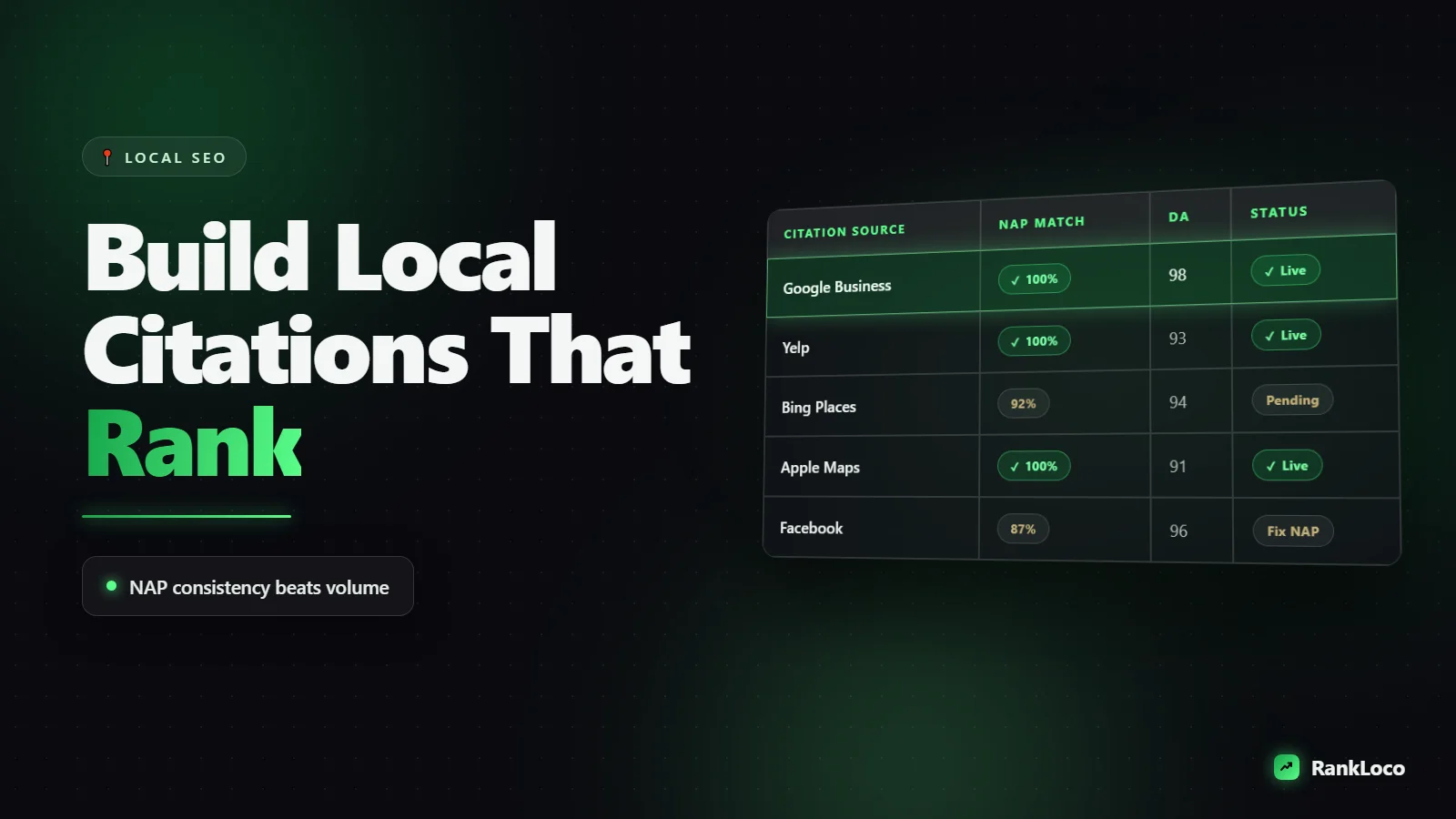
Build local citations (name, address, phone listings on directories) for each location with its own local NAP. Get listed in city-specific directories, chambers of commerce, and industry sites for each market. Inconsistent citations confuse Google, so keep every branch's NAP identical across the web.
Local links
Links from local sources, sponsorships, news sites, and community organizations are gold for local rankings, and they must be earned per city. A link from an Austin newspaper helps your Austin location, not your Dallas one. Our guide on getting backlinks for a local business lays out tactics you can repeat in every market.
Multi-Location Local SEO Checklist
| Task | Per location? | Priority |
|---|---|---|
| Verified Google Business Profile | Yes | Critical |
| Dedicated location landing page | Yes | Critical |
| LocalBusiness schema on each page | Yes | High |
| Local phone number and NAP | Yes | High |
| Review-request flow per profile | Yes | High |
| Local citations with matching NAP | Yes | High |
| City-specific backlinks | Yes | Medium |
| Unique photos of each storefront | Yes | Medium |
| Consistent business name and categories | Shared | Critical |
| Rank tracking by location | Yes | High |
Track Rankings by Location, Not by Keyword Alone
Map Pack rankings change depending on where the searcher is standing. Your Austin location might rank first when someone searches downtown and third from the suburbs. A national rank check tells you nothing useful here. You need geo-specific rank tracking that checks each keyword from each target city.
Use RankLoco to track keyword rankings per location so you can see exactly how each branch performs in its own market and spot which cities need more reviews or links. If you are just getting started, here is how to track keyword rankings for free, and then measure the traffic those rankings drive with Google Analytics 4.
Common Multi-Location Mistakes That Kill Rankings
- One profile for the whole company. You will only rank in the city where that profile is registered.
- Thin, duplicated location pages. Google ignores them or ranks one and drops the rest.
- Keyword stuffing the business name. "Joe's Plumbing Austin Best Cheap 24/7" gets you suspended, not ranked.
- Ignoring reviews at smaller branches. Prominence is per location, so weak-review branches stay buried.
- Inconsistent NAP across directories. Mismatched data splits your signals.
- Not tracking by geography. You cannot fix what you cannot see.
For the broader fundamentals that apply to every branch, work through our local SEO playbook for small businesses and the local search ranking signals guide. Both go deeper on the relevance, distance, and prominence factors that decide who wins the Map Pack. And if a single profile is still underperforming, our guide on how to rank your Google Business Profile higher covers the single-location basics you can then replicate.
Frequently Asked Questions
Can I have multiple Google Business Profiles for one business?
Yes, as long as each profile represents a distinct physical location with its own real address and, ideally, a local phone number. You cannot create multiple profiles for the same address or for keyword variations. Doing so violates Google's guidelines and risks suspension of all your listings.
How many locations can I manage under one Google account?
You can manage hundreds of locations under one Google Business Profile account using Business Profile Manager. For 10 or more locations of the same brand, you can apply for bulk verification, which lets you verify many listings at once instead of one at a time.
Do I need a separate website for each location?
No. You need a separate landing page for each location on your main website, not a separate domain. Each page should have unique content, the local NAP, LocalBusiness schema, and an embedded map. One authoritative domain with strong location pages outperforms many thin microsites.
Why is only one of my locations showing in the Map Pack?
Usually because that location has more reviews, citations, or links, or because the searcher is closer to it. Check that every branch has a verified profile, a dedicated page, and its own review and citation base. Rankings are calculated per location, so weaker branches need their own signal building.
How long does it take to rank multiple locations in the Map Pack?
New or freshly verified profiles typically take one to three months to gain traction, and competitive markets take longer. Locations with more reviews and stronger local links climb faster. Consistent review generation and citation building over three to six months usually produces steady improvement per branch.
Does distance to the searcher override reviews and content?
Not entirely. Distance is one of three factors alongside relevance and prominence. A slightly farther location with far more reviews, complete information, and strong local links can outrank a closer but weaker competitor. Build all three signals rather than relying on proximity alone.