How to Do Keyword Mapping for a Small Website
Keyword mapping is the process of assigning one primary keyword (and a few supporting terms) to each page on your site so no two pages fight over the same search. To do it, list every page you have, pull the keywords you want to rank for, match one main keyword per URL based on search intent, and fill the gaps with new pages. Done right, it kills keyword cannibalization, tells Google exactly what each page is about, and turns a random collection of pages into a plan.
For a small website this matters more, not less. You have fewer pages, so every one has to earn its keep. Below is the exact process I use, from building the keyword list to the spreadsheet that becomes your content roadmap.
What keyword mapping actually is (and why small sites need it)
A keyword map is a spreadsheet that connects three things: a URL, the primary keyword that page should rank for, and the intent behind that keyword. Add a couple of secondary keywords and you have everything you need to write or optimize the page.
Without a map, small sites make the same two mistakes over and over. First, they write three blog posts that all target basically the same phrase, so Google splits authority across all three and none of them rank. That is keyword cannibalization. Second, they leave money keywords completely uncovered because nobody checked whether a page existed for them.
A map fixes both. It forces one keyword per page and shows you exactly which searches have no home yet.
Step 1: Crawl and list every page you already have
Start with what exists. Open a spreadsheet and create a row for every live URL on your site. You can grab these from your CMS, your XML sitemap, or a crawl tool. If you have not built one yet, here is how to create an XML sitemap and submit it to Google, which doubles as a clean list of your pages.
For each URL, note:
- The page title and current H1
- The page type (home, service, product, blog post, category, about)
- Any keyword it seems to target right now
This inventory is your foundation. On a 20 to 50 page site it takes an afternoon. Do not skip it, because you cannot map keywords to pages you have not written down.
Step 2: Build your keyword list
Now gather the keywords you want to win. Pull from several sources so you are not guessing:
- Google Search Console: the Performance report shows queries you already get impressions for. These are the fastest wins because Google already associates you with them.
- Seed keywords: your core services, products, and topics. Type each into a keyword tool to get related terms and volumes.
- Autocomplete and People Also Ask: great for finding the long-tail phrasing real people use. Here is how to find long tail keywords using Google Autocomplete and People Also Ask.
- Competitors: see what terms rank for the sites beating you. A content gap analysis against your competitors surfaces keywords they cover and you do not.
Dump everything into one column. Aim for a working list of 100 to 300 keywords for a small site. You will trim it down as you assign.
Step 3: Sort keywords by search intent
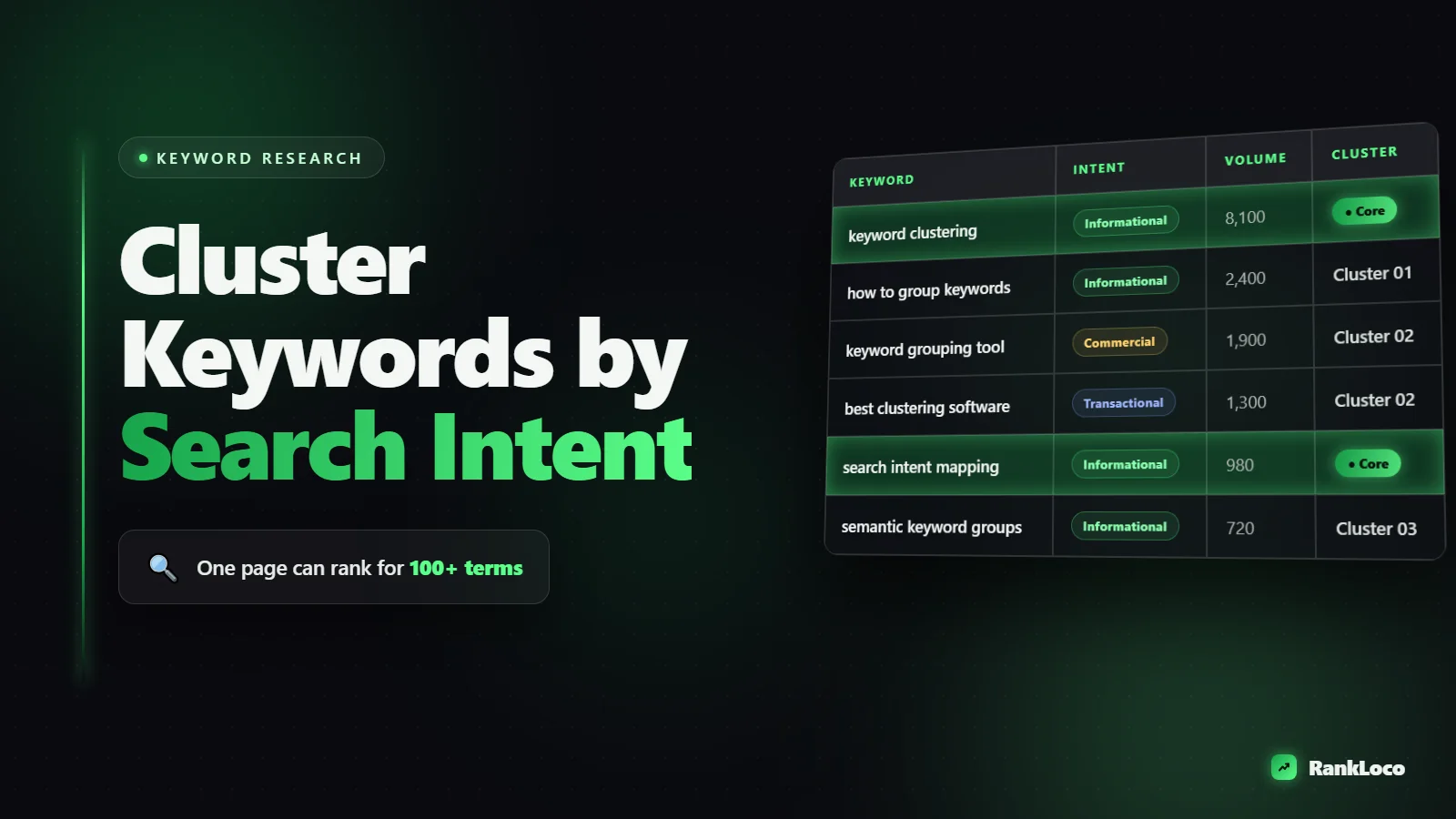
Intent decides which page type a keyword belongs on. Tag every keyword as one of four types:
| Intent | What the searcher wants | Page type it maps to |
|---|---|---|
| Informational | Answers, how-tos, definitions | Blog post, guide, FAQ |
| Commercial | To compare options before buying | Comparison, "best" post, category |
| Transactional | To buy or hire now | Service page, product page |
| Navigational | A specific brand or page | Home, about, brand pages |
The fastest way to check intent is to Google the keyword and look at what ranks. If the top 10 are all blog posts, that keyword is informational and you should not point it at a product page. If they are all service pages, do not try to rank a blog post for it. Match the format Google already rewards.
Step 4: Assign one primary keyword per page
This is the core of keyword mapping. Go through your keyword list and assign each keyword to the single best-fit URL from your page inventory. Rules that keep you out of trouble:
- One primary keyword per page. Pick the highest-value term that matches the page's intent and put it in a "Primary Keyword" column next to the URL.
- No keyword gets two pages. If two URLs both want the same term, you have cannibalization. Merge them, or make one the clear target and re-point the other at a related keyword.
- Group close variants together. "emergency plumber" and "24 hour plumber near me" are the same intent. Put both on one page as primary plus secondary, do not build two pages.
Add a "Secondary Keywords" column for the 3 to 8 related terms and variations each page should also mention naturally. These are usually part of the same topic cluster, which is why it helps to know how to build a keyword cluster to cover an entire topic before you finalize the map.
Prioritize by difficulty, not just volume
A small site cannot win a keyword the big brands own on day one. Before you commit a page to a high-volume term, sanity check whether you can realistically rank. Our guide on keyword difficulty and how to know if you can actually rank walks through this. As a rule, favor specific, lower-competition long-tail keywords for a young site. They convert better and rank faster.
Step 5: Find the gaps and plan new pages
Once every existing page has a primary keyword, look at your leftover keywords: the ones with strong intent and reachable difficulty that have no page yet. Each of these becomes a planned page.
Add rows to your map for these future URLs with a status like "To create." Now your keyword map is also a content calendar. You know exactly what to write next and which keyword it targets, instead of publishing random posts and hoping.
Prioritize the gaps like this:
- Transactional and commercial keywords first (they make money)
- Informational keywords that support those money pages (they build topical authority and feed internal links)
- Broad awareness topics last
What your finished keyword map should look like
A clean map has one row per page and these columns at minimum:
| Column | Example |
|---|---|
| URL | /services/gutter-cleaning |
| Page type | Service page |
| Primary keyword | gutter cleaning services austin |
| Intent | Transactional |
| Secondary keywords | gutter cleaning near me, gutter cleaning cost |
| Title tag | Gutter Cleaning Services in Austin | Company |
| Status | Live / To optimize / To create |
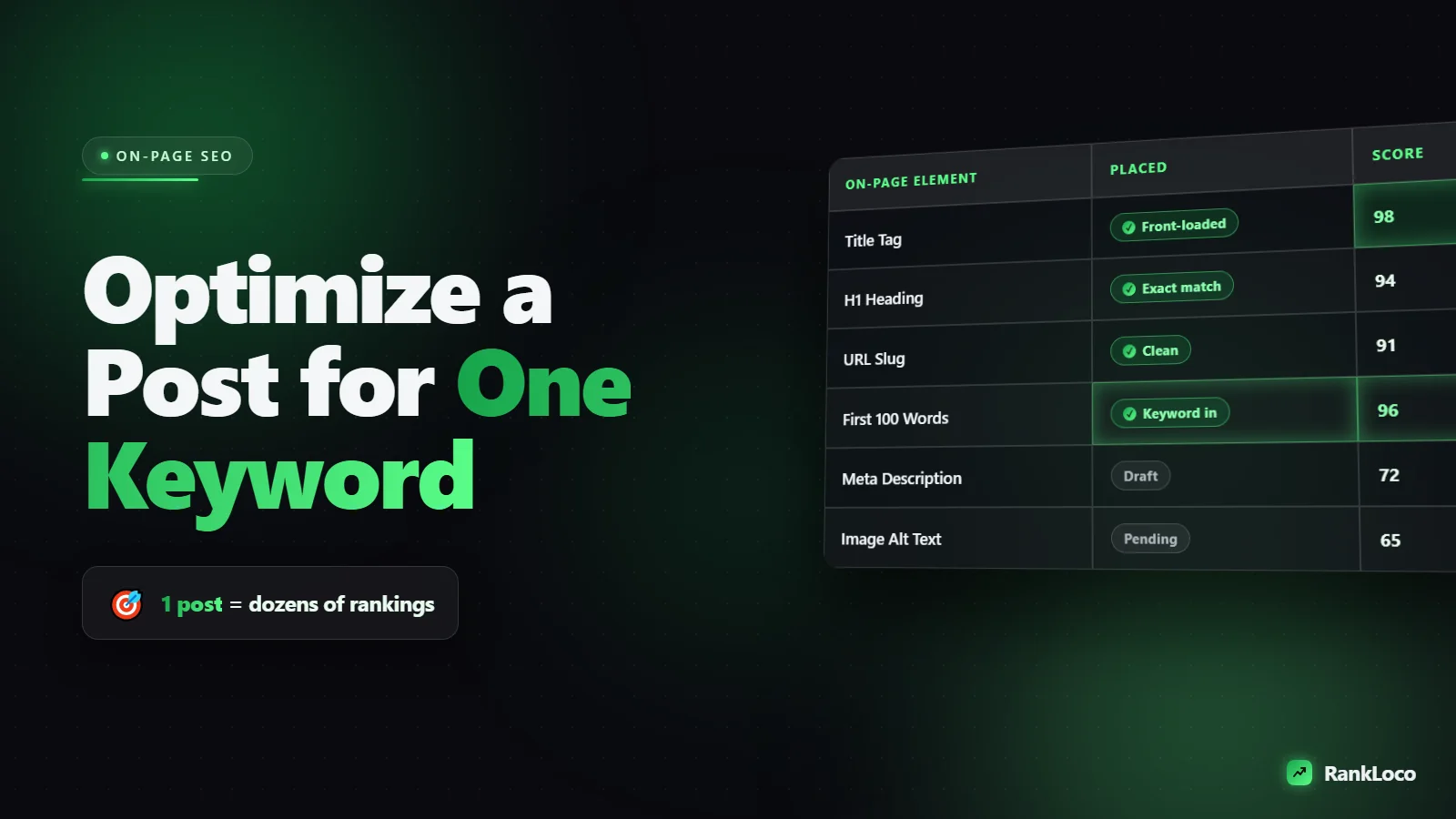
That is it. Everyone who touches your site can now see what each page is for. When you write or update a page, the primary keyword goes in the title tag, H1, URL, and opening paragraph, and the secondary keywords get worked into the subheadings and body naturally.
Step 6: Turn the map into on-page action
The map is useless if it sits in a spreadsheet. Work through it page by page:
- Optimize existing pages to match their assigned keyword. If a service page targets a buyer keyword, tighten it using these tips on how to optimize a service page to rank for buyer intent keywords.
- Fix cannibalization you spotted in Step 4. Merge or redirect competing pages so each keyword has one owner.
- Write the gap pages in priority order.
- Set up internal links so supporting blog posts link up to your money pages using descriptive anchor text.
Then track it. Put your primary keywords into a rank tracker and watch movement over the following weeks. RankLoco lets you monitor rankings per URL and run on-page audits so you can confirm each mapped page is actually targeting the keyword you assigned it. If a page stalls, the issue is often technical rather than content, in which case check why some pages get indexed but do not rank.
Keyword mapping checklist
- List every live URL with its page type
- Pull keywords from Search Console, seed terms, autocomplete, and competitors
- Tag each keyword with its search intent
- Assign one primary keyword to each page
- Add 3 to 8 secondary keywords per page
- Confirm no keyword is assigned to two pages
- Flag high-value keywords with no page as gaps to create
- Sanity check difficulty before committing to a term
- Write the primary keyword into title, H1, URL, and intro
- Track rankings per page and adjust
Revisit the map every quarter. Sites drift, new competitors appear, and Search Console will hand you fresh keyword ideas. For more playbooks like this, browse the rest of our SEO guides.
Frequently Asked Questions
How many keywords should I map to one page?
One primary keyword per page, plus 3 to 8 closely related secondary keywords and variations. Those secondaries should share the same intent as the primary. If a keyword needs a different page format or answers a different question, it belongs on its own page, not crammed into an existing one.
What is keyword cannibalization and how does mapping stop it?
Cannibalization is when two or more of your pages target the same keyword, so Google cannot tell which to rank and splits authority between them. A keyword map prevents it because you assign each keyword to exactly one URL. If two pages want the same term, you catch it during mapping and merge or re-target one.
Can I do keyword mapping for free?
Yes. Use Google Search Console for existing query data, Google autocomplete and People Also Ask for keyword ideas, and a plain spreadsheet for the map itself. Paid tools speed up volume and difficulty research, but a small site can build a solid first map with free sources and a few focused hours.
How often should I update my keyword map?
Review it every three months, and any time you add or remove pages. Search Console will surface new keywords you are getting impressions for, competitors publish new content, and intent for some queries shifts. A quarterly refresh keeps your map accurate and feeds your content calendar with fresh gaps to fill.
Should the homepage have a target keyword too?
Yes. The homepage usually targets your broadest, highest-value term, often your brand plus main service or category (for example "Austin gutter cleaning company"). Deeper, more specific keywords go on service, product, and blog pages. Do not try to rank the homepage for everything, or it ends up ranking for nothing.
What comes after keyword mapping?
Turn the map into on-page work: optimize existing pages to match their assigned keyword, fix any cannibalization, and write the gap pages in priority order. Then add internal links from supporting posts to your money pages and track rankings per URL so you can see which mapped pages are moving and which need more work.