How to Build a Keyword Cluster to Cover an Entire Topic
To build a keyword cluster for SEO, group keywords that share the same search intent into one bucket, target that bucket with a single comprehensive page, and connect related clusters with internal links so Google understands you cover the whole topic. In practice: dump a big seed list, group by intent (not just by matching words), assign one primary page per cluster, and support it with linked subtopic pages. That is the entire model, and the rest of this guide shows you how to execute it step by step.
What a keyword cluster actually is (and why it beats one-keyword-one-page)
A keyword cluster is a set of keywords that all mean roughly the same thing to a searcher and can be answered by one page. "best running shoes," "top running shoes," and "best shoes for running" are one cluster. You do not need three pages for those. You need one strong page.
The old approach was one keyword, one page. That produced thin, overlapping content that competed with itself (keyword cannibalization). Google now understands topics semantically, not string matches. When a single page ranks for one head term, it typically ranks for dozens of variations too. Clustering is how you plan for that reality instead of fighting it.
The payoff is topical authority. When you publish a well-linked group of pages that cover a topic from every angle, Google trusts you more on that topic and ranks you for terms you never explicitly targeted. That is why clustering is the backbone of any serious content plan.
Step 1: Build a big seed list before you group anything
You cannot cluster keywords you have not collected. Start wide, filter later. Pull from these sources:
- Google Autocomplete and People Also Ask: type your core term and record every suggestion. This is the fastest way to surface real phrasing. Our guide on how to find long tail keywords using autocomplete and People Also Ask walks through the exact process.
- A keyword tool: use RankLoco or another tool to expand your seed term into hundreds of related queries with volume and difficulty data.
- Google Search Console: if the site already ranks, the Queries report shows terms you get impressions for but may not target on purpose. Gold for cluster gaps.
- Competitor pages: pull the terms competitors rank for on the topic. A proper content gap analysis against your competitors finds clusters you are missing entirely.
Aim for a raw list of 100 to 500 keywords for a decent-sized topic. Messy is fine at this stage. You are collecting raw material, not the final map.
Step 2: Group keywords by search intent, not by words
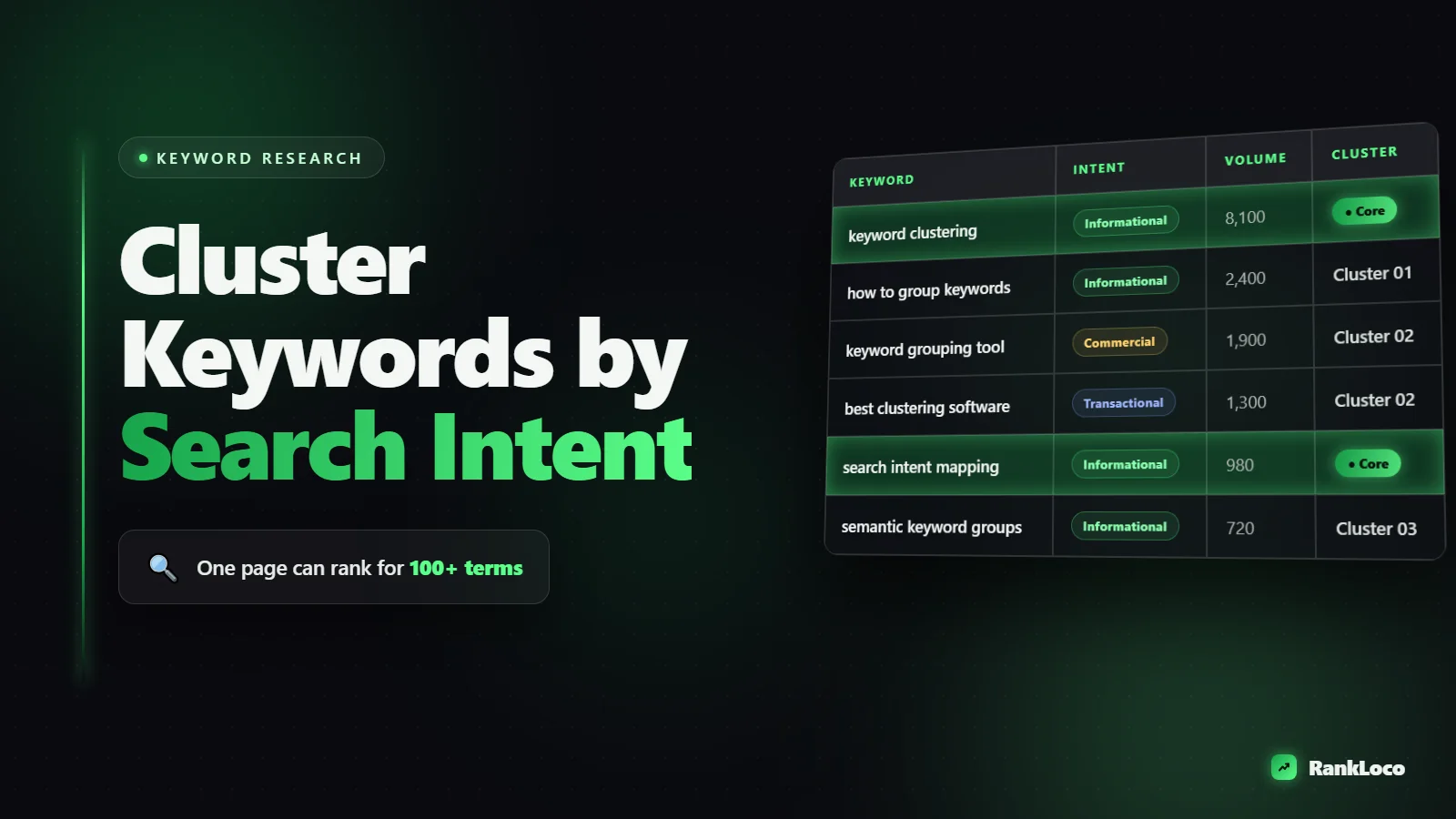
This is the step people get wrong. They cluster by shared words ("anything with 'coffee grinder' goes here") instead of by what the searcher wants. Two queries belong in the same cluster only if the same page can satisfy both.
Use this quick test: would the top-ranking results for keyword A also rank for keyword B? If the SERPs overlap heavily, same cluster. If they are totally different, split them.
Example with "coffee grinder":
| Keyword | Intent | Cluster |
|---|---|---|
| best coffee grinder | Compare products | Buying guide |
| top rated coffee grinders | Compare products | Buying guide |
| burr vs blade grinder | Understand a difference | Comparison explainer |
| how to clean a coffee grinder | Solve a task | How-to |
| coffee grinder for espresso | Narrow product need | Sub buying guide |
Notice "best" and "top rated" merge, but "how to clean" splits off because no buying guide will ever rank well for a maintenance query. Matching pages to intent is the whole game, and it is worth reading our breakdown of search intent and how to match content to what users want before you finalize groups.
The four intent buckets
- Informational: how, what, why, guide, tutorial. Blog posts and explainers.
- Commercial: best, top, review, comparison, alternative. Buying guides and comparison pages.
- Transactional: buy, price, discount, near me. Product and service pages.
- Navigational: brand plus term. Usually your own branded pages.
Never mix intents in one cluster. A single page cannot be a tutorial and a product page at the same time and rank for both.
Step 3: Pick the primary keyword and page type for each cluster
Within each cluster, choose one primary keyword: usually the highest-volume term that best represents the group. That primary term drives your title tag, URL, and H1. Every other keyword in the cluster becomes a secondary term you work into subheadings and body copy naturally.
Then decide the page type. A cluster around "how to build a keyword cluster" is a blog guide. A cluster around "keyword research software" is a product or landing page. Map each cluster to the format that matches its intent.
Before committing, sanity-check whether you can realistically rank. A cluster with a high difficulty primary term may be out of reach for a new site. Read keyword difficulty explained so you know when to attack a term head-on and when to go after easier long-tail clusters first. New sites should prioritize low competition keywords and build up.
Step 4: Structure clusters into a pillar and spokes (topic hub)
Clusters do not live in isolation. Organize related clusters into a hub-and-spoke model:
- Pillar page: broad, high-level page targeting the head term (e.g. "Keyword Research Guide").
- Cluster pages: deeper pages each targeting one subtopic (e.g. "long tail keywords," "keyword difficulty," "keyword clustering").
- Links: every cluster page links up to the pillar, and the pillar links down to every cluster page. Cluster pages link sideways to each other where relevant.
This linking is what turns a pile of posts into a topic Google recognizes. It passes authority around your best pages and shows crawlers how everything connects. Internal linking is genuinely one of the highest-leverage things you can do, and our internal linking strategy guide covers how to do it without over-optimizing anchor text.
Step 5: Map clusters to a content plan (and spot cannibalization)
Put your clusters into a simple spreadsheet. One row per cluster. Columns:
- Cluster name
- Primary keyword and its volume/difficulty
- Secondary keywords
- Intent
- Page type
- Target URL (existing or new)
- Pillar it belongs to
- Status (live, needs update, to write)
This map instantly exposes two problems. First, cannibalization: if two existing URLs both target the same cluster, consolidate them into one page and redirect the loser. Second, gaps: clusters with no page yet become your content backlog, prioritized by volume and difficulty.
Cluster mapping example
| Cluster | Primary keyword | Page type | Status |
|---|---|---|---|
| Keyword clustering | how to build a keyword cluster | Guide | To write |
| Long tail research | find long tail keywords | Guide | Live |
| Keyword difficulty | keyword difficulty explained | Guide | Live |
| Research process | how to do keyword research | Pillar | Needs update |
Step 6: Write the page to cover the full cluster
A page ranks for its whole cluster only if it actually answers the whole cluster. Use the secondary keywords as your outline. Each question or subtopic in the cluster becomes a subheading. If "burr vs blade" is in your buying-guide cluster, add a section that settles it.
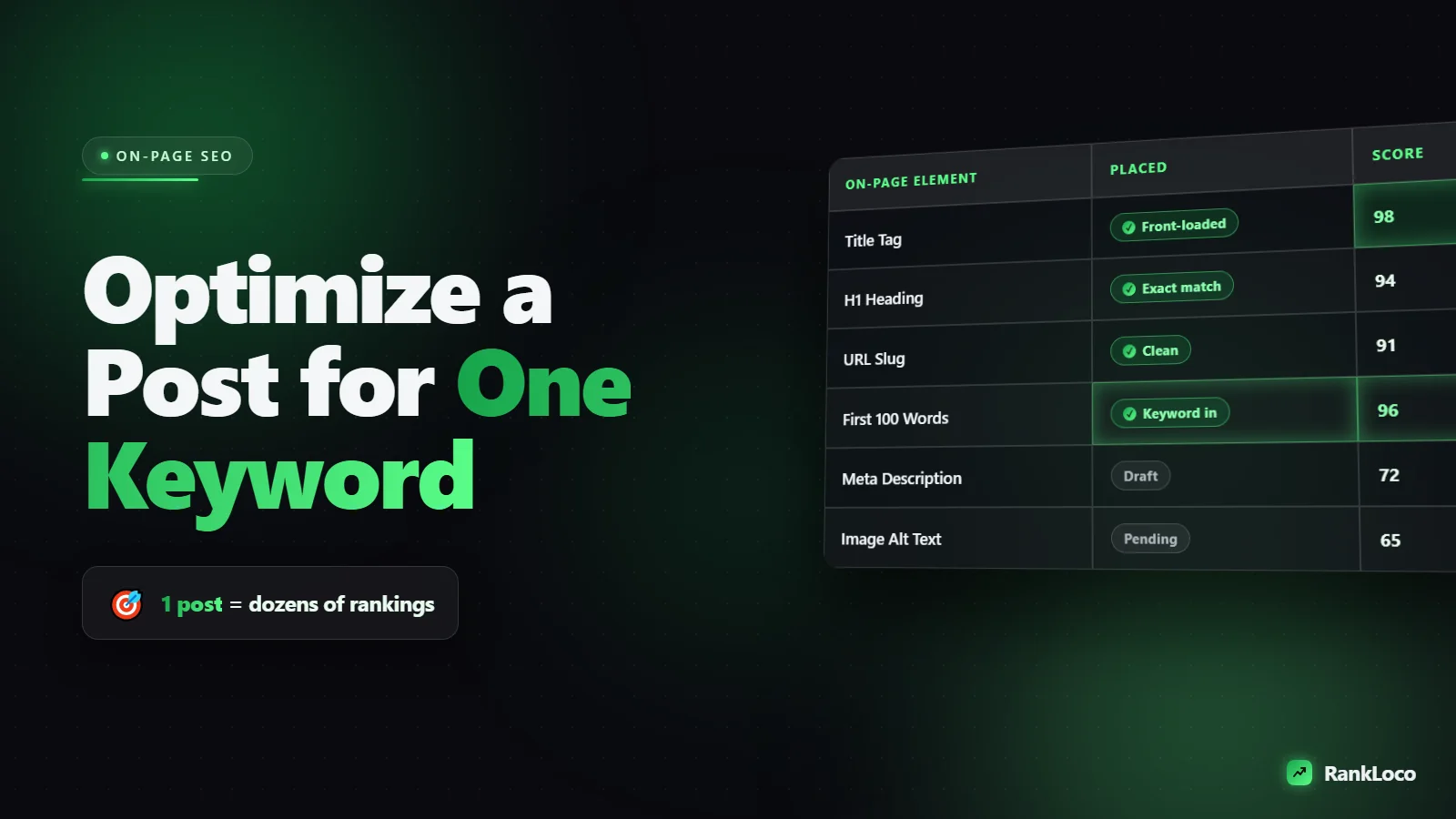
Cover the People Also Ask questions in an FAQ section. This wins featured snippets and question keywords at the same time. We break this down in the guide on how to write FAQ content that ranks for question keywords. Then optimize the page itself using the checklist in how to optimize a blog post for a target keyword.
Step 7: Track the whole cluster, not just the primary keyword
One page ranks for dozens of terms, so tracking only the head keyword hides most of your progress. Load every keyword in the cluster into a rank tracker and watch the group move together. You will often see the long-tail terms rank first, then the head term climb as the page gains authority.
Set up rank tracking in RankLoco to monitor each cluster as a group, or start with our guide on how to track keyword rankings for free if you are just beginning. Watching the cluster as a unit tells you whether the page is winning the topic or just a single term.
Keyword clustering checklist
- Collect 100+ seed keywords from autocomplete, PAA, GSC, tools, and competitors
- Group by shared search intent, verified with SERP overlap
- Split any keywords that need a different page type
- Pick one primary keyword per cluster
- Assign a page type that matches intent
- Organize clusters into pillar and spoke hubs
- Map everything in a spreadsheet with target URLs
- Fix cannibalization by consolidating overlapping pages
- Write each page to cover every secondary term and PAA question
- Interlink pillar and clusters both directions
- Track the full cluster, not just the head term
Do this for one topic first. Get the pillar and its clusters live and interlinked, watch them rank, then repeat for the next topic. That is how you build coverage that compounds. For the wider process this fits into, see our full guide on how to do keyword research in 2026, and browse more SEO guides for the writing and technical steps that follow.
Frequently Asked Questions
How many keywords should be in a keyword cluster?
There is no fixed number. A cluster can have 3 keywords or 40. What matters is that every keyword shares the same intent and can be answered by one page. Quality of grouping beats size. If a page cannot naturally satisfy all of them, split into two clusters.
What is the difference between a keyword cluster and a topic cluster?
A keyword cluster is a group of related keywords targeting one page. A topic cluster (or hub) is the bigger structure: a pillar page plus several keyword-cluster pages that link together to cover a whole subject. Keyword clusters are the building blocks of a topic cluster.
Can I put keywords with different search volumes in the same cluster?
Yes. Volume does not decide clustering; intent does. A cluster often mixes a high-volume head term with several low-volume long-tail variations. You target the head term as the primary keyword and weave the long-tail terms into subheadings and body copy.
Do I need a paid tool to build keyword clusters?
No. You can cluster manually using Google autocomplete, People Also Ask, Search Console, and a spreadsheet. Tools like RankLoco speed up the grouping and add volume and difficulty data, but the intent-based logic is the same. Start manual, upgrade when the list gets too big to handle by hand.
How do I know if two keywords belong in the same cluster?
Search both and compare the top 10 results. If the same URLs rank for both queries, one page can satisfy both, so cluster them. If the results are mostly different, the searcher wants different things and you need separate pages. SERP overlap is the fastest reliable test.
How long does it take for a keyword cluster to rank?
Long-tail terms in a cluster can rank within a few weeks on a healthy site. Competitive head terms often take three to six months as the page earns links and internal authority. Track the whole cluster so you see the early long-tail wins while the primary keyword climbs.