How to Write FAQ Sections That Win Featured Snippets
To write FAQ content that ranks for featured snippets, phrase each question exactly how people type it into Google, then answer it in a self-contained 40 to 55 word paragraph placed directly under the question. Use a clear question-then-answer structure, add FAQPage schema, and target queries that already show a snippet or a People Also Also Ask box. Google lifts answers that are concise, factual, and formatted so they can stand alone without the surrounding page.
Most FAQ sections never win a snippet because they are written as an afterthought: three vague questions bolted to the bottom of a page to look thorough. That is a waste. Done right, an FAQ block is one of the highest-ROI pieces of content you can write, because it targets long-tail questions with clear intent and low competition. Here is exactly how to build one that earns the box.
What a featured snippet actually rewards in FAQ content
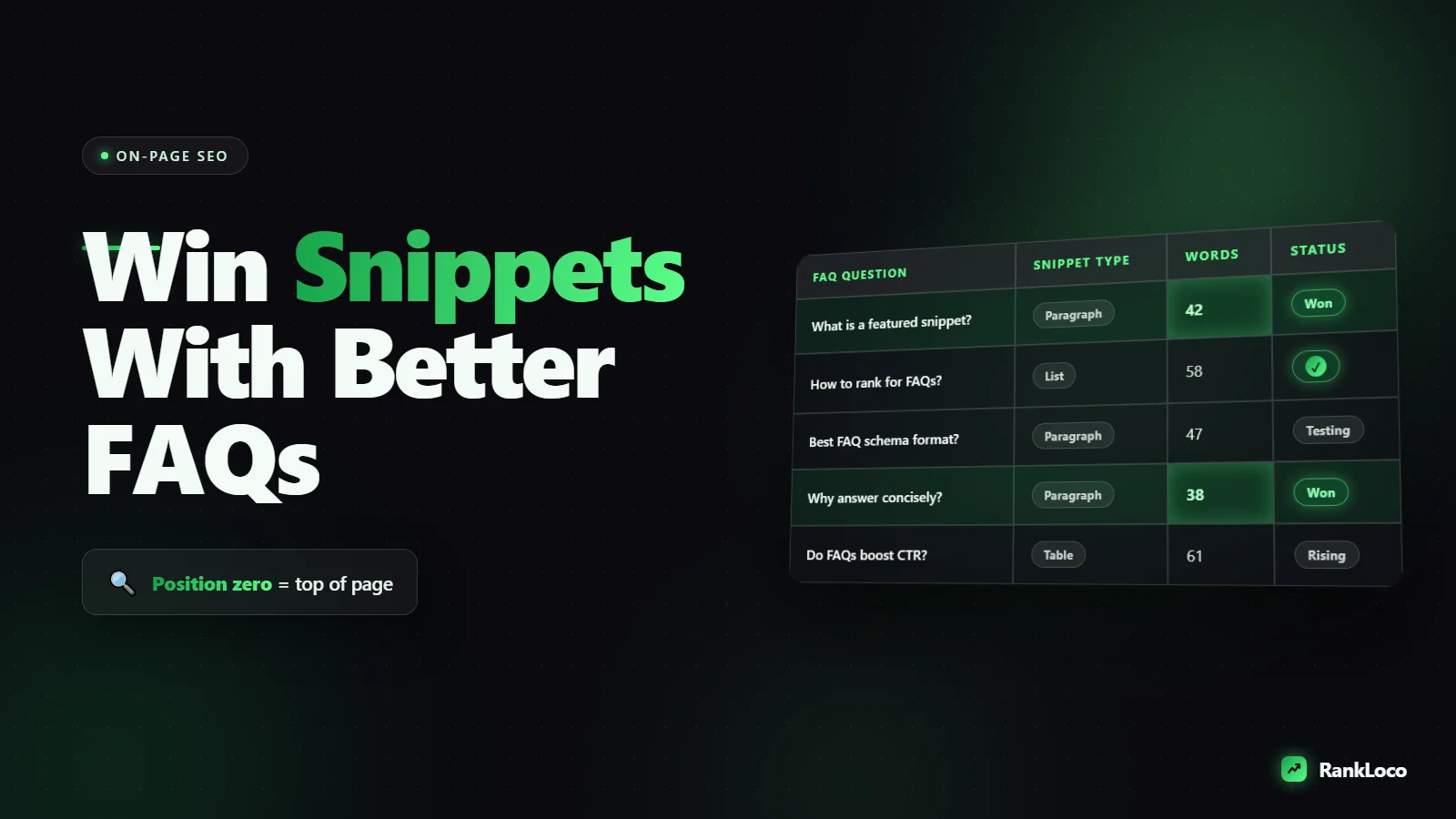
A featured snippet is the answer box Google pulls to the top of the results (position zero). For question-based queries, Google is looking for one thing: a short, direct answer it can display in roughly 40 to 60 words without cutting off mid-thought. Your job is to hand it that answer on a plate.
There are three snippet formats that FAQ content commonly wins:
- Paragraph snippets: a short block of text answering a "what," "why," or "how much" question. This is the most common and the easiest to target with FAQs.
- List snippets: ordered or unordered lists answering "how to" or "steps" questions. Format your answer as a real HTML list and Google may pull it.
- Table snippets: comparison or pricing data. If your answer involves numbers or options, a clean table can win.
The common thread: structure. Google cannot extract an answer buried in a rambling paragraph. It extracts answers that are visually and semantically separated from the rest of the page.
How to find FAQ questions worth answering
You cannot snippet-optimize a question nobody asks. Before you write a single answer, build a list of real questions tied to your topic. These are the sources that actually work:
People Also Ask and autocomplete
Type your main topic into Google and read the People Also Ask box. Click one question and it expands into more. These are literal snippet-eligible questions Google has already decided people want answered. Google autocomplete does the same job for partial queries. I break down the full process in this guide on how to find long tail keywords using Google autocomplete and People Also Ask, and FAQ content is where those long-tail questions pay off fastest.
Search Console queries
Open Google Search Console, filter the Queries report for terms containing "how," "what," "why," "can," and "does." You are looking for question queries where you already get impressions but rank on page two. Those are snippet opportunities you can win by adding a clean FAQ answer.
Your sales and support inbox
The questions customers email you are gold because they use natural language and reveal real intent. Mine your support tickets, live chat logs, and sales call notes. These questions often have almost no competition because no competitor thought to answer them.
How to format an FAQ answer that Google will lift
This is where most people lose the snippet. The formatting rules below are not optional if you want position zero.
| Element | What to do | Why it works |
|---|---|---|
| Question | Use an h3 heading, phrased exactly as searched | Signals the question clearly to crawlers |
| Answer length | 40 to 55 words in the first sentence or two | Matches Google's typical snippet display size |
| Answer placement | Direct answer first, context after | Google reads the opening as the extractable answer |
| Answer format | Full sentence that restates the question | Self-contained answers display cleanly |
| Lists | Real ol/ul tags, not sentences with commas | Required for list snippets |
Lead with the answer, not the windup
Do not open an answer with "This is a great question" or "It depends on several factors." Open with the answer. If the question is "How long does SEO take?" your first sentence should be "SEO typically takes four to six months to show meaningful ranking gains for a new site." Then add nuance in the following sentences. Google grabs the top, so the top has to be the answer.
Restate the question in the answer
Snippets display without the question attached sometimes, so the answer needs to make sense alone. For "What is a good bounce rate?" write "A good bounce rate for a blog is typically 60 to 80 percent," not "It is usually between 60 and 80 percent." The subject must be in the sentence.
Keep the first answer tight, then go deeper
Give the 40 to 55 word direct answer, then expand below it with examples, caveats, or a short list. This serves both the snippet-hungry crawler and the human who wants the full picture. You are not choosing between depth and snippets. You structure for both.
Add FAQPage schema to reinforce your answers
FAQPage structured data tells Google explicitly which text is a question and which is the answer. It does not guarantee a snippet, but it removes ambiguity and can earn rich result treatment. Mark up each question-and-answer pair with FAQPage schema, keep the schema text identical to the visible on-page text, and validate it in Google's Rich Results Test.
If you run WordPress and do not want another plugin, you can hand-roll it. Follow this walkthrough on how to add schema markup to a WordPress site without a plugin and drop the JSON-LD block into your page. The rule that trips people up: the schema answer text must match what a visitor sees. Hidden or mismatched content violates Google's guidelines.
A step-by-step FAQ writing checklist
Run every FAQ section through this before publishing:
- Pull real questions from People Also Ask, autocomplete, and Search Console.
- Confirm snippet opportunity: search the question and check whether a featured snippet or PAA box already shows. If it does, the query is snippet-eligible.
- Phrase the h3 question word-for-word as people search it.
- Write a 40 to 55 word direct answer that restates the question and leads with the answer.
- Format steps as lists and comparisons as tables where it fits.
- Add context below the direct answer for depth.
- Make each answer unique. Do not repeat your body content verbatim or you risk cannibalization.
- Add FAQPage schema matching the visible text.
- Validate in the Rich Results Test.
- Track the target queries after publishing to see which answers climb.
Where to place the FAQ on the page
Put the FAQ near the bottom of a long guide, after the main content, so it supports rather than interrupts the primary topic. For a product or service page, an FAQ above the footer handles objections and captures long-tail questions at once. Either way, do not stuff 20 questions in. Six to ten focused, snippet-worthy questions beat a wall of filler every time.
One caution: do not create a question in your FAQ that duplicates an h2 you already answered in the body. That creates two competing answers on one page. If you are already fighting internal overlap, read how to find and fix keyword cannibalization before expanding your FAQ blocks.
How to measure whether your FAQ is winning snippets
Winning position zero is not a set-and-forget task. Google rotates snippets, and a competitor can take yours with a tighter answer. Track your target question keywords over time so you can see when you gain or lose the box, then rewrite answers that slip. A tool like RankLoco lets you monitor those exact question queries and watch the ranking movement after you publish, and you can learn the broader workflow in this guide on how to track keyword rankings over time to measure progress.
Also watch impressions and click-through rate in Search Console. Snippets can actually lower CTR if the answer fully satisfies the searcher, so pair snippet targeting with a reason to click: a deeper list, a template, or a tool. FAQ content and voice search overlap heavily too, since voice assistants read snippet answers aloud, so it is worth reviewing how to optimize blog content for voice search queries while you build these sections. For more playbooks like this, browse the RankLoco blog.
Common FAQ mistakes that kill your snippet chances
- Vague questions: "Learn more about pricing" is not a search query. "How much does SEO cost per month?" is.
- Buried answers: wrapping the answer in three sentences of throat-clearing before you say anything useful.
- Answers that are too long: a 200 word answer gives Google nothing clean to extract.
- No schema: leaving the FAQPage markup off and making the crawler guess.
- Repeating body copy: copy-pasting an existing section into the FAQ instead of writing a fresh, self-contained answer.
- Ignoring intent: answering a question nobody searches for just to pad the page.
Frequently Asked Questions
How many questions should an FAQ section have?
Aim for six to ten focused questions that each target a real search query. Fewer than four looks thin, and more than a dozen usually means you are padding with questions nobody searches. Quality and snippet-worthiness beat volume. Every question should earn its place by matching actual search demand.
Does FAQ schema guarantee a featured snippet?
No. FAQPage schema helps Google understand your content and can earn rich result treatment, but it does not force a featured snippet. Snippets are chosen based on how well your answer matches the query and how cleanly it can be extracted. Schema supports the effort; concise, well-structured answers win the box.
How long should a featured snippet answer be?
Keep the direct answer between 40 and 55 words, delivered in the first one or two sentences. Google typically displays around 40 to 50 words in a paragraph snippet, so anything longer risks getting cut off. Give the tight answer first, then add context below it for human readers.
Can one page win featured snippets for multiple questions?
Yes. A single page can hold several FAQ answers, and each one can win a snippet for a different query. The key is making every answer unique and self-contained so Google can extract them independently. Avoid repeating the same answer or overlapping with your h2 sections, which splits ranking signals.
Should FAQ answers repeat my main article content?
No. Write fresh, self-contained answers rather than copying body paragraphs. Duplicate text creates competing answers on one page and can confuse Google about which to rank. Treat each FAQ answer as a standalone snippet candidate with its own phrasing, even when it covers a related point from your main content.
Where should I find questions to answer in my FAQ?
Pull them from Google's People Also Ask box, autocomplete suggestions, your Search Console query report, and real customer support messages. These sources use natural search language and reveal genuine intent. Prioritize questions that already trigger a featured snippet or PAA box, since those are proven snippet-eligible queries.