How to Optimize Blog Content for Voice Search Queries
To optimize content for voice search, answer specific questions in plain, conversational language within the first 40 to 50 words of a section, target long-tail and question-based keywords (who, what, where, when, why, how), and structure your page with clear headings, FAQ schema, and fast load times. Voice assistants almost always read from a featured snippet or a direct answer block, so the goal is to be the single clearest answer to a spoken question, not to stuff keywords.
Voice search is not a separate ranking system. It pulls from the same organic index you already compete in. The difference is how people phrase queries out loud and how the device chooses what to say back. Below is exactly how to adapt your blog content for that.
How Voice Search Queries Differ From Typed Searches
People type in fragments and speak in full sentences. Someone typing might search "best running shoes flat feet." The same person speaking asks "what are the best running shoes for flat feet?" That shift changes which keywords you target and how you word your answers.
Three patterns dominate voice queries:
- They are longer. Voice queries run 5 to 9 words on average instead of 2 to 3.
- They are questions. A large share start with how, what, where, when, why, or can.
- They are local and immediate. "Near me," "open now," and "how do I" phrasing is common because people often ask while doing something.
The practical takeaway: your content needs to contain the actual question a person would speak, followed by a tight, speakable answer.
Find the Question Keywords People Actually Speak
You cannot optimize for voice without knowing the real questions. Start by mining question phrasing instead of head terms.
- Use Google's own suggestions. Type your topic and read the autocomplete, the "People Also Ask" box, and "Related searches" at the bottom of the results page. Every PAA question is a voice search candidate.
- Pull long-tail question variations. Enter "how," "what," "why," and "can" before your seed keyword and record what appears. These are the spoken forms of your topic.
- Check your Search Console queries. Filter the Performance report for queries containing question words. You are often already getting voice traffic for phrases you never targeted on purpose.
- Group by intent. Not every question is worth a section. Prioritize ones with search demand and a clear informational answer.
If you want to scale this, our guide to the best free keyword research tools for small business covers where to pull question data without paying, and RankLoco's keyword research can surface question variants and their volume so you build sections around phrases people truly ask. You can also read how to estimate search volume for keywords without a paid tool to decide which questions deserve their own heading.
Structure Each Answer to Be Spoken Aloud
Voice assistants read a snippet, not a paragraph of setup. The content most likely to be chosen follows a simple shape: ask the question in a heading, then answer it immediately and completely in 2 to 3 sentences.
Use the question as your subheading
Phrase your H2 or H3 exactly as a person would speak it. "How long should a blog post be?" beats "Blog Post Length." The match between the spoken query and your heading is a strong relevance signal and makes your page easy to lift.
Answer in the first 40 to 50 words
Put the direct answer right under the heading before you expand. Aim for a self-contained response at roughly a 9th-grade reading level. Google's voice answers average around 29 words, so lead with a tight version, then add detail below for readers who want more.
Write the way people talk
Cut jargon, contractions are fine, and keep sentences short. If you would not say it out loud to a friend, rewrite it. This overlaps heavily with writing for humans in general, which we cover in how to write SEO friendly blog content that reads naturally.
Win the Featured Snippet That Voice Reads From
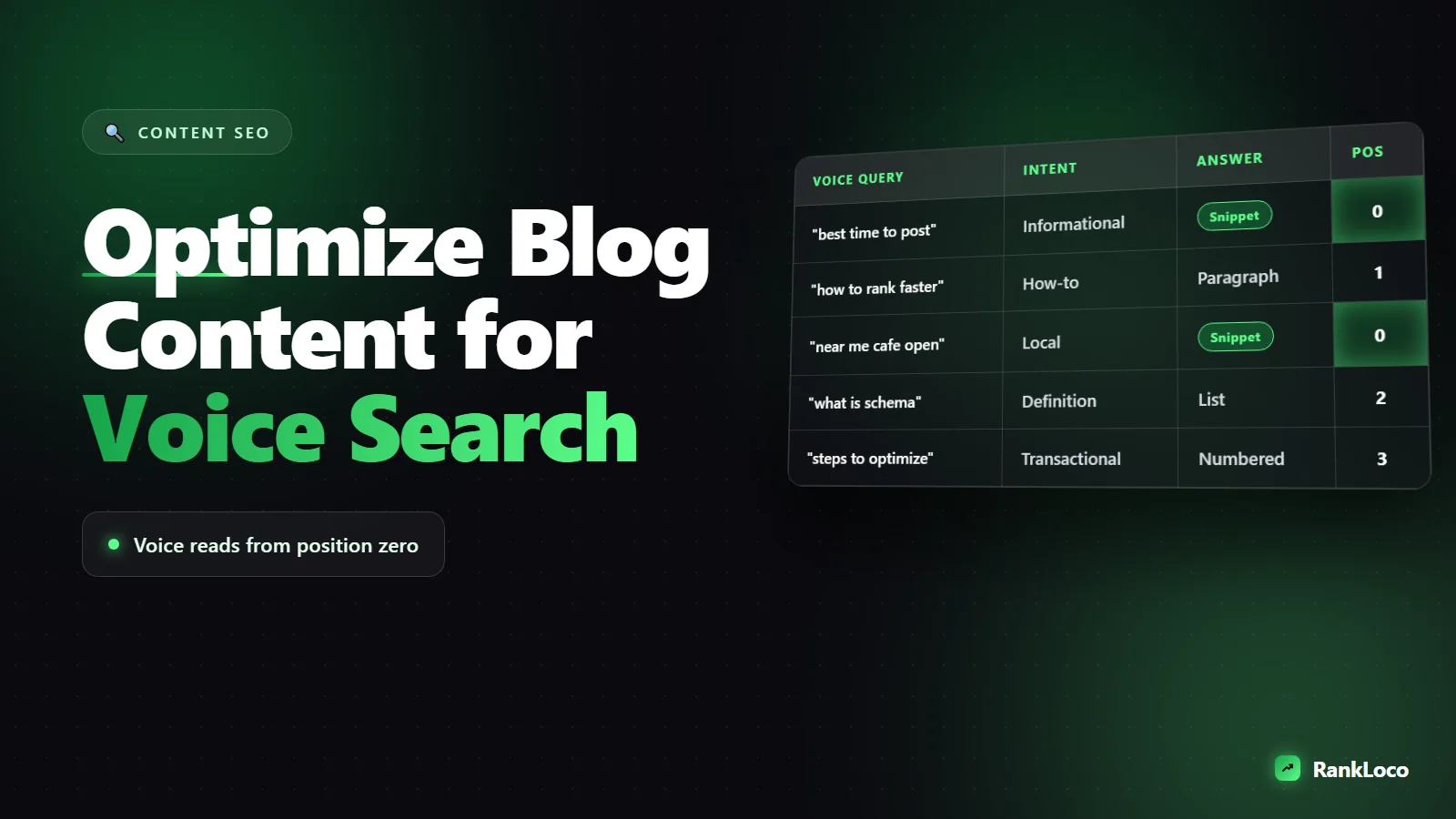
On most informational voice queries, the assistant reads the featured snippet (position zero). If you do not own the snippet, you do not get the voice answer. So snippet optimization is voice optimization.
| Snippet type | Best content format | When to use it |
|---|---|---|
| Paragraph | 40 to 60 word definition or direct answer | "What is," "why does" questions |
| Numbered list | Ordered steps with short items | "How to," "steps to" questions |
| Bulleted list | Unordered items, parallel phrasing | "Best," "types of," "examples of" |
| Table | Comparison rows with clear headers | "Versus," pricing, specs |
Match the format to the question type. If a query returns a list snippet, give Google a clean numbered or bulleted list. If it returns a paragraph, lead with a tight definition. Check the live result for your target query and copy the format that is winning, then do it better.
Add FAQ and HowTo Schema to Reinforce Answers
Structured data helps search engines understand that a block of text is a question and its answer. FAQ schema on a page with real questions and answers increases the odds of being pulled for voice and gives you extra real estate in regular results.
- Add FAQPage schema for genuine question and answer pairs on the page.
- Use HowTo schema for step-by-step tutorials.
- Keep the schema answers identical to the visible text. Mismatches get ignored or penalized.
You do not need a bloated plugin to do this. Follow our walkthrough on how to add schema markup to a WordPress site without a plugin and validate it in Google's Rich Results Test before you publish.
Fix the Technical Factors That Gate Voice Results
Voice results skew toward fast, mobile-friendly, secure pages because most voice happens on phones and smart speakers. If your page is slow or breaks on mobile, it rarely gets read.
- Speed up the page. Voice answer pages load noticeably faster than average. Compress assets and lazy-load below-the-fold content. Start with our guide to optimizing images for SEO to load faster, since images are usually the heaviest part of a blog page.
- Nail mobile usability. Readable font sizes, tap-friendly spacing, no intrusive pop-ups.
- Serve HTTPS. Secure pages dominate voice answers.
- Keep content crawlable. If Google cannot index the section cleanly, it cannot read it aloud.
Optimize for Local Voice Queries
A big chunk of voice search is local: "where's the nearest," "is X open now," "book an appointment near me." If you serve a local market, your Google Business Profile and NAP consistency matter as much as your blog copy. Keep hours, address, and categories accurate, and build pages that answer location-specific questions directly. Our guides on keyword research for a local service business and optimizing Google Business Profile posts for local search cover the local side in depth.
A Practical Voice Search Optimization Checklist
- Research real question phrasing from autocomplete, PAA, and Search Console.
- Create an H2 or H3 for each high-value question, worded as people speak it.
- Answer each question in 40 to 50 words directly under the heading.
- Use lists and tables where the query format calls for them.
- Add a Frequently Asked Questions section with FAQ schema.
- Match content format to the current featured snippet for the query.
- Keep reading level conversational and sentences short.
- Ensure the page is fast, mobile-friendly, and served over HTTPS.
- Cover local intent (near me, hours, booking) if relevant.
- Track whether target question keywords move into the top 3.
Track Whether Your Voice Optimization Is Working
You cannot directly see "voice" traffic in most reports, so you measure proxies: rankings for question keywords, featured snippet ownership, and impressions for long-tail question queries in Search Console. If you are climbing into the top 3 and owning snippets for your question terms, you are winning the voice reads too.
Set up rank tracking for your question keywords and watch them over time. RankLoco lets you monitor question-based phrases and see when you capture a featured snippet, which is the clearest signal you are eligible for voice. For the full workflow, see how to track keyword rankings over time to measure progress, and browse more guides on the RankLoco blog or start a free audit and keyword search to find your question opportunities.
Frequently Asked Questions
Does voice search use a different ranking algorithm than normal search?
No. Voice search pulls from the same organic index and ranking systems as typed search. The assistant usually reads the featured snippet or top result. So ranking in the top three and owning the snippet for a question is what makes you eligible to be the spoken answer.
How long should a voice search answer be?
Keep the core answer to about 29 to 50 words so it can be read aloud cleanly. Place it immediately under a question heading, then expand with detail below for readers. A tight lead sentence plus one or two supporting sentences is the sweet spot for getting lifted.
What kind of keywords work best for voice search?
Long-tail, conversational, question-based keywords work best. Instead of two-word head terms, target full spoken questions starting with how, what, why, where, when, or can. These phrases have clearer intent and less competition, making it easier to rank and be chosen as the answer.
Does FAQ schema help with voice search rankings?
FAQ schema does not directly boost rankings, but it helps search engines identify question and answer pairs, which improves your chances of being surfaced for voice and in rich results. Keep schema answers identical to your visible text and validate the markup before publishing to avoid errors.
How do I find the questions people ask by voice?
Mine Google autocomplete, the People Also Ask box, and Related searches for your topic. Then filter your Search Console Performance report for queries containing question words. Group the real questions by intent and build a heading and short answer for each high-demand one.
Is voice search optimization worth it for a small blog?
Yes, because the work overlaps entirely with ranking for question keywords and featured snippets, which drive typed traffic too. You are not building a separate asset. You are writing clearer, more direct content that wins snippets, and voice answers come as a bonus from the same effort.