How to Recover From a Google Core Update
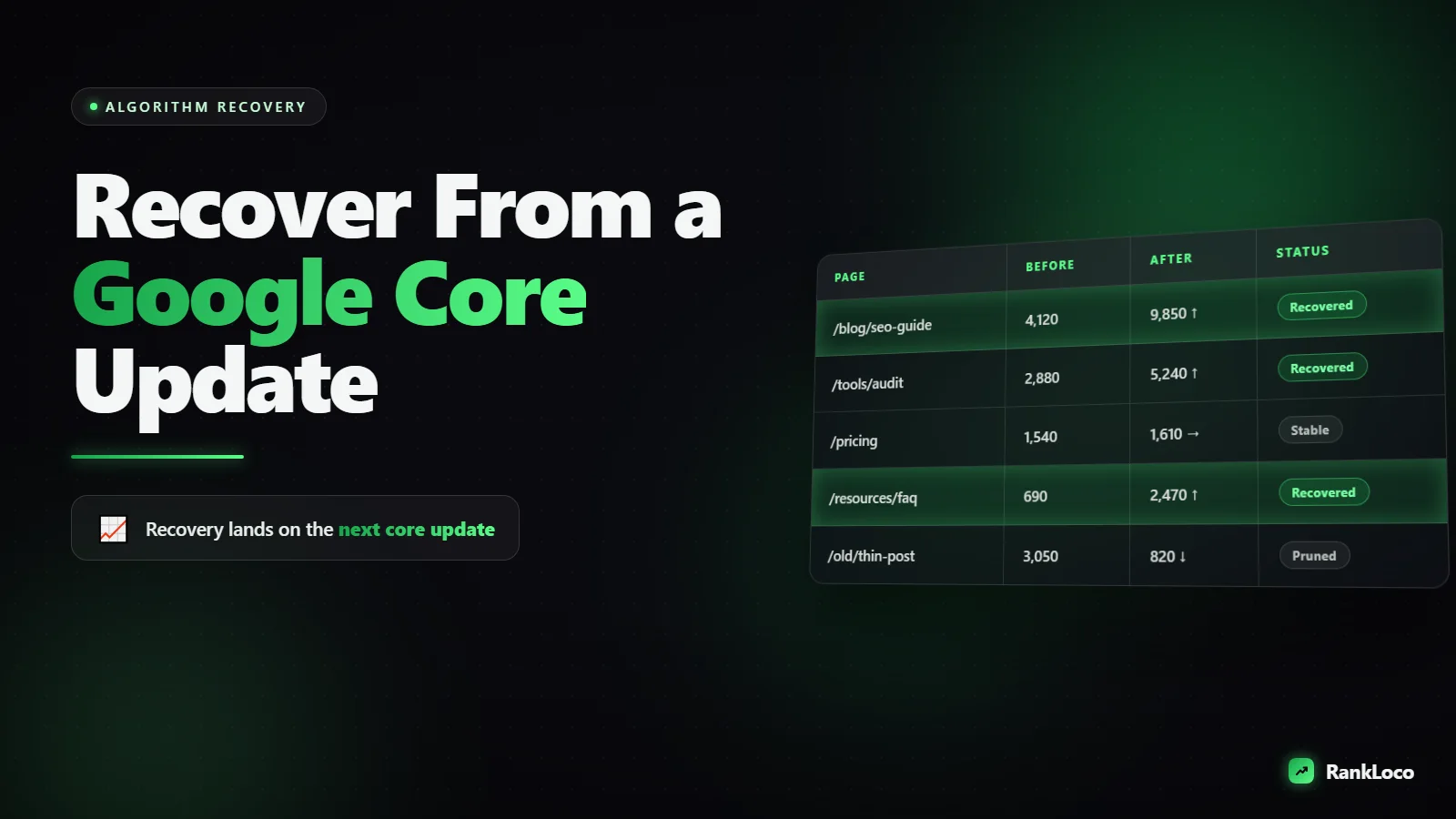
To recover from a Google core update, first confirm the drop is real by checking Search Console traffic against the update's rollout dates, then identify which pages and query types lost rankings. Core updates reassess content quality, relevance, and trust across your whole site, so recovery means improving the pages that fell (and often the pages linking to them), not chasing a single technical bug. Most recoveries land on the next core update, weeks or months later, not overnight.
That last sentence trips people up. There is no button to press and no penalty to lift. A core update is Google re-scoring the web. If your content got outranked by something better, the fix is being better. Let's walk through exactly how to figure out what happened and what to do about it.
Confirm It Was Actually the Core Update
Before you rewrite half your site, prove the core update caused the drop. Plenty of traffic losses get blamed on updates when the real cause is a botched migration, a noindex tag left in production, or seasonality.
- Line up the dates. Google announces core update rollout start and end dates. In Google Search Console, open Performance, set the date range to cover 4 weeks before and after, and compare. A core update hit looks like a step change that begins during the rollout window and holds.
- Check clicks and impressions separately. If impressions dropped, you lost rankings. If impressions held but clicks fell, the problem is SERP layout or CTR, often a new SERP feature stealing your clicks, not the core update.
- Segment by page and query. Sort by page. Recovery is easier when you see a pattern: a whole content category tanked, or your money pages dropped while blog traffic held.
- Rule out the boring stuff. Confirm no accidental noindex, no robots.txt block, no canonical pointing to the wrong URL, no server outages during the window.
If the timing doesn't match a known update, stop reading about core updates and run a full SEO audit to find what actually broke.
Diagnose Which Pages Lost Ground and Why
Export your losers. Pull the pages and queries that lost the most clicks and impressions during the rollout, then group them. You are looking for the story behind the drop.
Compare your dropped pages to what now ranks
For each big loser, run the query and study the pages that replaced you. Ask honest questions:
- Do the winners answer the query more completely than you do?
- Are they more current? Old content with stale dates and dead advice gets demoted fast.
- Do they show more first-hand experience: real examples, screenshots, original data, author expertise?
- Is your page a thin affiliate roundup or AI-spun filler competing against genuinely useful pages? Core updates crush that.
Look for site-wide quality drag
Core updates score sites holistically. A pile of low-value pages (thin tag archives, doorway pages, old content nobody reads) can drag down your good pages. If 30% of your indexed URLs are junk, that dilutes the whole site's perceived quality.
The Google Core Update Recovery Checklist
Work through this in order. Start with the highest-traffic pages that lost the most.
| Area | What to check | Action |
|---|---|---|
| Content quality | Does the page fully answer the query and beat what ranks now? | Rewrite for depth, accuracy, and original insight. Cut fluff. |
| Freshness | Stale stats, outdated screenshots, old years in titles | Update facts, refresh examples, re-verify every claim |
| Experience (E-E-A-T) | Named author, credentials, first-hand proof | Add author bios, real examples, original data or testing |
| Search intent match | Are you serving the intent the SERP now rewards? | Re-shape the page to match dominant intent (guide vs. tool vs. comparison) |
| Thin/duplicate content | Low-value pages diluting the site | Consolidate, improve, or noindex/prune the dead weight |
| Internal links | Are strong pages passing authority to your money pages? | Fix your internal linking structure |
| Technical health | Core Web Vitals, crawlability, mobile | Run the technical SEO fixes that move rankings |
Fix Content Quality First (It's Almost Always Content)
Core updates are content-quality events far more than technical ones. If you only do one thing, improve your content. Here's the practical order of operations.
Rewrite your top losers to genuinely be the best result
Take your highest-value dropped page and rebuild it to be more useful than everything ranking above it. That means:
- Answer the main question in the first two sentences, then go deeper than competitors.
- Add the sub-questions people actually ask (pull them from People Also Ask and related searches).
- Include specifics: numbers you can back up, step-by-step instructions, real screenshots, examples from your own work.
- Cut everything that pads word count without adding value. Length is not the goal; usefulness is.
Add real experience and authorship signals
Google's helpful content guidance leans hard on demonstrated experience. Show it. Add a real author with relevant credentials. Reference things you personally tested or observed. If your content reads like it could have been written by anyone about anything, that's a problem the update will keep punishing.
Prune or improve the dead weight
Inventory every indexed URL. For each low-traffic, low-value page, decide: improve it, merge it into a stronger page with a 301 redirect, or noindex it. Reducing the ratio of thin pages to strong pages often lifts the site as a whole on the next update.
Rebuild Trust and Authority Signals
If your content is already solid, the differentiator is trust. Google is deciding whether your site deserves to be the answer.
- Backlinks: Earn links from relevant, credible sites. Also audit for spammy links you (or a past agency) built; disavow only the clearly toxic ones.
- Brand signals: Consistent name, real contact info, an about page, and evidence you're a legitimate operation.
- Consistency for local sites: If you serve a local market, clean citations and consistent NAP data reinforce trust across the board.
- Reviews and reputation: Positive, genuine reviews and mentions strengthen how Google reads your reliability.
Track Recovery Properly and Wait for the Next Update
Here's the part nobody likes: core update recovery usually happens on a future core update, not continuously. Google confirms this. You make your fixes, then the next core update re-scores your site and your improvements register. That gap can be a few weeks to several months.
What to do in the meantime:
- Set a baseline. Log your current rankings and traffic for the affected keywords before you change anything, so you can prove recovery later.
- Track daily. Watch your target keywords with a rank tracker so you catch movement the moment the next update rolls. RankLoco makes it easy to monitor rankings and spot when an update starts shifting your positions.
- Keep publishing quality. Don't freeze. A steady stream of genuinely helpful content signals a healthy, active site.
- Document changes with dates. When recovery comes, you'll know which fixes worked.
Common Recovery Mistakes That Waste Months
- Panic-deleting content: Removing pages that were fine loses traffic you'll never get back. Diagnose first.
- Chasing tiny technical tweaks: Shaving 0.2s off load time won't reverse a content-quality demotion.
- Keyword stuffing the rewrites: Writing for the algorithm instead of the reader is exactly what the update targets.
- Expecting instant results: If you rewrite everything on day one and see nothing in a week, that's normal. Wait for the next core update.
- Buying links to "fix" it: Manipulative link building digs a deeper hole.
Recovery is not glamorous. You diagnose what fell, honestly compare yourself to what now wins, fix content and trust, and wait for Google to re-score. For more playbooks on getting rankings back and growing them, browse the RankLoco blog.
Frequently Asked Questions
How long does it take to recover from a Google core update?
Recovery typically arrives on the next core update, which can be anywhere from a few weeks to several months after the one that hit you. Google re-scores sites during core updates, so improvements you make between updates usually won't register in rankings until the next rollout.
Can you recover from a core update without waiting for the next one?
Rarely. Some ranking movement can happen as Google re-crawls and re-evaluates improved pages, but a full core update recovery almost always aligns with a subsequent core update. Make your fixes now so they're already in place when the next update rolls out.
Is a core update the same as a manual penalty?
No. A manual penalty appears in Search Console under Manual Actions and can be lifted with a reconsideration request. A core update is an algorithmic re-scoring with no notice and no button to appeal. You recover by improving quality, not by submitting a request.
Do I need to delete pages after a core update?
Not automatically. Only prune pages that are genuinely thin, duplicate, or valueless after you've analyzed traffic and intent. Deleting pages that were performing or could be improved just loses ground. Improve or consolidate first; delete only true dead weight.
How do I know if my content was hit for quality or intent?
Compare your dropped page to what now ranks. If the winners are more complete, current, and credible, it's a quality issue. If they serve a different format (a tool, a comparison, a video) than your page, it's an intent mismatch and you need to change what the page delivers, not just polish it.
Will improving Core Web Vitals help me recover?
Only slightly, and only if speed was genuinely bad. Core updates are primarily about content helpfulness, relevance, and trust. Fix technical issues because they matter for users, but don't expect page speed alone to reverse a content-driven demotion.