What Are SERP Features and How to Win Them
SERP features are the non-standard results Google shows around the traditional blue links: featured snippets, People Also Ask, image packs, video carousels, the local map pack, knowledge panels, sitelinks, and more. You win them by matching the exact format Google wants for a query (a direct answer, a list, a table, structured data, or a strong local profile) and earning enough authority to be pulled into that slot. This guide breaks down every major feature and the specific steps to capture each one.
What Counts as a SERP Feature
A SERP feature is anything on the search results page that isn't a plain organic listing. Google uses them to answer queries faster, and they eat clicks that would otherwise go to the standard results. If you rank #1 but a featured snippet sits above you, that snippet is stealing your traffic. Understanding which features appear for your keywords, and formatting your content to win them, is one of the highest-leverage things you can do in SEO.
Here are the features worth chasing, ranked by how often they matter for most sites.
| Feature | What it looks like | Best for |
|---|---|---|
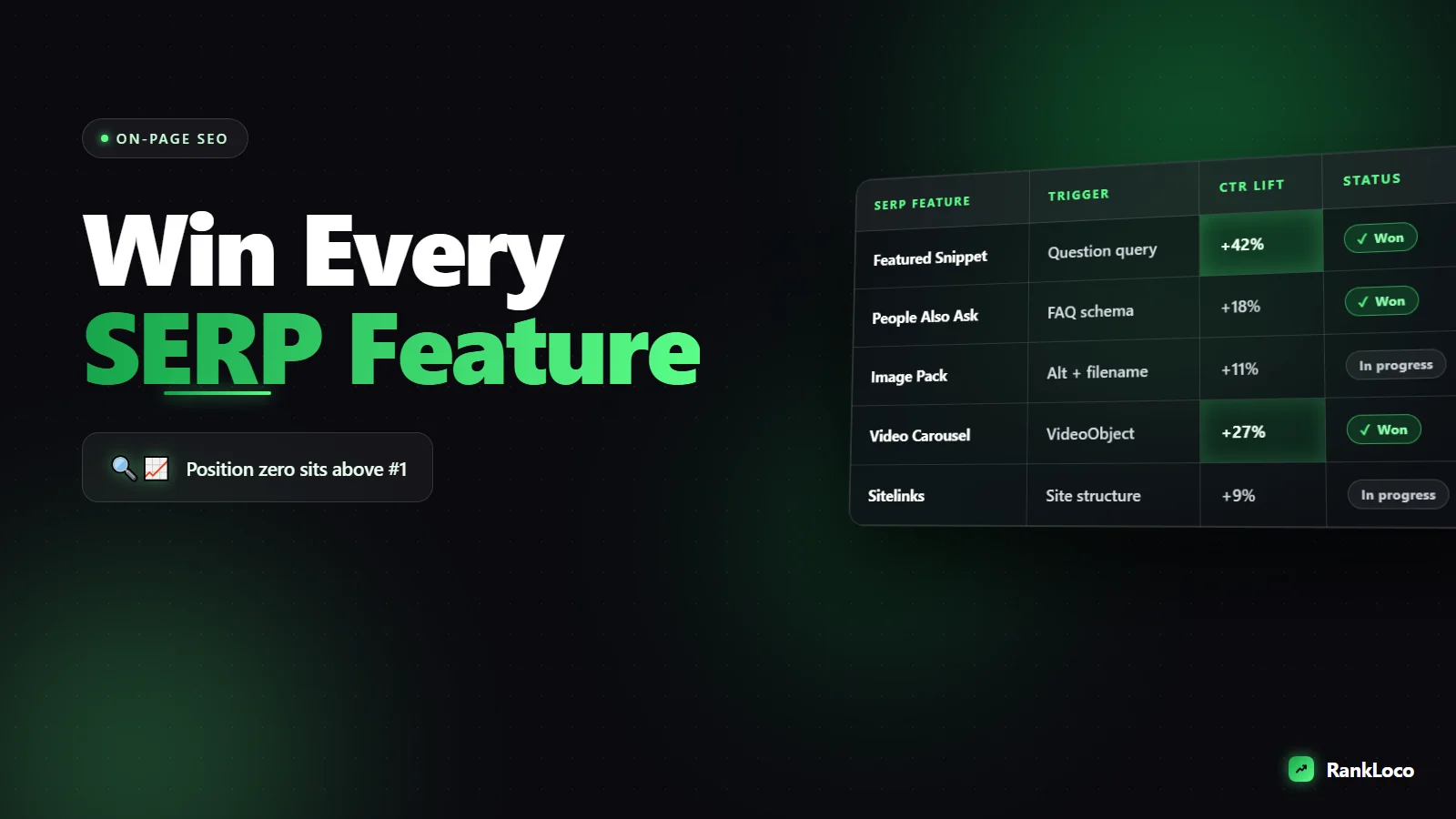
| Featured snippet | Boxed answer at the top (position zero) | Question and definition queries |
| People Also Ask | Expandable question accordion | Related sub-questions |
| Local map pack | Map with 3 business listings | Local intent ("near me") |
| Image pack | Row of images | Visual queries |
| Video carousel | Scrollable video thumbnails | How-to and review queries |
| Sitelinks | Sub-pages under a brand result | Branded and navigational searches |
| Knowledge panel | Info box on the right | Entities, brands, people |
| Reviews / star ratings | Yellow stars in a listing | Products, recipes, services |
| Top stories | News carousel | Timely, newsworthy topics |
How to Win Featured Snippets (Position Zero)
The featured snippet is the biggest prize because it sits above the #1 organic result. Google pulls it from a page that already ranks on page one, usually in the top 5, so you rarely win a snippet without ranking well first. Your job is to format the answer so it's the easiest one for Google to lift.
The three snippet formats
- Paragraph snippet: a 40 to 60 word direct answer. Ask the question as an H2 or H3, then answer it immediately in the first sentence below.
- List snippet: an ordered or unordered list. Use real HTML list tags with a clear intro sentence. Great for "how to" and "steps" queries.
- Table snippet: a comparison or data table. Use proper table markup, not an image.
Snippet-winning checklist
- Find the query and check what format currently wins. Match it exactly.
- Put the question in a subheading using the searcher's exact wording.
- Answer in the very next sentence, self-contained, 40 to 60 words.
- Follow with deeper detail so the page still earns the click.
- Keep the answer factual and skimmable, no fluff before it.
- Make sure you already rank on page one for the term. If not, that comes first.
Snippets rotate. Track them so you know when you win, lose, or get stolen. You can monitor which of your keywords trigger snippets and who holds them inside RankLoco so you're not guessing.
How to Win People Also Ask (PAA) Boxes
People Also Ask boxes are a cluster of related questions that expand into short answers. They're everywhere and they're easier to win than the main snippet because there are multiple slots per query. Each answer inside a PAA is pulled the same way a featured snippet is: a clear question followed by a tight answer.
To capture PAA slots:
- Build a list of the actual questions that appear. Type your main keyword into Google and click a few PAA boxes to expand more.
- Add an FAQ section or Q&A subheadings that answer those questions directly, one question per H3.
- Keep each answer to 2 to 4 sentences with the key fact up front.
- Add FAQPage schema so Google can parse your Q&A cleanly.
PAA and featured snippets feed each other. A page structured around real questions tends to win both. Solid keyword research is how you find the exact questions people ask, so start there before you write.
How to Win the Local Map Pack
The map pack is the block of three business listings with a map, and for any local query it dominates the page. Winning it has nothing to do with your website content and everything to do with your Google Business Profile, reviews, proximity, and local signals.
The essentials:
- Claim and fully complete your Google Business Profile. Categories, hours, services, photos, and description all matter.
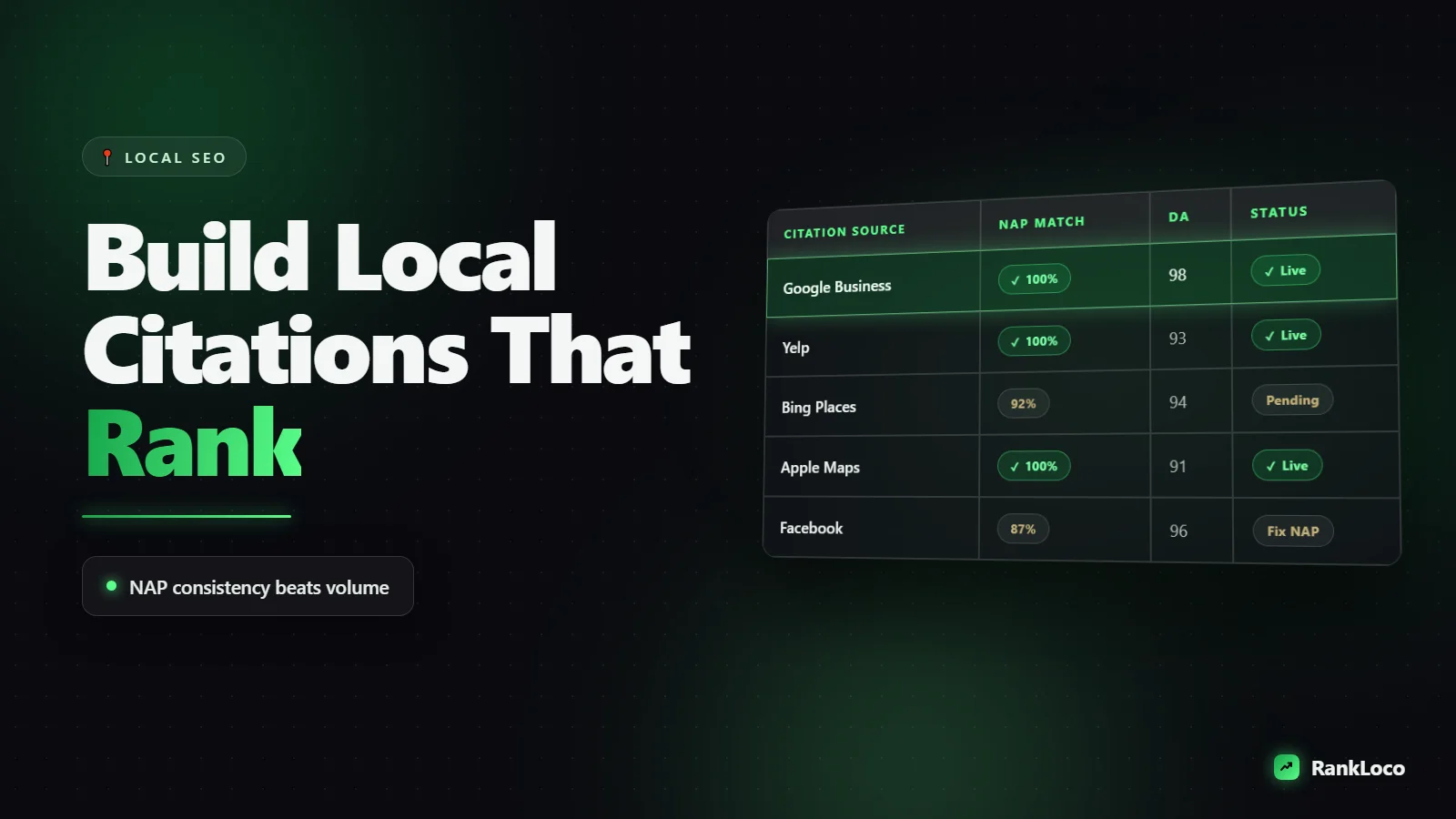
- Keep your name, address, and phone identical everywhere online. Read why NAP consistency for local SEO matters if this is loose right now.
- Earn steady, recent reviews and reply to them.
- Build accurate local citations across directories.
Local features run on their own playbook. Our guide to Google Maps ranking factors covers what actually moves you into the top three, and it's the fastest local traffic you can win.
How to Win Image and Video Features
Image packs and video carousels show up for visual and how-to queries. If your topic has any visual element, these are open slots most competitors ignore.
Image packs
- Use original, high-quality images, not stock everyone else uses.
- Write descriptive, keyword-relevant file names and alt text.
- Add images near the relevant text on the page and include an image sitemap.
Video carousels
- Publish on YouTube with a keyword-optimized title and description.
- Add timestamps (chapters) so Google can surface key moments.
- Embed the video on a matching page and add VideoObject schema.
How Schema Markup Unlocks Rich Results
Structured data is how you tell Google exactly what your content is, which unlocks review stars, FAQ accordions, recipe cards, product info, and more. It doesn't guarantee a feature, but many rich results are impossible without it.
Prioritize these schema types:
- FAQPage for question and answer content.
- Review / AggregateRating for products and services (star ratings).
- HowTo for step-by-step guides.
- Product for ecommerce pages (price, availability).
- LocalBusiness for physical locations.
If you run a local site, our breakdown of how local business schema markup helps you rank shows exactly what to add. Validate everything with Google's Rich Results Test before you ship it.
How to Win Sitelinks and Knowledge Panels
You don't directly control these two, but you influence them.
Sitelinks appear under your result for branded searches. Google generates them automatically based on a clear site structure. Help it by using a logical navigation, descriptive internal links, and clean, unique page titles. A solid site architecture is also good technical SEO that pays off in more ways than sitelinks.
Knowledge panels pull from trusted sources about an entity (a brand, person, or place). To improve your odds: keep your Google Business Profile accurate, get consistent mentions across the web, use Organization schema with your logo and social links, and maintain a strong presence on authoritative sites in your niche.
How to Find Which SERP Features to Target
Don't chase every feature. Chase the ones that show up for your money keywords. Here's the process:
- Pull your target keyword list.
- For each keyword, note which SERP features currently appear (snippet, PAA, map pack, images, video).
- Match content format to the feature. Question in a subheading for snippets, lists for list snippets, tables for comparisons, GBP work for the map pack.
- Prioritize features on keywords where you already rank on page one, since those are the quickest wins.
- Track before and after so you can prove which changes captured the feature.
Doing this by hand for a big keyword list is brutal. A rank tracker that flags SERP features per keyword saves hours and shows you exactly where the opportunities are. Browse more SEO guides if you want to go deeper on the content side.
SERP Feature Optimization Checklist
- Identify which features appear for each target keyword.
- Add question-based subheadings with 40 to 60 word direct answers.
- Use real list and table markup, never images of lists or tables.
- Build a genuine FAQ section with FAQPage schema.
- Add relevant schema for your content type (Review, HowTo, Product, LocalBusiness).
- Optimize images with descriptive alt text and file names.
- Publish and embed video with chapters for video queries.
- Fully complete and maintain your Google Business Profile for local intent.
- Keep site structure clean to earn sitelinks.
- Track features monthly and adjust format when you lose a slot.
Frequently Asked Questions
Do SERP features increase or decrease my traffic?
It depends. Winning a featured snippet or map pack slot usually increases clicks and visibility. But features you don't own (like a snippet above your #1 listing or a knowledge panel that answers the query fully) can reduce your clicks. The goal is to own the features on your keywords, not just rank below them.
Can I appear in a featured snippet without ranking on page one?
Almost never. Google pulls featured snippets from pages already ranking on page one, usually the top five. So the play is: rank on page one first, then format your answer (a tight 40 to 60 word response under a question heading) to become the easiest one for Google to lift into the snippet.
How do I remove my page from a featured snippet?
Add the nosnippet meta tag or use data-nosnippet on the specific text you don't want lifted. Most people should not do this, since snippets usually help. Only opt out if you find the snippet answers the query so completely that people stop clicking through to your page.
What is the difference between a featured snippet and People Also Ask?
A featured snippet is a single boxed answer at the very top of the results (position zero). People Also Ask is an expandable list of related questions lower on the page, with multiple slots. Both pull short answers from ranking pages, but PAA gives you more chances to appear across related questions.
Does schema markup guarantee a rich result?
No. Valid schema makes your page eligible for a rich result, but Google decides whether to show it based on quality, relevance, and trust. Add correct, non-spammy structured data, validate it with the Rich Results Test, and treat it as improving your odds rather than a guarantee.
How often do SERP features change?
Constantly. Features appear and disappear per query, and the page that holds a snippet can change week to week. That's why you should track your target keywords over time rather than checking once. Regular monitoring tells you when you win, lose, or get displaced so you can react fast.