Search Intent: How to Match Content to What Users Want
Search intent is the reason behind a search: what the user actually wants when they type a query. To rank in 2026, your page has to match that intent, not just the keyword. The fastest way to check intent is to Google the term yourself and look at what already ranks. If the top 10 are all how-to guides and you built a product page, you will not rank no matter how many backlinks you buy.
Google has spent two decades learning what satisfies each query. The pages sitting in the top positions are a live scoreboard of what Google believes the intent is. Your job is to read that scoreboard, then build something that fits the pattern and beats it on usefulness. Below is exactly how to do that.
The four types of search intent
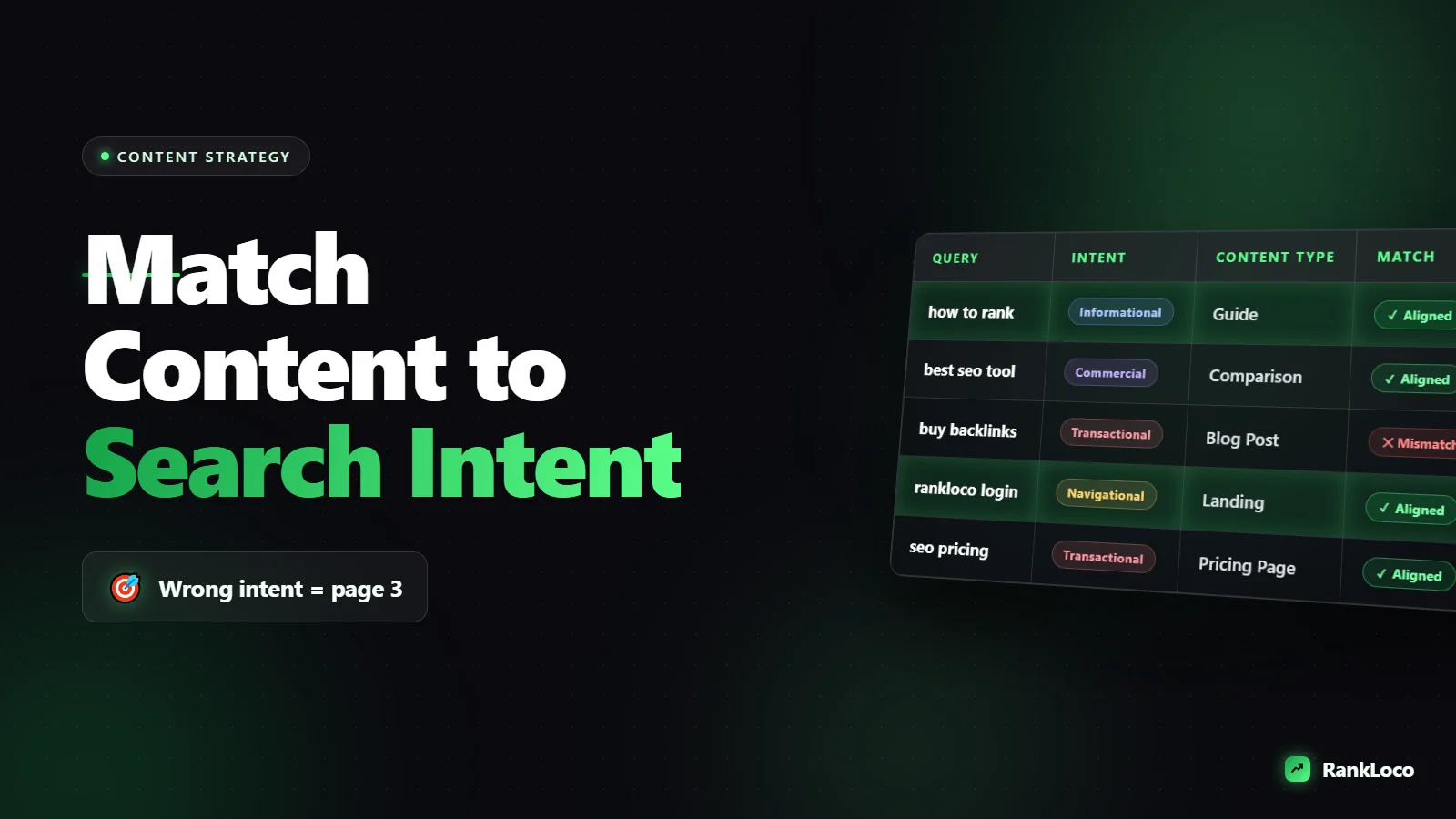
Almost every query falls into one of four buckets. Get the bucket right and you are halfway to ranking. Get it wrong and the best content in the world will sit on page three.
| Intent type | What the user wants | Query examples | Best content format |
|---|---|---|---|
| Informational | To learn or understand something | "what is search intent", "how to change a tire" | Guides, tutorials, definitions |
| Navigational | To reach a specific site or page | "gmail login", "rankloco pricing" | Branded pages, login screens |
| Commercial | To research before buying | "best rank tracking tools", "ahrefs vs semrush" | Comparisons, reviews, listicles |
| Transactional | To take an action or buy now | "buy running shoes", "seo audit tool free trial" | Product pages, pricing, signup |
The mistakes happen at the edges. "Best CRM software" looks transactional because of the buying signal, but the SERP is full of listicle reviews, which is commercial intent. "CRM software" alone often shows a mix of product pages and definitions. Never assume. Always check.
How to diagnose search intent from the SERP
Reading the results page is the single most reliable intent research method. Here is the process I run for every target keyword before writing a word.
- Search the exact query in an incognito window. Logged-out and incognito removes personalization so you see closer to a neutral SERP.
- Note the dominant content format. Are the top results blog posts, product pages, category pages, videos, or tools? That format is your baseline. Match it.
- Read the titles and meta descriptions. They tell you the angle Google rewards. If every title says "2026" or "free" or "for beginners", that modifier is part of the intent.
- Check the SERP features. A featured snippet signals a quick-answer informational query. A shopping carousel signals transactional intent. A local map pack means the query has a geographic component. Our guide on what SERP features are and how to win them breaks down what each one demands.
- Scan People Also Ask. These related questions reveal the sub-questions users have, which you should answer inside your content.
If the top 10 are wildly mixed (some product pages, some guides), that is a fractured or ambiguous intent. You can win these by covering the query broadly or by targeting the specific sub-intent that is underserved.
Matching content format and depth to intent
Once you know the intent, three things have to line up: format, depth, and the next action you offer.
Format: give them the shape they expect
If informational queries dominate the SERP, do not force a hard sell. Write the guide. If it is commercial, build the comparison table or the ranked list. If it is transactional, get out of the way and let them convert with a clean product page. Fighting the format is the most common reason good content fails.
Depth: match the effort the query deserves
"What time is the Super Bowl" needs one sentence. "How to do keyword research" needs a full walkthrough. Length is not a ranking factor, but thoroughness relative to intent is. Look at the word count and subtopic coverage of the current top results as a floor, then decide whether you can be more complete without padding. Our breakdown of how to do keyword research in 2026 is a good model of matching depth to a research-heavy query.
Next action: fit the buyer stage
Informational readers are not ready to buy, so push them to a related guide or a newsletter, not a demo. Commercial readers want a comparison and maybe a free trial. Transactional visitors want the buy button front and center. Mismatch the call to action and your bounce rate spikes, which tells Google your page did not satisfy the query.
Intent modifiers: the words that change everything
Small words inside a query flip the intent completely. Train yourself to spot these modifiers because they decide what you build.
- Informational signals: how, what, why, guide, tutorial, ideas, examples, tips
- Commercial signals: best, top, review, vs, comparison, alternative, cheapest
- Transactional signals: buy, price, coupon, discount, near me, free trial, order
- Local signals: near me, in [city], open now, delivery
Local modifiers deserve special attention. "Plumber near me" is transactional with a geographic layer, and it triggers the map pack. If you serve a local market, treat these queries with a location-optimized page and profile. Our local SEO playbook for small businesses covers exactly how to rank for those intent-loaded local searches.
Mapping keywords to the buyer journey
Search intent maps cleanly onto the marketing funnel, and building content for each stage is how you capture demand at every point instead of only chasing bottom-funnel money terms.
| Funnel stage | Intent | Content to build |
|---|---|---|
| Top (awareness) | Informational | How-to guides, definitions, problem-focused posts |
| Middle (consideration) | Commercial | Comparisons, "best of" lists, case studies |
| Bottom (decision) | Transactional | Product pages, pricing, free trials, demos |
A common failure is having only bottom-funnel pages. You compete with everyone for a tiny pool of ready-to-buy searchers and ignore the much larger top and middle of the funnel. Build a spread. Then connect them with a smart internal linking strategy so informational readers can flow toward your commercial and transactional pages.
How to audit existing pages for intent mismatch
If a page ranks on page two and stalls, or gets impressions but no clicks, intent mismatch is a prime suspect. Run this quick audit on your underperformers.
- Pull the query the page actually ranks for in Google Search Console (Performance report, filter by page).
- Search that query and compare your page format against the top results. Same format? If not, that is your problem.
- Check the primary intent against your content type. A product page ranking for an informational query will underperform.
- Look at engagement signals. High impressions with low click-through often means your title promises the wrong thing. High clicks with fast pogo-sticking means the content did not deliver on the promise.
- Decide: reshape or split. Either rewrite the page to match the dominant intent, or create a separate page for the intent you were accidentally targeting.
Tracking these movements over time is where a tool earns its keep. With RankLoco you can watch rank positions for each target keyword and catch a page that is slipping because a SERP intent shifted, then use the site audit to flag pages competing against the wrong result type. For more diagnostic workflows, browse our library of SEO guides.
When search intent shifts (and it does)
Intent is not permanent. Google reinterprets queries as user behavior changes, and a core update can rewrite what ranks overnight. A query that used to reward product pages might suddenly favor guides. If you lose rankings after an algorithm change and your content did not get worse, check whether the SERP intent moved underneath you. Our guide on recovering from a Google core update walks through how to spot and respond to these shifts.
Build a habit: re-check the SERP for your top-priority keywords every quarter. If the format of the top results has changed, your content needs to change with it. The sites that win long term are the ones that keep re-matching intent instead of assuming the query means today what it meant two years ago.
Search intent checklist
- Search the exact keyword incognito before writing anything
- Identify the dominant content format in the top 10 and match it
- Classify the intent: informational, navigational, commercial, or transactional
- Spot intent modifiers (best, buy, how, near me) that shape the query
- Match content depth to what the top results cover, then beat it
- Align your call to action with the buyer stage
- Answer the People Also Ask questions inside your content
- Audit underperforming pages for intent mismatch every quarter
- Re-check SERP intent after major algorithm updates
Frequently Asked Questions
How do I find the search intent of a keyword?
Search the exact keyword in an incognito window and study the top 10 results. The dominant content format (guides, product pages, comparisons, or videos) reveals what Google believes the intent is. Also check SERP features and People Also Ask for extra signals about what users want.
Can one keyword have multiple search intents?
Yes. Ambiguous queries like "apple" or "CRM software" show mixed results because users want different things. When the SERP is fractured, you can either cover the topic broadly or target one specific underserved sub-intent. Check which angle has the weakest current results and build for that gap.
What happens if my content does not match search intent?
It will struggle to rank regardless of backlinks or on-page optimization, because Google prioritizes results that satisfy the query. Even if you rank briefly, poor engagement signals like fast pogo-sticking push you back down. Matching intent is a prerequisite, not an optional bonus.
Is search intent a Google ranking factor?
Google does not list "intent" as a named ranking factor, but its systems are built to reward pages that best satisfy the query behind a search. In practice, matching intent is one of the most important things you control, because it governs whether your content type can compete at all.
How often does search intent change for a keyword?
It varies, but core updates and seasonal shifts can change intent within months. Re-check the SERP for your priority keywords quarterly. If the format of the top results has changed (for example, from product pages to guides), update your content to match the new pattern.
What is the difference between search intent and keyword research?
Keyword research finds which terms people search and their volume. Search intent tells you why they search and what content to build. You need both: research identifies the opportunity, and intent analysis tells you the format and angle that will actually rank for it.