How to Find Low Competition Keywords for a New Website
To find low competition keywords for a new website, target long-tail queries (3+ words) with clear intent, low keyword difficulty, and search results that are dominated by weak pages (forums, thin blogs, outdated posts) rather than big brands. Start by pulling keyword ideas around your niche, filter for difficulty under about 20 and search volume you can live with, then manually check the top 10 results to confirm you can beat them. That last step, the manual SERP check, is what separates keywords you'll rank for from keywords you'll waste months on.
A brand-new site has no domain authority and no track record with Google. You cannot outrank established sites on broad, competitive terms yet. Your entire early strategy should be finding gaps: queries with real demand where the current results are beatable. Here's exactly how to do it.
What "low competition" actually means for a new site
Most people obsess over the keyword difficulty (KD) score their tool spits out. That number matters, but it's only half the picture. A keyword is genuinely low competition when three things line up:
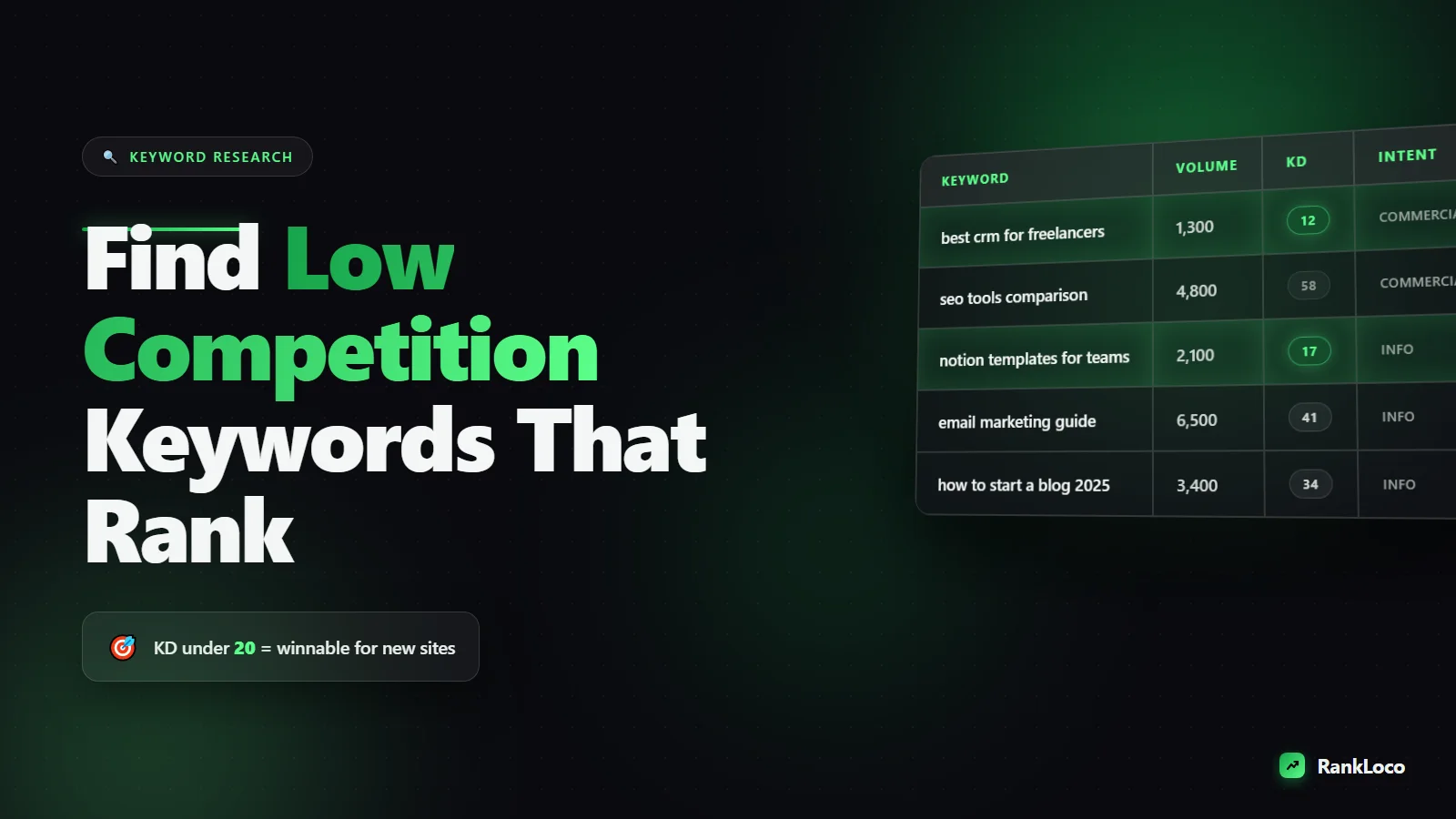
- Low keyword difficulty score: Usually under 20 on most tools for a brand-new site. Under 10 is ideal in your first few months.
- Weak pages ranking on page one: The actual URLs ranking are thin, off-topic, old, or from low-authority domains. This is the signal that matters most.
- Clear, matchable intent: You can create a page that answers the query better than what's there. If the intent is muddy, skip it.
KD scores are estimates based on backlink data. They miss context. A keyword can show KD 15 but have four Fortune 500 sites on page one because it's commercially valuable. Another can show KD 25 but be covered only by Reddit threads and a 2018 blog post. The second one is the real opportunity. Never trust the score alone.
Step 1: Build a seed list from your niche
Before you touch a tool, list the core topics your site covers. If you sell handmade dog collars, your seeds are things like "dog collar," "dog leash," "puppy training," "dog measurements." These seeds are too broad to rank for, but they're the raw material for finding the long-tail variations you can win.
Pull expansion ideas from free sources first:
- Google autocomplete: Type your seed and note every suggestion. Add letters ("dog collar a," "dog collar b") to force more.
- People Also Ask boxes: Each question is a keyword with proven demand and often weak competition.
- Related searches at the bottom of the SERP.
- Reddit, Quora, and niche forums: The exact phrasing people use in questions is gold for long-tail targeting.
- Amazon and YouTube search bars for product and how-to angles.
If you want the full free workflow, we broke it down in how to do keyword research without expensive tools. For this article, assume you now have 100 to 300 raw keyword ideas.
Step 2: Filter for long-tail, specific queries
Long-tail keywords (3 or more words) are your bread and butter as a new site. They have lower volume individually, but they add up, they convert better because intent is specific, and they face far less competition. Compare these:
| Keyword | Type | New site can rank? |
|---|---|---|
| dog collar | Head term | No, big brands own it |
| best dog collar for pulling | Mid-tail | Maybe, in 6-12 months |
| how to measure a dog for a martingale collar | Long-tail | Yes, likely fast |
Prioritize keywords where the query itself tells you exactly what page to build. Questions ("how to," "what is," "why does"), comparisons ("X vs Y"), and specific modifiers ("for small apartments," "under $50," "for beginners") are usually less competitive because big sites don't bother targeting them individually.
Step 3: Check keyword difficulty and volume
Now run your filtered list through a keyword tool to get difficulty and volume data. You can track difficulty scores and monthly volume for your whole list inside RankLoco so you're not eyeballing it. Set your thresholds:
- Keyword difficulty: Aim for under 20. In your first 90 days, favor under 10.
- Search volume: Don't chase huge numbers. 50 to 500 searches a month is a perfect starting range for a new site. Ten keywords at 100 searches each beat one keyword at 5,000 you'll never rank for.
- Trend: Skip declining topics unless they're evergreen.
Watch out for zero-volume keywords, but don't discard them all. Long-tail questions often show "0" or "10" in tools while actually driving steady clicks, because tools undercount low-volume terms. If the query clearly matches something people search, keep it.
Step 4: Manually inspect the SERP (the part everyone skips)
This is the most important step. Open a private browser window and search each candidate keyword. Look at the top 10 results and score them against a beatability checklist:
- Are there forum threads, Q&A sites, or Reddit ranking? That's a huge green flag. Google is showing those because nothing better exists.
- Are the ranking pages old? Posts from 2019 or earlier that haven't been updated are vulnerable.
- Are the pages actually about the query, or is Google stretching to fill the SERP with loosely related content? Off-topic results mean an unmet need.
- How thin is the content? Short, shallow pages that don't fully answer the question can be beaten with a genuinely better page.
- Are the domains authoritative? A page one full of DR 70+ sites is a no. A page one with small blogs and DR 20 sites is a yes.
Also note the SERP features present. If there's a featured snippet pulled from a weak page, you can often steal it with a cleaner, more direct answer. Score each keyword green (build now), yellow (build later), or red (skip).
Step 5: Confirm search intent matches your page
A keyword can be low competition and still worthless to you if the intent doesn't match what you offer. If everyone ranking for a term is a free tool or a definition page, and you want to sell a product, Google has already told you what it wants to show. Fighting that is a losing game.
Before committing, decide what type of page the query demands: informational (guide, how-to), commercial (comparison, best-of), or transactional (product, service page). Match your page to it. Our guide on matching content to search intent walks through reading intent from the SERP so you build the right format the first time.
Step 6: Group keywords into clusters
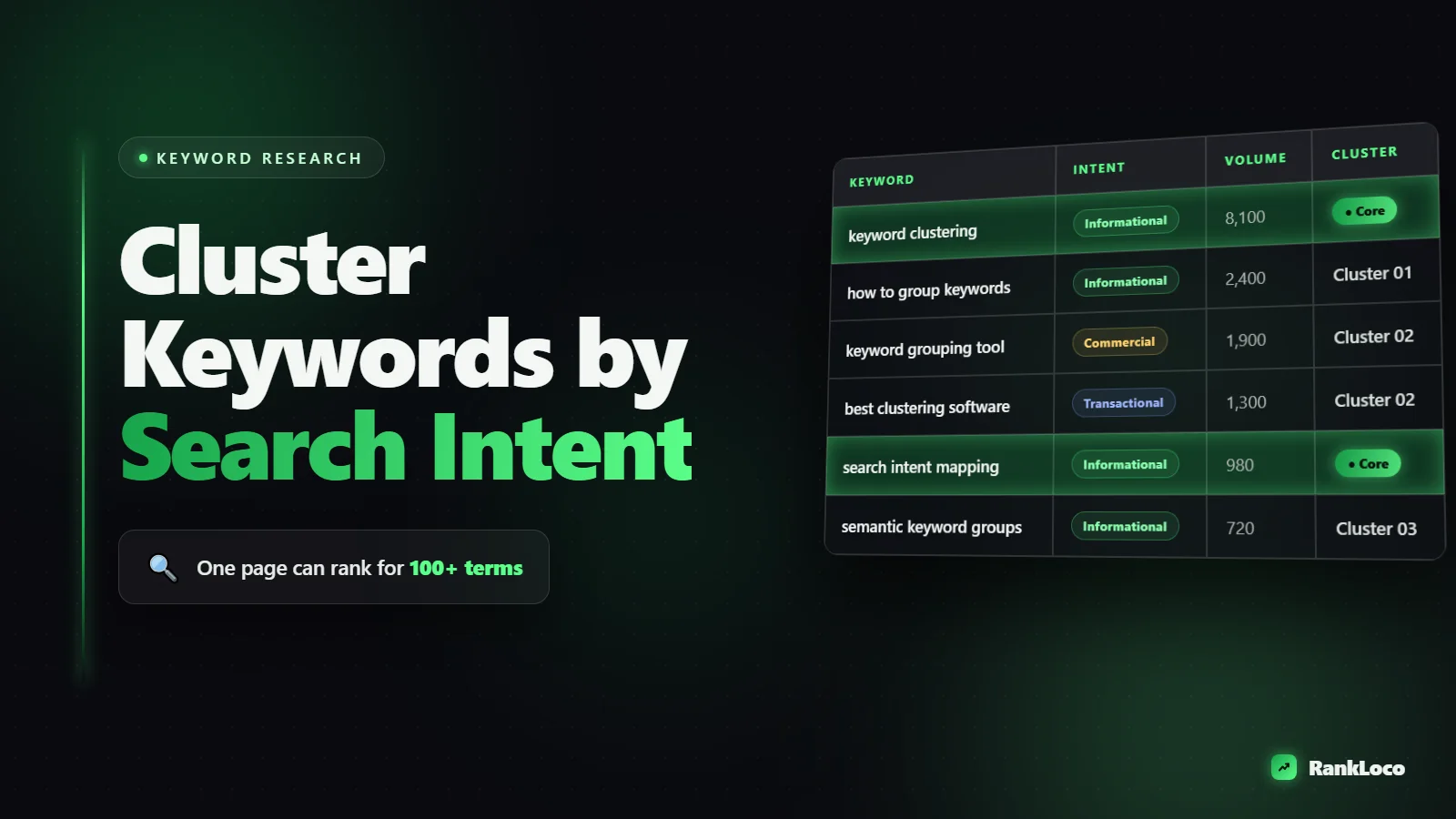
Don't build one page per keyword. Group closely related keywords that share the same intent into a single cluster, then build one strong page targeting all of them. "How to measure a dog for a collar," "dog collar size chart," and "what size collar for a puppy" can all live on one comprehensive page.
Clustering does two things: it lets one page rank for dozens of long-tail variations, and it builds topical depth that signals expertise to Google. As you publish clusters, connect them with a deliberate internal linking strategy so authority flows between your pages and Google understands how your content fits together.
A practical low-competition keyword checklist
Run every candidate through this before you write:
- Is it 3+ words with specific, clear intent?
- Is keyword difficulty under 20 (ideally under 10 to start)?
- Does it have real, if modest, search volume?
- Does the top 10 include forums, Q&A, or old/thin pages?
- Are the ranking domains weak enough to beat?
- Can you clearly tell what type of page to build?
- Does it fit a cluster you're already building?
- Is there commercial or traffic value to you?
If a keyword hits at least six of these, it's worth targeting. Add your winners to a tracker and monitor rankings weekly so you can see which pages gain traction and double down.
Common mistakes that keep new sites invisible
Chasing volume over winnability
The biggest trap. A keyword with 10,000 searches and KD 45 is useless to a site with zero authority. You'll rank on page five and get nothing. Ten winnable keywords beat one aspirational one every time.
Trusting the KD score without checking the SERP
Difficulty scores are estimates. The live SERP is ground truth. Always look at who's actually ranking before you commit hours to a page.
Ignoring intent to force a sale
If the SERP is all informational and you publish a product page, you won't rank no matter how good the page is. Serve the intent Google already validated, then capture the reader with internal links and a clear next step.
Publishing thin content on a good keyword
Finding the keyword is half the job. If you win a low-competition term with a shallow 300-word post, a competitor will beat you the moment they write something better. Build the best page for the query, period.
How long until a new site ranks for these?
With genuinely low-competition, long-tail keywords and solid pages, a new site can start seeing page-one rankings in 2 to 4 months, sometimes faster for very weak SERPs. Domain age, technical health, and content quality all factor in. Make sure your foundation is solid too: run through a technical SEO checklist so crawl and indexing issues aren't holding back pages you worked hard to create.
Frequently Asked Questions
What keyword difficulty score is low enough for a brand-new website?
Aim for keyword difficulty under 20, and prioritize under 10 in your first three months. But treat the score as a filter, not a verdict. Always open the live search results and confirm the ranking pages are actually weak before committing time to a keyword.
Are zero-volume keywords worth targeting?
Sometimes, yes. Keyword tools undercount long-tail and question queries, so a term showing "0" can still pull steady clicks. If the phrasing clearly matches how real people search and the intent is specific, target it inside a broader content cluster rather than skipping it.
How many keywords should a new website target at once?
Focus on one keyword cluster per page and publish steadily rather than all at once. Start with 10 to 20 winnable clusters, build strong pages for each, and track results. Quality and topical depth beat volume of thin pages when you have no authority yet.
Can I find low-competition keywords without paid tools?
Yes. Google autocomplete, People Also Ask, related searches, Reddit, and forums give you demand signals and exact phrasing for free. Paid tools speed up difficulty and volume analysis, but the manual SERP check that confirms winnability costs nothing but time.
Do long-tail keywords actually drive meaningful traffic?
Individually they're small, but they compound. Twenty pages ranking for long-tail terms at 100 to 300 searches each add up to real, targeted traffic that converts better than broad terms. They're also the fastest path to ranking when your site has no authority.
Should local businesses use the same low-competition approach?
The core method applies, but local businesses also weight geographic modifiers and map visibility. Combine keyword research with a focused local strategy. Our local SEO playbook for small businesses covers location-based keywords and Google Business Profile alongside standard keyword targeting.