How to Earn Backlinks With Original Research and Data
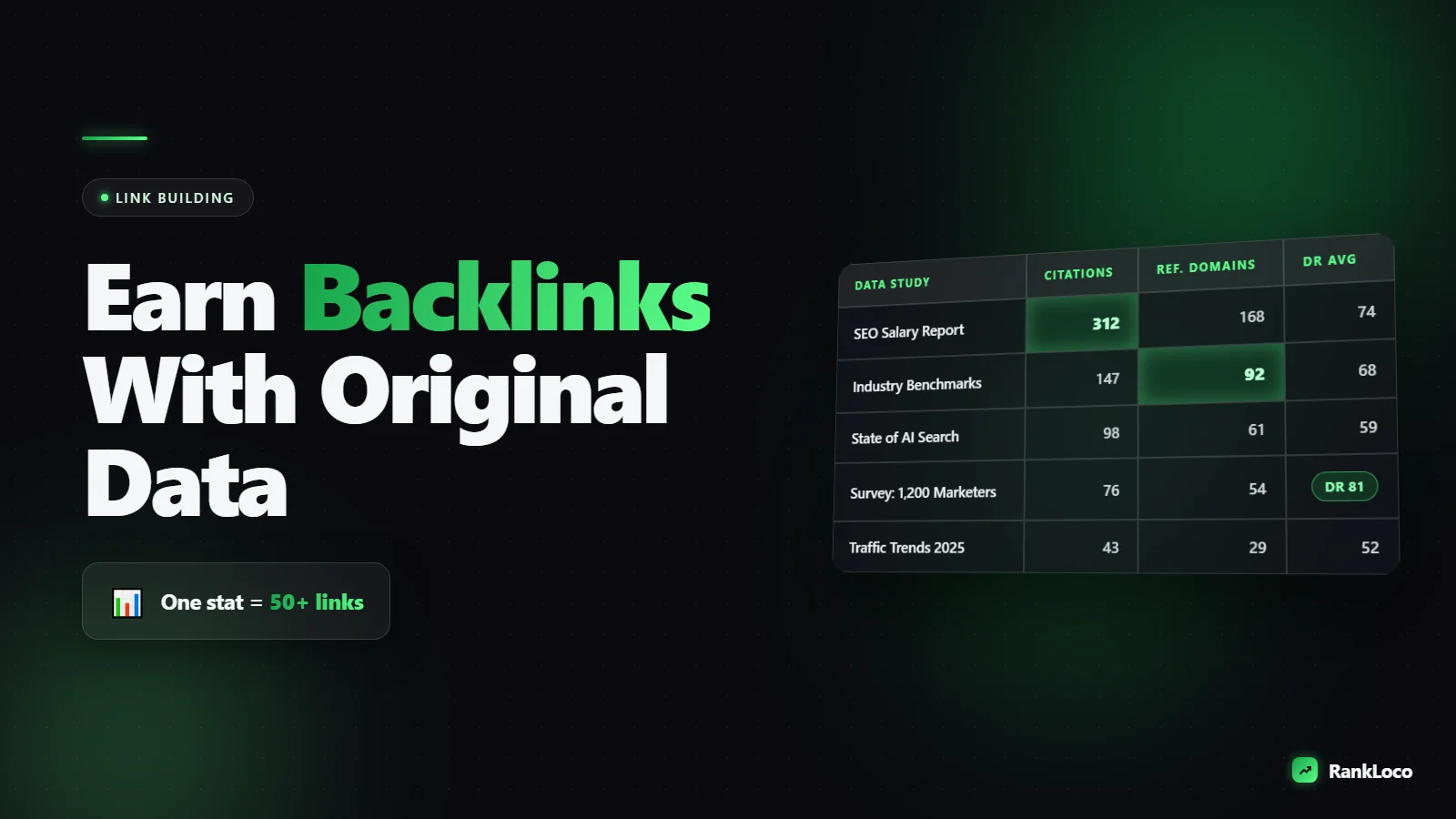
To earn backlinks with original research, publish a piece of data that nobody else has, then put it in front of writers who need a number to cite. The fastest route for most sites is a survey of your audience, an analysis of your own internal data, or a public dataset you've crunched into a fresh angle. Package the finding as a quotable stat, build a simple landing page, and pitch it to journalists and bloggers who already cover your topic. Original research works because people link to sources, not opinions.
Guest posts and directory links fade. A good stat gets cited for years, every time someone writes about your topic. That is why data-driven content is the highest-leverage link building play a small team can run. Below is exactly how to do it without a research budget or a PR agency.
Why Original Research Earns Links When Nothing Else Does
Writers cite statistics to make their arguments credible. Every time a journalist or blogger needs to say "X percent of people do Y," they search for a source and link to it. If you own that stat, you own the link, and you earn a new one every time someone new writes about the topic. That is passive link acquisition that compounds.
Compare that to a guest post, which gets you one link in exchange for a full article. Or a broken link outreach campaign, which takes dozens of emails per link. If you want a wider view of those tradeoffs, read our breakdown of guest posting vs broken link building. Research is different: one study can generate 50 or 100 links over its lifetime with zero additional outreach once it gains traction.
The catch is that most research never gets off the ground because people overthink the methodology. You do not need a PhD or a thousand respondents. You need one surprising, quotable number.
How to Find a Research Angle People Will Actually Link To
Before you collect any data, decide what question you want to answer. The best research angles share three traits: they are specific, they are surprising or confirm something nobody has measured, and they live in a topic that writers are actively covering.
Start with what journalists search for
Go to Google and type your topic followed by words like "statistics," "percentage," "average," "benchmark," or "report." Look at what ranks. If the top results are old, thin, or from weak domains, that is a gap you can fill. If writers are citing a 2019 stat because nothing newer exists, update it with 2025 data and you'll inherit those citations.
Pick a research format you can actually execute
Match the format to the data you can realistically get your hands on:
- Audience survey: Ask your email list, customers, or a relevant community a focused set of questions. Tools like Google Forms or Typeform cost nothing. Aim for 100 to 300 responses for a defensible stat.
- Internal data analysis: You already sit on data most people cannot see. Pricing trends, average response times, conversion patterns, seasonal demand. Anonymize it and turn it into a benchmark.
- Public dataset mining: Government data, Census figures, public APIs, and open datasets are free. The value is in the angle you apply, not the raw numbers.
- Content or SERP analysis: Analyze 500 pages, listings, reviews, or ads in your niche and report patterns. This is cheap and highly linkable because it is hard to replicate.
Validate demand before you build
Check that people are already linking to data in your space. Use a backlink tool to see which data pages your competitors earned links from. Our guide on how to analyze a competitor backlink profile walks through finding the exact statistics pages that attract links, so you can build something better on the same theme.
How to Run a Simple Study Without a Budget
Keep the scope tight. One clear question beats a sprawling report nobody finishes reading. Here is the workflow.
- Write your headline stat first. Draft the sentence you hope to prove, like "62% of small businesses never check their Google Business Profile." Working backward keeps your questions focused on producing a quotable result.
- Design 5 to 10 questions max. Every extra question lowers completion rates. Use multiple choice and scales, not long text answers, so the data is easy to quantify.
- Collect responses from a real source. Your email list, a relevant subreddit or Facebook group, LinkedIn, or a paid panel if you have budget. Note exactly who you surveyed, because transparency about your sample is what makes the data citable.
- Clean and analyze. A spreadsheet handles most jobs. Calculate percentages, averages, and the two or three cuts that reveal something interesting (by industry, by company size, by region).
- Document your methodology. State the sample size, dates, and how you collected data. One honest paragraph is enough, and it is what separates linkable research from a throwaway blog poll.
Do not fabricate numbers to make them punchier. Writers verify, and one fake stat destroys your credibility and any future outreach. If your data is boring, find a sharper cut rather than inventing one.
How to Package Research So People Want to Cite It
The study is only half the work. Presentation determines whether people link to you or just mention you. Build a dedicated page, not a buried blog section, and structure it to be scannable.
| Element | Why it earns links |
|---|---|
| Headline stat up top | Gives writers a copy-paste quote in the first five seconds |
| Key findings list | Each bullet is a potential standalone citation |
| Simple charts | People embed and credit visuals, creating a natural link |
| Methodology section | Signals credibility so editors feel safe linking |
| "Cite this study" box | Pre-written attribution lowers friction to link |
| Downloadable data | Gives journalists the raw numbers, earning goodwill and links |
Add a short section telling people how to reference your work, including a suggested sentence and the URL. The easier you make attribution, the more links you convert. If you use a WordPress site, consider adding dataset or article schema to help search engines understand the page. Our guide to adding schema markup without a plugin covers the setup.
How to Promote Your Research to Earn the First Links
Published research does not rank or earn links on its own. You need to seed the first wave of citations, which then feeds the compounding effect.
Pitch the writers who already cover the topic
Search for articles on your subject that cite older or weaker statistics. Email the author with a short, specific pitch: name their article, point to the exact stat you can improve, and offer your fresher data as a better source. Keep it under 100 words. You are doing them a favor, not begging for a link.
Use HARO and journalist request platforms
Reporters constantly request data and expert commentary. When a request matches your research, reply with your headline stat and a link. Being the source with actual numbers wins over generic quotes every time.
Turn one study into many promotion assets
- A LinkedIn post with the single most surprising finding
- A short thread breaking down three stats
- A guest post that references and links back to the full study
- An email to your list asking them to share
- A pitch to industry newsletters that round up data
Reclaim mentions that forget to link
As your stat spreads, some sites will quote your number without linking to you. That is a link waiting to be claimed. Set up alerts for your study title and brand name, then ask for attribution. Our walkthrough on how to find and reclaim unlinked brand mentions shows the exact process, which turns casual citations into real backlinks.
How to Measure Whether Your Research Is Working
Track two things: links earned and rankings gained. Watch your backlink count climb in the weeks after publishing, and note which outreach channels produced the most citations so you double down next time. Track where the research page ranks for terms like "[topic] statistics" and "[topic] data," since ranking for those queries creates a self-serve link machine. A rank tracker like RankLoco lets you monitor those positions and spot when your study starts pulling in referral traffic. For the long view, see our guide on how to track keyword rankings over time so you can tie link growth to ranking movement.
Refresh the data annually. An updated edition gives you a fresh promotion cycle and keeps your page as the current source, which protects the links you already earned. This pairs well with a broader habit of updating old posts to improve rankings, since data pages decay faster than evergreen how-tos.
A Realistic Starting Plan for Small Teams
If you have never run research, do not aim for a 50-page industry report. Start with a single-question survey of your email list, write up the one surprising finding, and pitch 20 writers who cover your niche. That alone can land your first handful of editorial links. Once you see it work, scale the sample size and the promotion.
If you want more budget-free link ideas to run alongside your research, our guide to getting backlinks with no budget pairs well with this approach. For more guides on building authority, browse the RankLoco blog.
Frequently Asked Questions
How many survey responses do I need for linkable research?
Aim for at least 100 responses for a credible stat, and 300 or more if you want to cut the data by segments like industry or company size. Be transparent about your sample size and how you collected it. Writers care more about honest methodology than a huge number, so a well-documented 150-person survey beats a sloppy 2,000-person one.
How much does it cost to create original research for link building?
You can do it for free using Google Forms for surveys, your own internal data, or public datasets. Costs only rise if you buy a response panel (often $200 to $1,000) or design custom charts. Most small businesses sit on usable internal data already, so the main investment is time, not money.
What makes a statistic go viral and earn backlinks?
Statistics earn links when they are specific, surprising, and tied to a topic people write about often. A number that contradicts conventional wisdom or quantifies something nobody has measured spreads fastest. The single stat should be copy-paste ready in one sentence, so writers can drop it into their articles without extra work.
How long does it take for research to start earning links?
Your first links from direct outreach can arrive within days to a few weeks. The compounding links, where new writers find and cite your study organically, build over months as your page ranks for "[topic] statistics" searches. Plan for a six to twelve month horizon before a study hits its full link potential.
Can I use public data instead of running my own survey?
Yes. Government data, Census figures, and open APIs are free and often underused. The value comes from the angle you apply: combining two datasets, filtering for a niche, or visualizing a trend nobody else has shown. Just cite your sources clearly so your analysis stays credible and citable.
Where should I publish my research on my site?
Publish it on a dedicated, permanent URL rather than inside a dated blog roll, so the link equity accumulates on one page. Give it a clean, descriptive slug, add appropriate schema, and link to it from related articles. A stable URL matters because you want every future citation pointing to the same page.