How to Optimize Content for E-E-A-T on a Small Business Site
To optimize content for E-E-A-T on a small website, show real first-hand experience in your content, name the actual human who wrote it with proof of their expertise, earn mentions and links from sites your industry trusts, and make trust signals (contact info, reviews, policies) obvious on every page. E-E-A-T is not a single ranking knob you turn. It is the sum of signals Google uses to decide whether your content deserves to rank for queries where accuracy matters.
Here is the thing most small-business owners get wrong: they treat E-E-A-T like a technical checkbox. It is not. It is about proving that a real, qualified person or business stands behind the content. Below is exactly how to do that when you do not have a huge brand or a team of PhDs.
What E-E-A-T Actually Means (and Why the Extra E Matters)
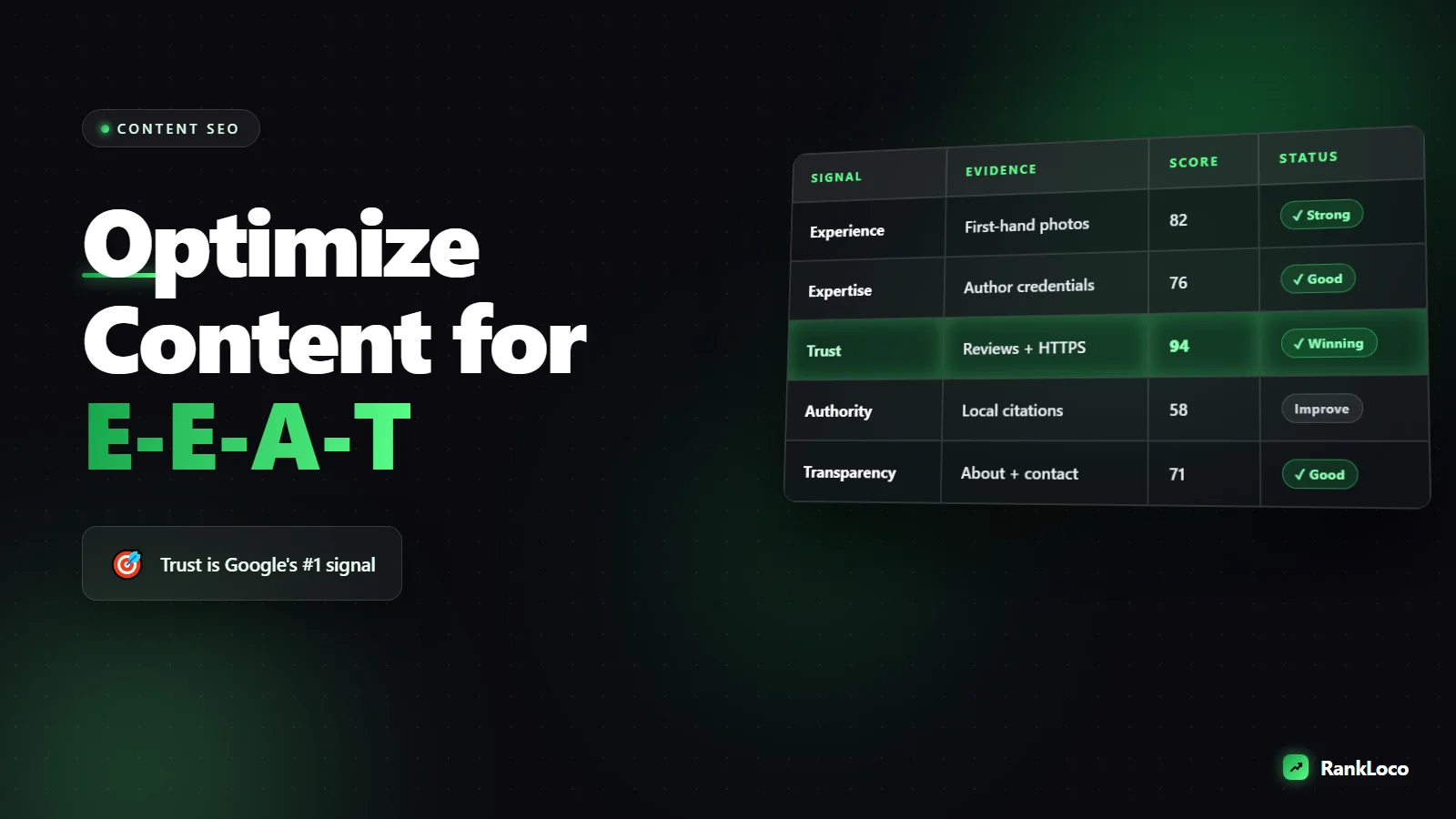
E-E-A-T stands for Experience, Expertise, Authoritativeness, and Trust. Google added the first "E" (Experience) in late 2022, and for small businesses it is the easiest one to win. You do not need credentials to have used a product, served a customer, or run a process a hundred times. You just need to show it.
- Experience: Have you actually done the thing you are writing about? First-hand use, real photos, specific details only an operator would know.
- Expertise: Does the author have the knowledge or qualifications to speak on the topic?
- Authoritativeness: Do other people and sites in your field recognize you as a go-to source?
- Trust: Is the site safe, honest, accurate, and transparent about who runs it? Google says Trust is the most important member of the family.
None of these are direct ranking factors you can measure in a dashboard. They are concepts Google's systems and human quality raters use to evaluate whether a page should rank, especially for YMYL (Your Money or Your Life) topics like health, finance, and legal advice.
Prove First-Hand Experience in the Content Itself
This is where small businesses crush generic content farms. A plumber, accountant, or bakery owner has done the work. Put that into the writing.
- Use specific, operator-level details. Instead of "replacing a water heater is straightforward," write "on a 40-gallon gas unit, budget about three hours and expect to swap the T&P valve, because the old one is almost always corroded."
- Add original photos. Real photos of your work, your shop, your process, and your team beat stock images every time. Name the files descriptively and compress them so they do not slow the page. Our guide on how to optimize images for SEO covers the exact settings.
- Tell a short story. "We had a customer in Dallas whose system failed twice before we found the real cause." That line signals you have lived this.
- Include numbers from your own experience. How long a job takes, typical cost ranges, common mistakes you see. Do not invent statistics. Report what you actually observe.
Build Author Bios and Byline Credentials That Hold Up
Anonymous content is a trust killer. Every meaningful article should have a named author with a real, detailed bio.
Your author box should include:
- Full name and job title ("Licensed Master Electrician, 14 years in the field")
- A one or two sentence summary of relevant experience and credentials
- Links to the author's LinkedIn or professional profiles
- A photo of the actual person
Create a dedicated author page for each contributor that lists their background, certifications, and all the articles they have written. Link the byline to it. This gives Google an entity to associate with your content and helps it understand who is responsible for what.
If you are a solo business owner, that is fine. You are the expert. Build out one strong "About the owner" page and link every article to it.
Make Trust Signals Impossible to Miss
Trust is the foundation. If Google (or a visitor) cannot tell who you are or how to reach you, nothing else matters. Run through this checklist on your site:
| Trust Element | Where It Goes | Why It Matters |
|---|---|---|
| Physical address and phone | Footer, contact page, About page | Confirms a real business exists |
| About page with real people | Main navigation | Shows who stands behind the content |
| Customer reviews and testimonials | Homepage, service pages | Third-party validation of quality |
| Clear privacy and refund policies | Footer links | Signals legitimacy and honesty |
| HTTPS (SSL certificate) | Site-wide | Basic security requirement |
| Author bylines and bios | Every article | Accountability for content |
Reviews do double duty here: they build trust on the page and help you rank locally. If you run a local operation, follow our steps on how to get more Google reviews to rank higher locally and feature those reviews on relevant pages.
Earn Authority With Links and Mentions From Your Industry
Authoritativeness is largely about what the rest of the web says about you. For a small site, you build it one relationship at a time, not with spammy link schemes.
- Get cited by local and industry sources. Local news, chambers of commerce, supplier directories, and trade associations all pass authority. Our breakdown of the best backlink sources for local service businesses gives you a target list.
- Claim unlinked brand mentions. If someone references your business without linking, ask for the link. Here is how to find and reclaim unlinked brand mentions.
- Publish genuinely useful content people want to cite. Original data from your own jobs, free calculators, detailed how-to guides. These earn links naturally.
- Get your author quoted elsewhere. Respond to journalist requests and contribute expert commentary. A recognized author name across multiple sites builds entity authority.
Match Content Depth to Search Intent
E-E-A-T does not mean writing longer. It means fully satisfying the query with accurate, well-organized information. Thin content that skims the surface signals low expertise.
- Answer the main question in the first paragraph, then go deeper.
- Cover the follow-up questions people actually ask. Mining long-tail keywords from Google Autocomplete and People Also Ask shows you what to include.
- Cite reputable sources when you reference facts, studies, or guidelines. Link out to primary sources, not random blogs.
- Keep information current. Add a "last updated" date and actually update the content when things change.
Writing that reads like a human wrote it for humans is part of this. If your content feels machine-generated or keyword-stuffed, it undercuts every trust signal. Our guide on how to write SEO-friendly content that reads naturally walks through the balance.
Use Schema Markup to Connect Your Entities
Structured data does not directly boost E-E-A-T, but it helps Google understand the relationships you are trying to establish: who the author is, what organization published the content, and how they connect.
Add these schema types:
- Organization schema on your homepage with your logo, name, address, and social profiles via sameAs.
- Person schema on author pages, linked to the article's author field.
- Article schema with author, datePublished, and dateModified.
- Review or LocalBusiness schema where relevant.
You can add this without a bloated plugin. Follow our tutorial on how to add schema markup to WordPress without a plugin to keep it clean.
Clean Up Trust-Killing Technical Issues
Trust also includes basic site health. A site littered with broken pages, duplicate content, and crawl errors looks neglected, and neglected sites do not earn trust.
- Fix crawl errors so Google can actually access your pages. Here is how to fix crawl errors in Google Search Console.
- Resolve duplicate pages with canonical tags so your authority is not split across copies.
- Keep the site fast and stable. Slow pages erode trust and conversions.
The E-E-A-T Optimization Checklist
- Add first-hand experience, original photos, and specific details to every article.
- Give every article a named author with a detailed bio and author page.
- Build out a thorough About page with real people and your story.
- Display address, phone, policies, and reviews prominently.
- Earn links and citations from trusted local and industry sources.
- Keep content accurate, current, and matched to search intent.
- Add Organization, Person, and Article schema.
- Fix technical trust issues: HTTPS, crawl errors, duplicates, speed.
- Track whether your improvements move rankings over time.
That last point matters. E-E-A-T work pays off slowly, so you need to measure it. Use RankLoco to track keyword rankings for your target pages and run on-page and technical audits that flag the trust and quality issues above before they cost you. Watching keyword rankings over time tells you whether your content improvements are actually landing, and you can find more playbooks in our SEO guides.
Frequently Asked Questions
Is E-E-A-T a direct Google ranking factor?
No. Google has confirmed E-E-A-T is not a single ranking factor you can optimize directly. It is a framework its systems and human quality raters use to assess whether content is trustworthy and high quality. You influence it by improving the underlying signals: experience, author credentials, links, and site trust.
How important is E-E-A-T for small business sites?
Very, especially if you cover YMYL topics like health, finance, or legal advice, where Google holds content to a higher standard. For a small site competing against bigger brands, strong first-hand experience and clear trust signals are often how you stand out and rank, since you can demonstrate real expertise they cannot fake.
Do I need author bios if I am a solo business owner?
Yes. Create one strong About page that establishes you as the expert, with your experience, credentials, and a photo. Link every article byline to it. A solo owner with 15 years of hands-on experience is exactly the kind of author Google wants to reward, so make that expertise visible.
How long does it take to see results from E-E-A-T improvements?
Expect weeks to a few months. Trust and authority signals, especially earned links and recognition, compound slowly. On-page changes like adding bios, photos, and experience details can be read quickly, but the authority side takes consistent effort. Track rankings monthly so you can tie changes to movement.
Can AI-generated content hurt my E-E-A-T?
Raw, unedited AI content usually hurts you because it lacks first-hand experience and can contain inaccuracies, both of which undercut trust. Google rewards helpful content regardless of how it is produced, but you must add real experience, verify facts, and have a qualified human review and sign off on it with a byline.
What is the difference between E-A-T and E-E-A-T?
E-A-T (Expertise, Authoritativeness, Trust) was the original framework. In December 2022 Google added a second "E" for Experience, recognizing that first-hand, real-world experience with a topic is valuable even without formal credentials. For small businesses, that added Experience is often the easiest signal to win.