Why Keyword Difficulty Scores Mislead New Sites and What to Use Instead
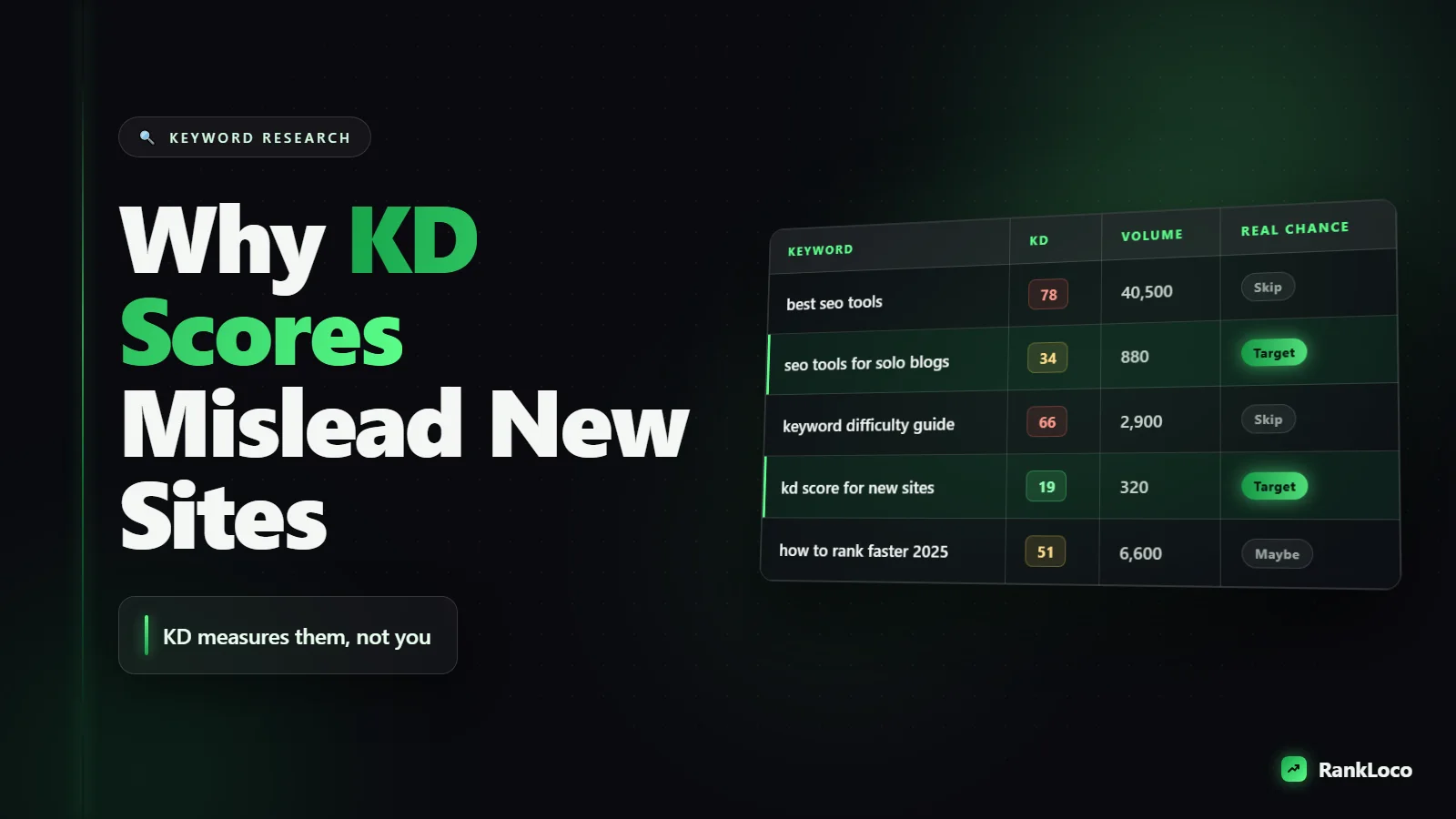
Keyword difficulty (KD) is a 0-100 score that estimates how hard it is to rank on page one for a term, mostly based on the backlink strength of the sites already ranking. For a new website, that number is misleading because it assumes you have the domain authority, content depth, and link profile of an established competitor. A "low" KD of 20 can still be impossible for a six-week-old site, while a "medium" KD of 35 might be wide open if the ranking pages are weak and off-topic. KD tells you how strong the incumbents are. It does not tell you whether you can beat them.
That gap is why new sites waste months chasing keywords that tools labeled "easy." Below is what KD actually measures, why it breaks down for young domains, and the metrics that actually predict whether you can rank.
What keyword difficulty actually measures (and what it ignores)
Every tool calculates KD differently, but they all lean on the same core input: the link authority of the URLs currently ranking in the top 10. More referring domains pointing at those pages equals a higher score. Some tools mix in domain-level authority, content length, or search volume, but backlinks do most of the heavy lifting.
Here is the problem. That formula measures the competition, not your ability to compete. It completely ignores:
- Your site's age and authority. A KD of 15 means nothing if every ranking site has 500 referring domains and you have three.
- Search intent match. KD does not check whether the ranking pages actually answer the query well. Weak content can hold a high-KD spot.
- Topical relevance. Google heavily favors sites that have proven depth on a topic. A new site with zero topical authority struggles even on "easy" terms.
- SERP features. If the page is buried under ads, a map pack, and a featured snippet, the "page one" you're fighting for barely exists.
So KD is a decent relative gauge between two keywords on the same established site. For a brand new domain, it is closer to a vanity number than a plan.
Why keyword difficulty misleads new websites specifically
Your domain can't cash the check KD assumes
KD scores quietly assume you can produce a page roughly as strong as the ones ranking now. New sites can't. You have no backlink equity, little crawl history, and no track record on the topic. A term rated "20/100" might require 40 referring domains to crack because that's what everyone on page one has. The score never told you that.
Low volume keywords get inflated difficulty
Tools often struggle with tiny-volume, long-tail queries. They either refuse to score them or slap on a confusing number because there's not enough SERP data. Ironically these obscure, specific terms are exactly where new sites win. The tool undersells your best opportunities.
KD hides weak SERPs that you could actually beat
Some high-KD terms have a top 10 full of forum threads, outdated articles, and pages that don't match intent. A strong, focused piece can leapfrog them even with low authority, because Google rewards the better answer. KD averages the link strength and tells you to stay away. You'd be walking past money.
What to use instead of keyword difficulty for a new site
Replace the single KD number with a quick manual SERP analysis plus a few harder metrics. This takes two minutes per keyword and beats any score. Here's the framework.
1. Read the actual SERP before you trust any score
Open an incognito tab and search the term. This is the single most reliable "difficulty" check there is. Ask:
- Are the top results from giant brands (Amazon, Wikipedia, Forbes, Healthline) or from smaller sites your size?
- Do the ranking pages genuinely answer the query, or are they thin and off-topic?
- Is intent commercial, informational, or navigational, and does your page match it?
- How many SERP features (ads, snippet, People Also Ask, video pack, map pack) eat the clicks?
If you see Reddit threads, small blogs, and forum posts ranking, that's a green light. If it's wall-to-wall authority sites, move on no matter what KD says.
2. Check the referring domains of the weakest page on page one
Don't look at the number one result. Look at positions 7 to 10. Those are the pages you need to outrank first. If the weakest page one URL has only a handful of referring domains (or none), you have a real shot. If even position 10 has dozens of links, the keyword is harder than its KD suggests. You can pull this with any backlink tool, and it's the same muscle you use when you analyze a competitor backlink profile to find opportunities.
3. Weigh intent match over raw difficulty
A perfectly matched page on a lower-volume term beats a mismatched page on a juicy one every time. If someone searching the keyword wants a comparison and you have a comparison, you're already ahead of the generic blog posts ranking now.
4. Prioritize specificity (the long tail)
The more words in the query, the lower the real competition and the clearer the intent. New sites should live on the long tail for the first 6 to 12 months. These queries have fewer entrenched pages and convert better because they're specific. Learn to mine them with our guide to finding long tail keywords using Google Autocomplete and People Also Ask.
A realistic scoring system for new sites
Instead of one KD number, rate each keyword on four quick signals. Score each 1 to 3 and add them up. Anything 9 or higher is worth targeting now.
| Signal | 1 point (hard) | 2 points (maybe) | 3 points (go) |
|---|---|---|---|
| Weakest page-one site | Major brand/authority | Mid-size niche site | Small blog, forum, or thin page |
| Referring domains (position 7-10) | 30+ | 5 to 29 | 0 to 4 |
| Intent match with your page | Wrong intent | Partial match | Exact match |
| Query specificity | Broad 1-2 word head term | 3-4 word phrase | Specific long-tail (5+ words) |
This takes the guesswork out without pretending a single number can capture it. A term with KD 35 that scores 11 on this table is a far better bet than a KD 18 term that scores 6.
How to build a keyword plan a new site can actually win
- Start narrow, then expand. Pick a tight topic cluster you can own. Publishing 10 deep articles on one subject builds topical authority faster than 10 scattered posts. A content gap analysis against your competitors shows you which sub-topics they skipped.
- Target long-tail first, head terms later. Rank for the specific questions, earn links and signals, then move up to the broader terms once you have authority. Our walkthrough on finding low competition keywords for a brand new website covers the full process.
- Match the dominant intent exactly. Look at the format ranking now (listicle, how-to, comparison, tool page) and produce a better version of that format.
- Build real E-E-A-T. Google trusts sites that demonstrate experience and expertise. Strengthening that helps you rank even on competitive terms, which is why it's worth learning to optimize content for E-E-A-T on a small business site.
- Track what you publish. Rankings move over weeks, not days. Use RankLoco to monitor positions so you can tell which bets are paying off and double down. Here's how to track keyword rankings over time to measure progress.
When keyword difficulty is actually useful
KD isn't worthless. It's useful once you have authority and want to compare two similar keywords quickly, or when you're triaging a large list and need a rough first filter. The right move is to use KD as a coarse sort, then run the manual SERP check on your shortlist. Never target a keyword based on KD alone, and never dismiss one either. The SERP is the source of truth.
If you want to speed this up, pull difficulty, volume, and SERP data together with a keyword tool so you're not jumping between tabs. Plenty of options exist, including several solid free ones in our roundup of the best free keyword research tools for small business owners. Whatever you use, make the manual SERP read the final gate. For more playbooks on ranking a young site, browse the rest of our SEO guides, or start running audits and keyword research with RankLoco.
Frequently Asked Questions
Is a keyword difficulty of 30 hard for a new website?
It depends entirely on the SERP, not the number. A KD of 30 can be easy if the pages ranking have few backlinks and weak content, or nearly impossible if they're all major brands. Always open the search results and check the referring domains of positions 7 to 10 before deciding.
What keyword difficulty should a new site target?
Ignore the specific threshold and target long-tail keywords where the weakest page-one results are small sites with few or no backlinks. In practice that often means terms KD tools rate below 20, but the SERP check matters far more than the score. Specificity and intent match beat any difficulty cutoff.
Why do different tools show different keyword difficulty scores?
Each tool uses its own formula and its own backlink index. One may weigh referring domains heavily, another may factor in content length or domain authority. Because the inputs and index sizes differ, scores for the same keyword can vary by 20 points or more. Treat them as rough relative gauges, never absolutes.
How long does it take a new website to rank for low difficulty keywords?
Most new sites see movement on genuine long-tail terms within 2 to 6 months, assuming the content matches intent and the site is technically sound. Head terms and competitive queries take much longer because they require backlinks and topical authority you have to earn over time.
Does search volume matter more than keyword difficulty for new sites?
Early on, intent and winnability matter most. A low-volume keyword you can rank for and that converts beats a high-volume term you'll never crack. Chase specific, buyer-intent long-tail queries first, then pursue higher-volume terms once your authority grows.
Can I rank for high difficulty keywords without backlinks?
Occasionally, if the ranking pages poorly match intent and you publish a clearly better answer. But it's the exception. For most competitive terms you'll need links eventually. Build links through legitimate tactics like earning them from quality local sources while you dominate the long tail first.